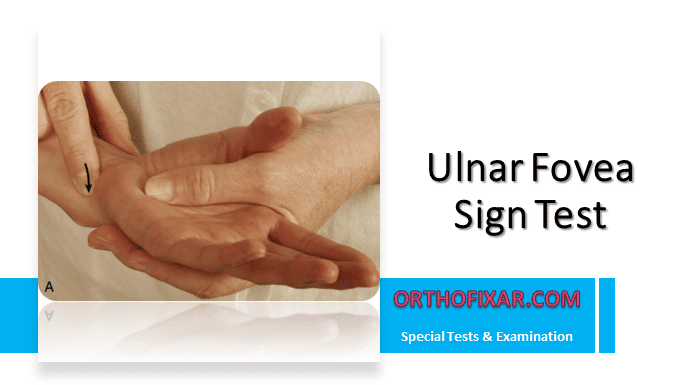
The ulnar fovea sign test is a specialized clinical examination technique used to evaluate ulnar-sided wrist pain and dysfunction. It’s also called Ulnar Snuff Box Test.
This test serves as a valuable diagnostic tool in differentiating between various pathological conditions affecting the ulnar aspect of the wrist, including ligamentous injuries and joint instabilities that are often challenging to diagnose through routine examination alone.
The ulnar fovea sign test is particularly useful in distinguishing between several distinct pathological conditions:
- Ulnotriquetral ligament tears – injuries to the ligament connecting the ulna to the triquetrum bone
- Lunotriquetral instability – disruption of the connection between the lunate and triquetrum bones
- Triquetrum/hamate pathology – various conditions affecting these carpal bones
- Foveal disruption – damage to the triangular fibrocartilage complex (TFCC)
These conditions often present with similar symptoms, making clinical differentiation challenging without specific provocative tests like the ulnar fovea sign.
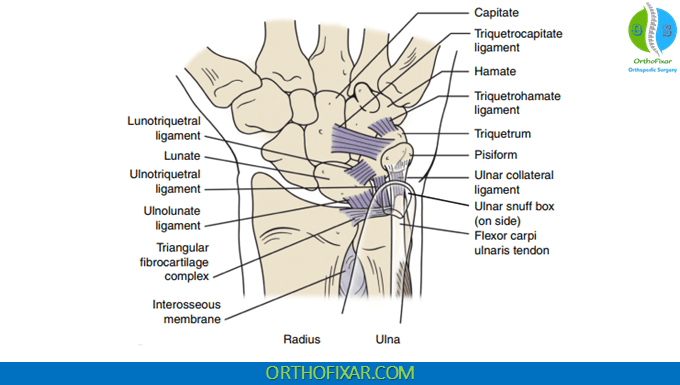
The ulnar fovea, also known as the ulnar snuff box, is a depression located between:
- The ulnar styloid process (laterally)
- The flexor carpi ulnaris tendon (medially)
- The triquetrum bone (deep)
- The anterior surface of the ulnar head and pisiform (boundaries)
The pain elicited during this test is believed to originate from stress placed on the distal radioulnar ligaments and the ulnotriquetral ligament. These structures are integral to maintaining stability of the distal radioulnar joint (DRUJ) and proper carpal mechanics.
See Also: Wrist Anatomy: Bones, Ligaments & Joints
How to Perform the Ulnar Fovea Sign Test?
The patient should be positioned in either a standing or sitting position, ensuring comfort and relaxation of the upper extremity. The affected wrist and forearm must be maintained in a neutral position throughout the examination.
The examiner identifies the ulnar fovea by locating the depression between the ulnar styloid process and the flexor carpi ulnaris tendon. Using the thumb or index finger, the examiner applies firm, directed pressure into the foveal depression. The pressure should be directed against the lunate bone, penetrating through the soft tissue interval toward the underlying bony and ligamentous structures.
The Ulnar Fovea Sign Test should always be performed bilaterally for comparison with the unaffected side.

What is a Positive Ulnar Fovea Sign Test?
The Ulnar Fovea Sign Test is considered positive when:
- The patient’s characteristic pain is replicated
- The area demonstrates significant tenderness compared to the contralateral side
- Pain intensity is markedly different between affected and unaffected sides.
A positive test suggests involvement of the ulnotriquetral ligament complex and associated structures but must be interpreted within the broader clinical context.
See Also: Wrist Pain Causes
Test Reliability
The sensitivity of the ulnar fovea sign test in detecting foveal disruptions and/or UT ligament injuries was 95.2%. Its specificity was 86.5%.
Associated Clinical Findings
Linscheid Squeeze Test Variation
An important variation of the ulnar fovea sign involves dynamic assessment. When crepitus (grinding sensation) is palpated during the foveal compression while moving the wrist from ulnar to radial deviation, this constitutes a positive Linscheid squeeze test. This finding provides additional diagnostic information about cartilage integrity and joint mechanics.
DRUJ Stability Correlation
The clinical findings often correlate with distal radioulnar joint stability:
- Ulnotriquetral ligament tears are commonly associated with a stable DRUJ
- Foveal disruptions of the TFCC are typically associated with an unstable DRUJ
This correlation helps guide treatment decisions and prognosis discussions with patients.
Clinical Applications and Limitations
Diagnostic Value
The ulnar fovea sign test serves as an important component of the comprehensive wrist examination, particularly when evaluating:
- Chronic ulnar-sided wrist pain
- Post-traumatic wrist dysfunction
- Suspected TFCC injuries
- Carpal instability patterns
Limitations
While valuable, the test should not be used in isolation. Consider these limitations:
- False positives may occur in patients with generalized joint hypersensitivity
- The test requires proper anatomical knowledge for accurate execution
- Results must be correlated with imaging studies and other clinical findings
- Patient cooperation and pain tolerance can affect test reliability
References & More
- Orthopedic Physical Assessment by David J. Magee, 7th Edition.
- Porretto-Loehrke A, Schuh C, Szekeres M. Clinical manual assessment of the wrist. J Hand Ther. 2016;29(2):123–135. PubMed
- Sachar K. Ulnar-sided wrist pain: evaluation and treatment of triangular fibrocartilage complex tears, ulnocarpal impaction syndrome, and lunotriquetral ligament tears. J Hand Surg Am. 2008;33(9):1669–1679. PubMed
- Tay SC, Tomita K, Berger RA. The “ulnar fovea sign” for defining ulnar wrist pain: an analysis of sensitivity and specificity. J Hand Surg Am. 2007;32:438–444. PubMed
- Rhee PC, Sauve PS, Lindau T, Shin AY. Examination of the wrist: ulnar-sided wrist pain due to ligamentous injury. J Hand Surg Am. 2014;39(9):1859–1862. PubMed
- Skirven TM, Osterman AL, Fedorczyk J, Amadio PC. Rehabilitation of the Hand and Upper Extremity. ed 6. St Louis: Elsevier; 2011.
- Poh F. Carpal boss in chronic wrist pain and its association with partial osseous coalition and osteoarthritis – a case report with focus on MRI findings. Indian J Radiol Imaging. 2015;25(3):276–279. PubMed
- Sachar K. Ulnar-sided wrist pain: evaluation and treatment of triangular fibrocartilage complex tears, ulnocarpal impaction syndrome and lunotriquetral ligament tears. J Hand Surg Am. 2012;37:1489–1500. PubMed