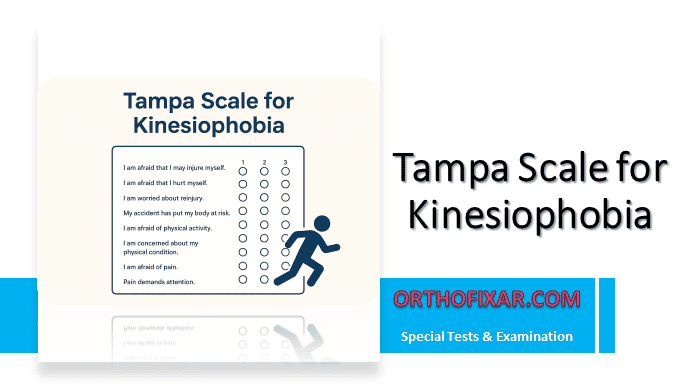
The Tampa Scale for Kinesiophobia (TSK) is a 17-item self-report questionnaire designed to measure the fear of movement or re-injury in patients with chronic pain conditions. Developed by Miller, Kori, and Todd in 1991, this instrument has become an essential tool in pain management and rehabilitation settings for identifying patients who may benefit from interventions targeting fear-avoidance behaviors.
What is Kinesiophobia?
Kinesiophobia refers to an excessive fear of movement or physical activity, often stemming from the belief that movement will cause pain or injury. This fear, particularly the fear of re-injury, can lead to maladaptive pain behaviors and significantly impair functional outcomes in patients with chronic pain, low back pain, or musculoskeletal injuries.
The relationship between pain and kinesiophobia creates a problematic cycle: patients experience pain, develop fear of re-injury, avoid movement as a protective mechanism, and consequently experience deconditioning and functional decline, which paradoxically perpetuates or worsens their condition.
See Also: Fear-Avoidance Beliefs Questionnaire (FABQ)
Clinical Significance
Fear-avoidance beliefs are recognized as significant predictors of disability and poor outcomes in chronic pain management. Research has consistently demonstrated that patients with elevated kinesiophobia scores have poorer rehabilitation outcomes, prolonged disability, and reduced return-to-work rates. Understanding and addressing kinesiophobia is therefore crucial for effective pain management and functional restoration.
Tampa Scale for Kinesiophobia Scoring
The Tampa Scale for Kinesiophobia consists of 17 items rated on a 4-point Likert scale:
- 1 = Strongly Disagree
- 2 = Disagree
- 3 = Agree
- 4 = Strongly Agree

Interpretation Guidelines
Lower scores (17-37): Indicate minimal fear of movement or re-injury; patient demonstrates relatively healthy approach to physical activity despite pain.
Moderate scores (38-50): Suggest moderate levels of kinesiophobia; patient may benefit from education and gradual exposure to movement.
Higher scores (51-68): Indicate significant fear of movement and substantial kinesiophobia; patient likely to have significant functional limitations and benefit from targeted fear-avoidance behavioral interventions.
Clinical experience suggests that scores above 37 warrant clinical attention, though this threshold may vary based on population and context.
Tampa Scale for Kinesiophobia Scoring Calculator
| Question | Strongly Disagree (1) | Disagree (2) | Agree (3) | Strongly Agree (4) |
|---|---|---|---|---|
| 1. I’m afraid that I might injury myself if I exercise | ||||
| 2. If I were to try to overcome it, my pain would increase | ||||
| 3. My body is telling me I have something dangerously wrong | ||||
| 4. My pain would probably be relieved if I were to exercise (R) | ||||
| 5. People aren’t taking my medical conditions seriously enough | ||||
| 6. My accident has put my body at risk for the rest of my life | ||||
| 7. Pain always means I have injured my body | ||||
| 8. Just because something aggravates my pain does not mean it is dangerous (R) | ||||
| 9. I am afraid that I might injure myself accidentally | ||||
| 10. Simply being careful that I do not make any unnecessary movements is the safest thing I can do to prevent my pain from worsening | ||||
| 11. I wouldn’t have this much pain if there weren’t something potentially dangerous going on in my body | ||||
| 12. Although my condition is painful, I would be better off if I were physically active (R) | ||||
| 13. Pain lets me know when to stop exercising so that I don’t injure myself | ||||
| 14. It’s really not safe for a person with a condition like mine to be physically active | ||||
| 15. I can’t do all the things normal people do because it’s too easy for me to get injured | ||||
| 16. Even though something is causing me a lot of pain, I don’t think it’s actually dangerous (R) | ||||
| 17. No one should have to exercise when he/she is in pain |
Clinical Applications
Patient Screening
The Tampa Scale for Kinesiophobia is particularly valuable in initial assessment to identify patients at risk for prolonged disability and poor outcomes. Screening high-risk patients allows for early intervention and individualized treatment planning.
Treatment Planning
Elevated Tampa Scale for Kinesiophobia scores indicate the need for cognitive-behavioral interventions, graded exposure to feared movements, and education regarding the distinction between pain and re-injury risk. Patients with significant kinesiophobia often benefit from multidisciplinary approaches combining physical therapy with psychological support.
Outcome Measurement
The Tampa Scale for Kinesiophobia can be administered repeatedly to monitor changes in fear-avoidance beliefs and the effectiveness of interventions. Reduction in Tampa Scale for Kinesiophobia scores correlates with improved functional outcomes and increased engagement in physical rehabilitation.
Research Applications
The scale has proven valuable in pain research, particularly in studies examining the fear-avoidance model of chronic pain and evaluating interventions targeting kinesiophobia.
Strengths of the Tampa Scale for Kinesiophobia
- Brevity: Easily administered in clinical settings without excessive patient burden
- Reliability: Demonstrates good internal consistency and test-retest reliability
- Validity: Strong psychometric properties with predictive validity for functional outcomes
- Applicability: Useful across various pain conditions and rehabilitation settings
- Accessibility: Simple language appropriate for diverse patient populations
- Sensitivity to Change: Responsive to therapeutic interventions
Limitations and Considerations
The Tampa Scale for Kinesiophobia, while clinically valuable, has certain limitations practitioners should acknowledge. The scale measures fear-related beliefs but does not directly assess actual movement capabilities or pain magnitude. Cultural and linguistic factors may influence responses, requiring adaptation for diverse populations. Additionally, the scale should be interpreted as one component of comprehensive pain assessment rather than as a standalone diagnostic tool.
Patient comprehension of items may vary, and some items addressing catastrophic thinking may be influenced by depression or other comorbid psychological conditions. Clinical judgment is essential in interpreting results within the broader context of each patient’s presentation.
Relationship to Broader Pain Models
The Tampa Scale for Kinesiophobia operationalizes key concepts from the fear-avoidance model of chronic pain, which proposes that pain-related fear leads to avoidance behaviors, deconditioning, and ultimately increased disability and chronicity. This model has significantly influenced contemporary understanding of chronic pain and rehabilitation approaches, emphasizing the importance of addressing psychosocial factors alongside biomedical considerations.
Clinical Integration
For optimal outcomes, Tampa Scale for Kinesiophobia results should guide rather than determine treatment decisions. Patients with elevated scores benefit from education regarding the distinction between protective pain and warning pain, gradual exposure to feared movements within a therapeutic context, and reassurance based on objective medical findings. Collaborative treatment planning involving physical therapists, physicians, and mental health professionals often yields superior outcomes in patients with significant kinesiophobia.
References
- Kori SH, Miller RP, Todd DD. Kinesiophobia: a new view of chronic pain behavior. Pain Management. 1990;Jan/Feb:35-43.
- Vlaeyen JWS, Kole-Snijders AM, Boeren RG, van Eek H. Fear of movement/(re)injury in chronic low back pain and its relation to behavioral performance. Pain. 1995;62(3):371-383. PubMed
- Miller RP, Kori SH, Todd DD. The Tampa Scale for Kinesiophobia. Unpublished report. 1991.
- Knapik A, Saulicz E, Gnat R. Kinesiophobia – introducing a new diagnostic tool. J Hum Kinet. 2011 Jun;28:25-31. doi: 10.2478/v10078-011-0019-8. Epub 2011 Jul 4. PMID: 23487514; PMCID: PMC3592098. PubMed