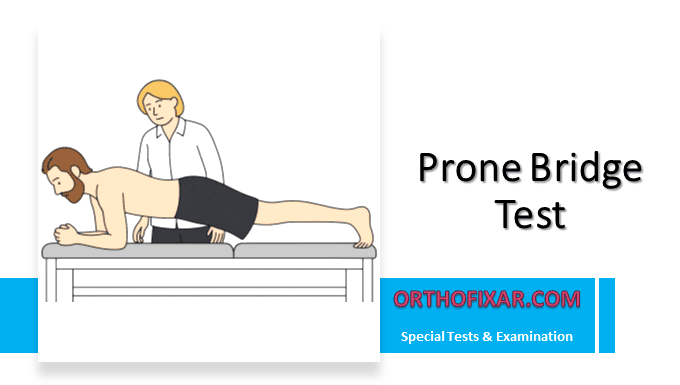
The Prone Bridge Test is a clinical examination test used to evaluate the endurance of the core musculature, specifically the abdominal and back extensor muscles, as well as the patient’s ability to maintain trunk stability under static conditions. It serves as an important indicator of core strength, neuromuscular control, and endurance, all of which are essential for spinal stability, posture, and functional movement. It’s also known as the Plank Test, 4-Point Hold Test, or Hover Test.
This test serves multiple clinical purposes:
- Muscular Endurance Assessment: Primarily measures the endurance of the abdominal muscles (rectus abdominis, transversus abdominis, internal and external obliques) and back extensor muscles (erector spinae, multifidus)
- Core Stability Evaluation: Assesses the patient’s ability to maintain neutral spine alignment and resist gravitational forces
- Functional Capacity: Provides insight into the patient’s capacity for activities requiring sustained trunk stabilization
- Baseline and Progress Tracking: Useful for establishing baseline measurements and monitoring rehabilitation progress
See Also: Lumbar Spine Prone Instability Test
How to Perform the Prone Bridge Test?
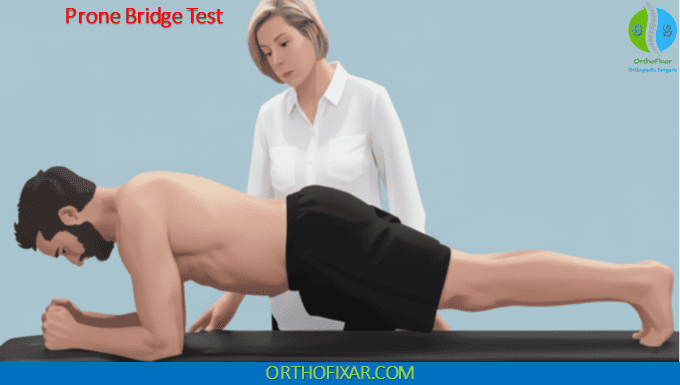
- The patient lies in a prone position on the examination table or mat. They are instructed to assume the elbow push-up position, with elbows placed directly under the shoulders, forearms resting on the ground, feet together, and hands shoulder-width apart.
- The patient lifts their body off the surface, forming a straight line (plank) from the shoulders through the hips to the feet. The neck should remain neutral, and the gaze directed toward the floor.
- The patient is asked to hold this position for as long as possible while maintaining proper alignment and control.
During the test, the examiner should closely monitor for:
- Increased lumbar lordosis: Suggests weakness in abdominal stabilizers or overactivation of lumbar extensors.
- Shaking or tremors: Indicates muscle fatigue or loss of motor control.
- Shoulder dipping or hip sagging: Reflects diminished endurance or poor neuromuscular coordination.
If any of these signs appear, the test should be stopped to prevent compensatory strain or injury.
See Also: Spine Examination
What does a Positive Prone Bridge Test Mean?
Standard Hold Time: A minimum of 90 seconds is considered the baseline for adequate core endurance.
Normal Values: Research indicates that healthy individuals typically achieve hold times of 145 ± 71.5 seconds (mean ± standard deviation), suggesting considerable variability in normal populations.
Performance Categories:
- Excellent: >180 seconds
- Good: 120-180 seconds
- Average: 90-120 seconds
- Below Average: 60-90 seconds
- Poor: <60 seconds
Note: These categories may vary based on age, sex, and activity level.
Several variables can influence Prone Bridge Test results:
- Body Composition: Higher body mass index may reduce hold times due to increased gravitational load
- Age: Endurance typically decreases with advancing age
- Sex: Males generally demonstrate longer hold times than females, though this gap narrows with training
- Training Status: Athletes and individuals with regular core training demonstrate significantly longer hold times
- Previous Injury: History of back pain or injury may limit performance.
The Prone Bridge Test is valuable in various clinical settings:
- Orthopedic Rehabilitation: Assessing readiness to return to activity following spine or trunk injuries
- Sports Medicine: Evaluating athletic core strength and injury risk
- Occupational Health: Determining capacity for jobs requiring sustained trunk stability
- Chronic Pain Management: Monitoring progress in patients with chronic low back pain
- Preventive Screening: Identifying individuals at risk for back injury due to insufficient core endurance.
Supine Bridge Test
This test is used to measure core trunk stability and strength of the hip and spine extensors and the contralateral external oblique and ipsilateral internal oblique muscles.
The patient lies supine with the hips at 45° and knees at 90°. The patient then “bridges” lifting the buttocks off the bed and maintains a straight line between the knees and shoulders with the pelvis held in neutral. The patient should be able to hold this plank position with no shaking for at least 90 seconds (normal: 170 ± 42.5 seconds). The test can be made more difficult by asking the patient to extend one knee while in the bridged position.

References & More
- Bohannon RW, Steffl M, Glenney SS, et al. The prone bridge test: performance, validity, and reliability among older and younger adults. J Body Mov Ther. 2018;22(2):385–389. PubMed
- . Reece JD. Development of a Prone Bridge Test As a Measurement of Abdominal Stability in Healthy Adults; 2009. https://scholarsarchive.byu.edu/etd/1845.
- Andrade JA, Figueiredo LC, Santos TR, et al. Reliability of transverse plane pelvic alignment measurement during the bridge test with unilateral knee extension. Rev Bras Fisioter. 2012;16(4):268–274. PubMed
- Brumitt J, Matheson JW, Meira EP. Core stabilization exercise prescription, Part 1: current concepts in assessment and intervention. Sports Health. 2013;5(6):504–509. PubMed
- Orthopedic Physical Assessment by David J. Magee, 7th Edition.