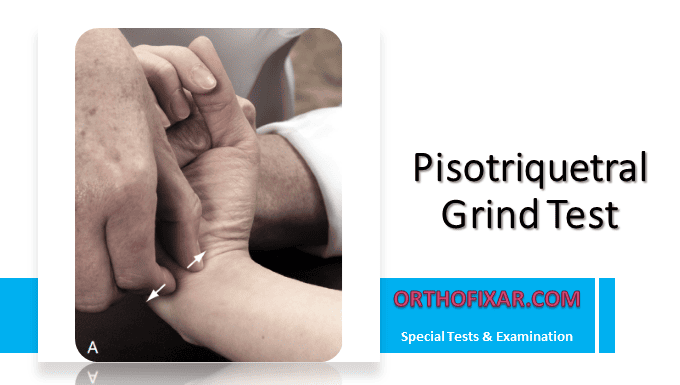
The Pisotriquetral Grind Test is a specialized clinical examination technique used to evaluate the integrity of the pisotriquetral joint and detect degenerative joint disease in the wrist. The Pisotriquetral Grind Test combines passive joint mobilization with compression to elicit symptoms indicative of pisotriquetral pathology.
The pisotriquetral joint is normally stabilized by several key structures:
- Pisohamate ligament – provides medial stability
- Pisometacarpal ligament – contributes to overall joint integrity
- Flexor carpi ulnaris tendon – major dynamic stabilizer
- Ulnar pisotriquetral ligament – reinforces the joint capsule
- Abductor digiti minimi – provides additional muscular support
- Extensor and flexor retinaculum – contribute to overall wrist stability
How to perform the Pisotriquetral Grind Test?
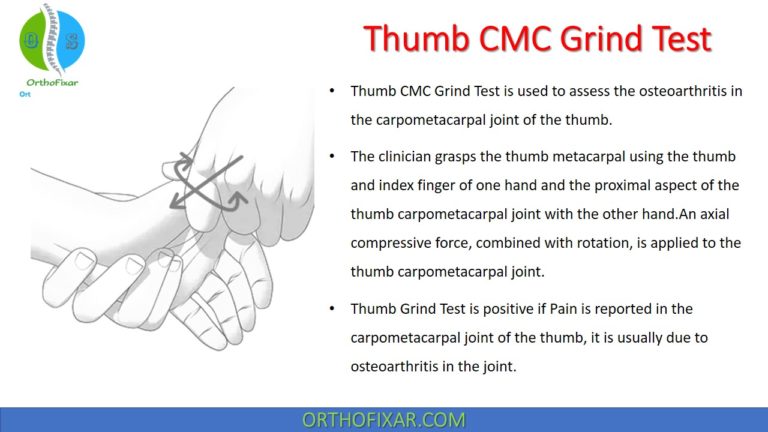
The patient is seated comfortably with arm relaxed and the wrist positioned in flexion initially. The examiner secures the patient’s hand with one hand while using the other to manipulate the pisiform bone by palpating and mobilizing it medially and laterally.
Perform this movement in two wrist positions:
- Wrist flexion (allows greater pisiform mobility)
- Wrist extension (restricts movement due to flexor carpi ulnaris tightness)
Apply gentle compression to the pisiform during the mobilization movements and monitor for crepitus, pain, or abnormal movement patterns
See Also: Wrist Pain Causes

What does a Positive Pisotriquetral Grind Test Mean?
- Crepitus: Grinding sensation during movement
- Pain: Localized discomfort at the pisotriquetral joint
- Excessive mobility: Abnormal range of motion compared to contralateral side
Diagnostic Significance
A positive Pisotriquetral Grind Test suggests pisotriquetral degenerative joint disease, which may present with:
- Ulnar-sided wrist pain
- Difficulty with gripping activities
- Potential ulnar nerve symptoms
See Also: Triangular Fibrocartilage Complex Injury & Treatment
Clinical Pearls
Relationship to Joint Play Assessment
This test is essentially identical to the standard joint play assessment of the pisiform, with the key difference being the addition of wrist flexion and extension during the mobilization. This dynamic component helps differentiate between normal joint mobility and pathological changes.
Neurological Considerations
Clinicians should be particularly attentive to increased pisiform mobility, as excessive movement can lead to ulnar nerve symptoms. This occurs because the pisiform bone forms the ulnar border of Guyon’s canal (ulnar tunnel), and abnormal pisiform positioning or mobility can compromise the ulnar nerve as it passes through this anatomical space.
References & More
- Orthopedic Physical Assessment by David J. Magee, 7th Edition.
- Reddy RS, Compson J. Examination of the wrist – soft tissue, joints and special tests. Curr Orthop. 2005;19:180–189.
- Rhee PC, Sauve PS, Lindau T, Shin AY. Examination of the wrist: ulnar-sided wrist pain due to ligamentous injury. J Hand Surg Am. 2014;39(9):1859–1862. PubMed
- Young D, Papp S, Giachino A. Physical examination of the wrist. Hand Clin. 2010;26(1):21–36. PubMed