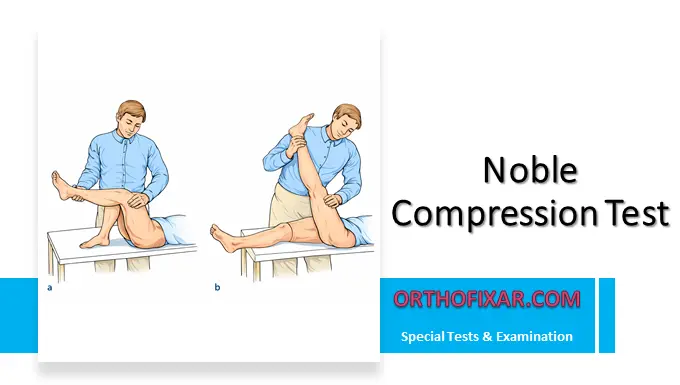
The Noble Test, also called the Noble Compression Test, is a clinical orthopedic physical exam maneuver used to assess suspected Iliotibial Band Syndrome (ITBS) that causes pain and frictional over the lateral femoral epicondyle. It helps provoke symptoms by stressing the distal iliotibial band (ITB) as it slides across the lateral femoral epicondyle during knee motion, aiming to reproduce the patient’s lateral knee pain.
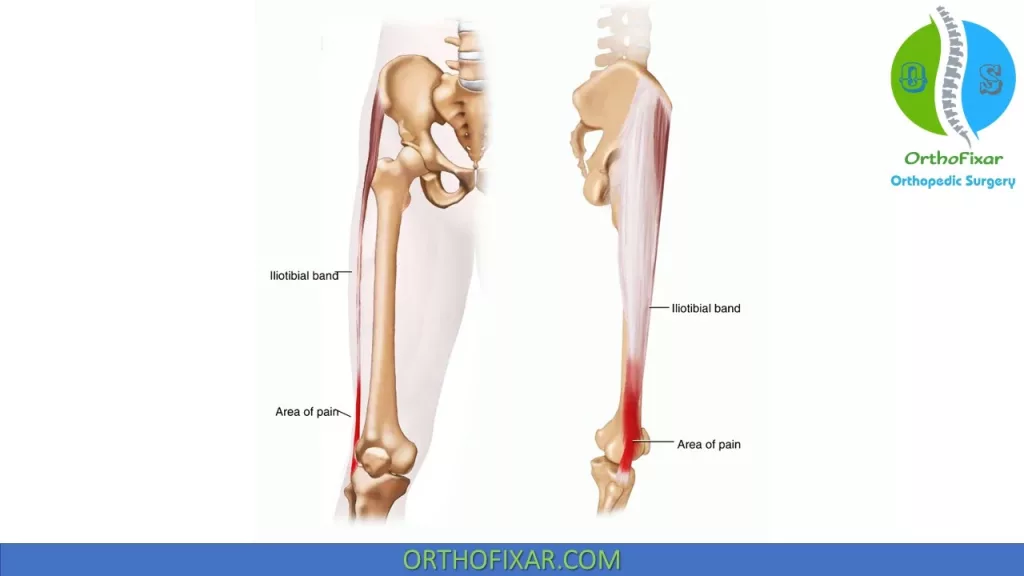
Iliotibial Band Syndrome is one of the most common causes of lateral knee pain in runners, cyclists, and athletes who perform repetitive knee flexion and extension. It usually presents as sharp or burning pain at the outside (lateral aspect) of the knee, often worst around 30° of knee flexion — where the ITB moves over the lateral femoral condyle.
While clinical history and examination remain the cornerstone of diagnosis, special tests like the Noble Test are routinely used to differentiate ITBS from other lateral knee disorders, such as meniscal injuries or patellofemoral pain syndrome.
How do you perform the Noble Compression Test?
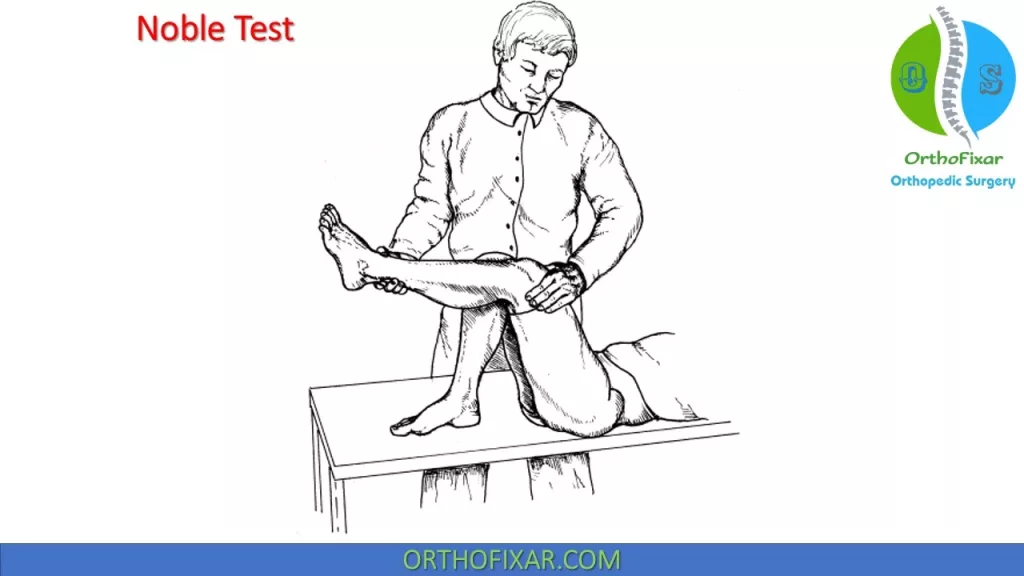
- The patient is supine. The examiner passively flexes the patient’s knee 90° and the hip approximately 50°.
- With the thumb of the other hand, the examiner gently presses on the lateral femoral condyle or 1 to 2 cm (0.4 to 0.8 inch) proximal to it.
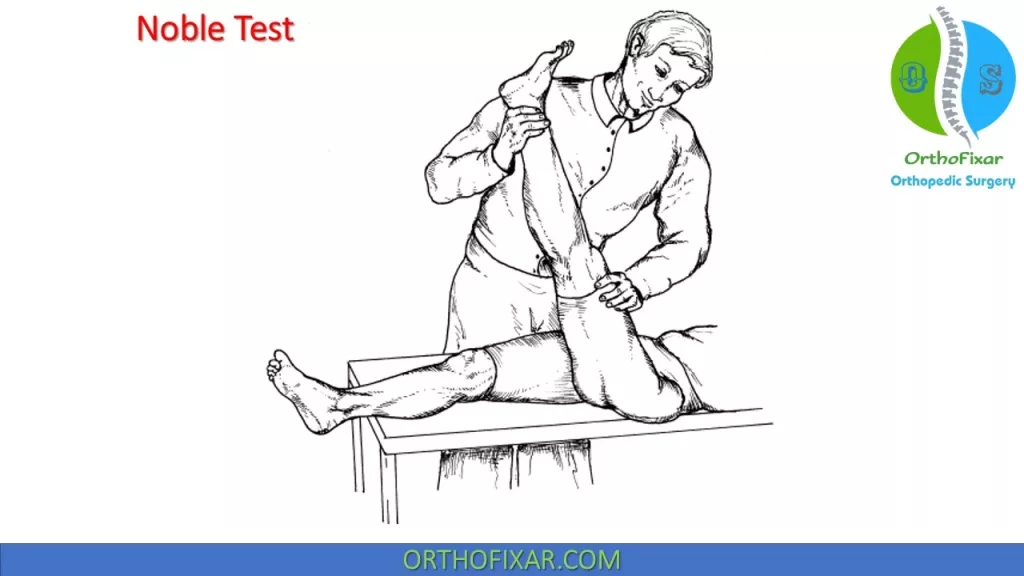
- Maintaining the flexion in the hip and pressure on the lateral femoral condyle, the examiner then increasingly extends the knee passively.
- Once the knee is in about 40° of flexion, the patient is requested to fully extend the knee.
See Also: Iliotibial Band Syndrome
What does a Positive Noble Compression Test Mean?
Noble compression test is considered positive if palpable snapping or localized pain (that is increased with pressure) is elected over the lateral epicondyle of the femur especially at 30 degrees of flexion (Extending the knee from 30° of flexion places maximum stress on the iliotibial tract.)
Positive Noble Test suggests any of the following:
- Contracture of the muscle or of the iliotibial tract itself.
- Inflammation of the IT band or its associated bursa.
- Inflammation of the lateral femoral condyle.
See Also: Renne Test
Notes
- Pain in the posterior thigh that occurs with increasing extension is most likely indicative of a contracture of the hamstrings and should not be confused with a contracture of the tensor fasciae latae.
- This test is often positive during walking when an iliotibial band friction syndrome is present.

Related Anatomy
- The tensor fasciae latae arises from the anterolateral margin of the ilium (anterior superior iliac spine ASIS). It is an anterior branch of the gluteus medius.
- Its tendon inserts into the anterior margin of the iliotibial tract, which reinforces the fascia lata of the thigh.
- The tensor fasciae latae inserts into the iliotibial tract, which in turn inserts into the tubercle of Gerdy on the proximal tibia.
Reference
- Michael D. Rosenthal: Clinical Testing for Extra-Articular Lateral Knee Pain. A Modification and Combination of Traditional Tests. N Am J Sports Phys Ther. 2008 May; 3(2): 107–109. PMID: 21509133. PubMed
- Vieira EL, Vieira EA, da Silva RT, Berlfein PA, Abdalla RJ, Cohen M. An anatomic study of the iliotibial tract. Arthroscopy. 2007 Mar;23(3):269-74. doi: 10.1016/j.arthro.2006.11.019. PMID: 17349469. PubMed
- Orchard JW, Fricker PA, Abud AT, Mason BR. Biomechanics of iliotibial band friction syndrome in runners. Am J Sports Med. 1996 May-Jun;24(3):375-9. doi: 10.1177/036354659602400321. PMID: 8734891. PubMed
- Noble HB, Hajek MR, Porter M. Diagnosis and treatment of iliotibial band tightness in runners. Phys Sportsmed. 1982;10:67–68. 71–72, 74. PubMed
- Noble HB, Hajek MR, Porter M. Diagnosis and treatment of iliotibial band tightness in runners. Phys Sportsmed. 1982;10:67–68. 71–72, 74.
Clinical Tests for the Musculoskeletal System 3rd Edition. - Millers Review of Orthopaedics -7th Edition book.