The Ligamentum Teres Test is a specialized orthopedic maneuver used to assess the integrity and irritability of the ligamentum teres of the hip. Although historically underappreciated, this ligament can become a source of intra-articular hip pain, particularly in athletes or patients with rotational trauma.
The ligamentum teres femoris is an intracapsular but extra-synovial ligament that connects the fovea of the femoral head to the acetabular notch. While its mechanical role has been debated, recent evidence suggests it contributes to hip stability, particularly in flexion and adduction positions. Injury to this structure can occur through traumatic dislocation, sports-related trauma, or degenerative changes.
See Also: hip Joint Anatomy
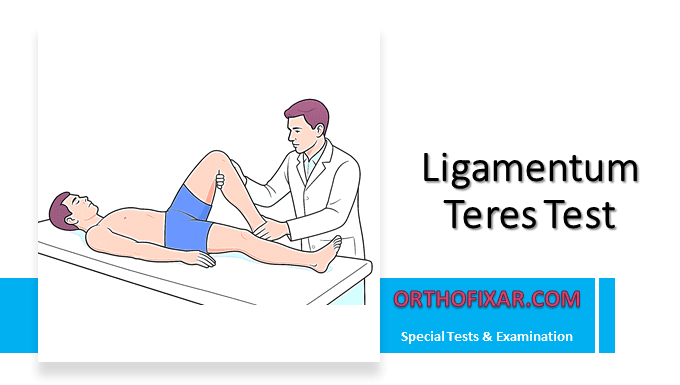
How to Perform the Ligamentum Teres Test?
- The patient lies supine on the examination table. The pelvis should remain stable with no rotation or compensatory movement.
- The clinician stands beside the hip being examined, ensuring full control of hip and leg movement.
- Flex the knee to 90° and passively flex the hip to approximately 70°. Confirm that the pelvis remains neutral and does not rotate.
- Abduct the hip maximally. Adduct the hip to 30° short of the previously reached full abduction. This position places optimal tension on the ligamentum teres.
- In this position, perform full internal (medial) and external (lateral) rotation of the hip. These movements maximally stress the ligamentum teres without causing impingement from surrounding structures.

What does a Positive Test Mean?
The test is considered positive if pain is reproduced during either:
- Medial rotation, or
- Lateral rotation
in the final test position.
Pain suggests:
- Ligamentum teres sprain or tear
- Intra-articular irritation or synovitis
- Possible associated microinstability of the hip.
A positive Ligamentum Teres Test should be correlated with:
- Hip arthroscopy findings
- MRI/MRA evaluation
- History of twisting injuries, instability, or persistent deep hip pain
It is especially useful in:
- Athletes (e.g., dancers, martial artists, soccer players)
- Patients with chronic hip pain not explained by standard tests.
Test Accuracy
In a Cohort study, the sensitivity and specificity of the test were:
- Sensitivity: 90%
- Sensitivity: 85%
The positive predictive value was 84%, and the negative predictive value was 91%. The presence of an ligamentum teres tear, pincer lesion, and labral tear that required repair was associated with a positive ligamentum teres test result. The κ coefficient for interobserver reliability was .80.
Summary Table
| Feature | Description |
|---|---|
| Purpose | Assess ligamentum teres integrity or irritation |
| Patient Position | Supine, pelvis stabilized |
| Examiner | Standing beside the affected hip |
| Key Steps | Hip flexion 70°, knee flexion 90°, max abduction → adduction (30° short), full IR/ER |
| Positive Test | Pain during medial or lateral rotation |
| Indicates | Ligamentum teres injury or intra-articular irritation |
References & More
- Reiman MP, Thorborg K. Clinical examination and physical assessment of hip joint-related pain in athletes. Int J Sports Phys Ther. 2014;9(6):737–755.
- O’Donnell J, Economopoulos K, Singh P, et al. The ligamentum teres test: a novel and effective test in diagnosing tears of the ligamentum teres. Am J Sports Med. 2014;42(1):138–143. PubMed
- Orthopedic Physical Assessment by David J. Magee, 7th Edition.