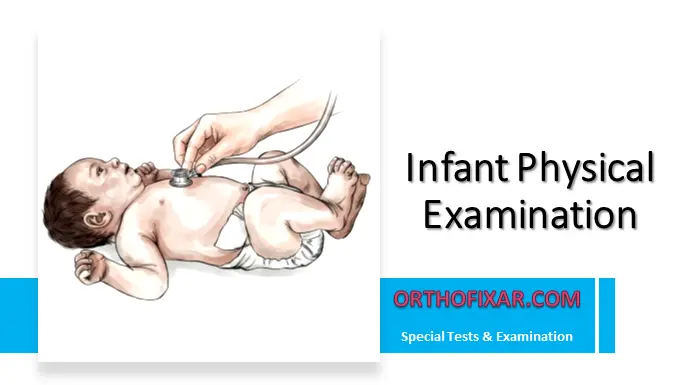
The infant physical examination is a systematic clinical evaluation performed to assess the health, growth, and development of newborns and infants. A thorough infant physical assessment helps healthcare professionals identify congenital abnormalities, developmental disorders, infections, and other medical conditions early in life.
The newborn physical assessment is one of the most important examinations performed immediately after birth and during infancy. It provides essential baseline information regarding neurological function, cardiopulmonary health, musculoskeletal integrity, and overall adaptation to extrauterine life.
This comprehensive guide reviews the principles, techniques, and components of the newborn examination using evidence-based medical literature and pediatric clinical guidelines.
What is an Infant Physical Examination?
An infant physical examination is a structured head-to-toe evaluation of a newborn or infant conducted by pediatricians, neonatologists, family physicians, nurses, or other healthcare providers.
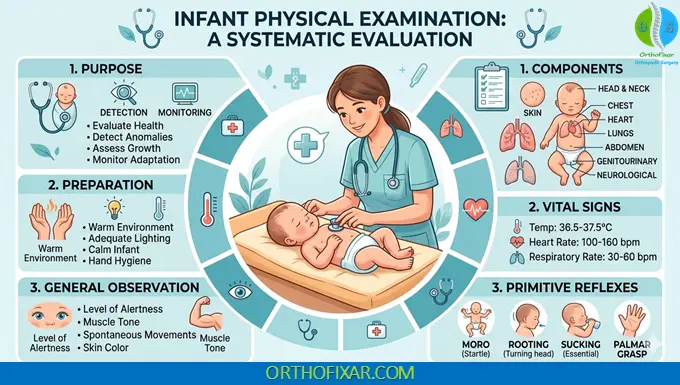
The examination aims to:
- Evaluate general health status
- Detect congenital anomalies
- Assess growth and developmental milestones
- Identify urgent medical conditions
- Monitor adaptation after birth
- Establish a baseline for future care
The newborn physical assessment is typically performed:
- Immediately after delivery
- Within the first 24 hours of life
- During routine well-baby visits throughout infancy
Importance of Infant Physical Assessment
A detailed infant physical assessment is essential because many neonatal disorders may initially appear subtle or asymptomatic.
Benefits of Early Examination
- Early detection of congenital heart disease
- Recognition of birth trauma
- Identification of metabolic disorders
- Detection of hip dysplasia
- Evaluation of neurological abnormalities
- Monitoring feeding and hydration status
- Identification of jaundice and infections
Early diagnosis improves outcomes and reduces infant morbidity and mortality.
Preparation for the Newborn Examination
Before starting the newborn examination, healthcare providers should ensure:
- Warm environment
- Adequate lighting
- Clean examination surface
- Calm infant when possible
- Hand hygiene and infection control
The examination should ideally occur when the infant is quiet and not crying excessively.
Components of Infant Physical Examination
General Observation
The first step in an infant physical assessment is general observation.
Assess:
- Level of alertness
- Muscle tone
- Spontaneous movements
- Skin color
- Respiratory effort
- Cry characteristics
- Symmetry of movement
Normal newborns typically exhibit flexed posture and spontaneous symmetric movements.
Vital Signs Assessment
Temperature
Normal neonatal temperature:
- 36.5°C to 37.5°C
Hypothermia may indicate infection or environmental exposure.
Heart Rate
Normal newborn heart rate:
- 100–160 beats/minute
Tachycardia or bradycardia may suggest underlying pathology.
Respiratory Rate
Normal respiratory rate:
- 30–60 breaths/minute
Signs of respiratory distress include:
- Nasal flaring
- Grunting
- Retractions
- Cyanosis
Skin Examination
Skin examination is an essential part of the newborn physical assessment.
Evaluate:
- Color
- Texture
- Perfusion
- Birthmarks
- Rashes
- Jaundice
Common Normal Findings
Vernix Caseosa
White protective coating covering newborn skin.
Lanugo
Fine body hair common in premature infants.
Milia
Tiny white papules on the face caused by blocked sebaceous glands.
Mongolian Spots
Bluish-gray pigmentation commonly over the sacrum.
Head and Neck Examination
Head Assessment
Inspect:
- Head shape
- Fontanelles
- Sutures
- Scalp swelling
Fontanelles
Anterior Fontanelle
- Diamond-shaped
- Normally soft and flat
Posterior Fontanelle
- Smaller and triangular
Bulging fontanelles may indicate increased intracranial pressure.
Common Findings
Caput Succedaneum
Diffuse scalp edema crossing suture lines.
Cephalohematoma
Subperiosteal hemorrhage limited by sutures.
Eye Examination
The eye examination during the infant physical examination evaluates visual structures and neurological integrity.
Assess:
- Red reflex
- Pupillary response
- Eye symmetry
- Conjunctiva
Absence of red reflex may indicate:
- Cataracts
- Retinoblastoma
Ear Examination
Inspect:
- Ear position
- Shape
- Cartilage development
Low-set ears may be associated with genetic syndromes.
Nose Examination
Assess:
- Patency of nostrils
- Nasal flaring
- Discharge
Newborns are obligate nasal breathers; nasal obstruction can impair feeding.
Mouth and Oral Examination
Evaluate:
- Palate integrity
- Tongue movement
- Sucking reflex
- Mucosal hydration
Important Findings
Cleft Palate
May interfere with feeding.
Epstein Pearls
Small benign cysts on the palate.
Tongue-Tie (Ankyloglossia)
Restricted tongue movement due to short frenulum.
Chest Examination
The chest assessment is a major component of the newborn examination.
Inspect:
- Chest symmetry
- Respiratory effort
- Breast enlargement
Auscultation
Heart Sounds
Evaluate:
- Murmurs
- Rhythm
- Rate
Lung Sounds
Normal lungs should have clear bilateral breath sounds.
Cardiovascular Examination
A complete infant physical assessment includes detailed cardiovascular evaluation.
Assess:
- Peripheral pulses
- Capillary refill
- Cyanosis
- Murmurs
Femoral pulses should be palpable and equal.
Weak femoral pulses may suggest coarctation of the aorta.
Abdominal Examination
Inspect:
- Umbilical cord
- Abdominal contour
- Distention
Palpation
Assess for:
- Liver enlargement
- Splenomegaly
- Masses
Genitourinary Examination
Male Infants
Assess:
- Testicular descent
- Hypospadias
- Hydrocele
Female Infants
Inspect:
- Labia
- Vaginal patency
- Discharge
Maternal hormones may cause transient vaginal discharge or bleeding.
Musculoskeletal Examination
The musculoskeletal component of the newborn physical assessment evaluates limb integrity and joint stability.
Assess:
- Limb movement
- Bone deformities
- Clavicles
- Spine
- Hip stability
Developmental Dysplasia of the Hip
Ortolani Maneuver
Detects reducible dislocated hips.
Barlow Maneuver
Detects unstable hips.
Neurological Examination
Neonatal neurological assessment is fundamental during the infant physical examination.
Evaluate:
- Muscle tone
- Primitive reflexes
- Symmetry
- Responsiveness
Primitive Reflexes
Moro Reflex
Startle response to sudden movement.
Rooting Reflex
Turns head toward stimulation.
Sucking Reflex
Essential for feeding.
Palmar Grasp
Finger flexion when palm stimulated.
Growth Measurements
Growth parameters are essential during every infant physical assessment.
Measure:
- Weight
- Length
- Head circumference
These measurements should be plotted on standardized growth charts.
Common Abnormal Findings in Newborn Examination
Jaundice
Yellow discoloration caused by elevated bilirubin.
Cyanosis
May indicate cardiopulmonary disease.
Respiratory Distress
Requires urgent evaluation.
Poor Feeding
Can signal neurological or systemic illness.
Hypotonia
May indicate neuromuscular disorders.
APGAR Score and Initial Newborn Assessment
The APGAR score is performed at:
- 1 minute
- 5 minutes after birth
Components
- Appearance
- Pulse
- Grimace
- Activity
- Respiration
Scores help assess neonatal adaptation immediately after delivery.
Infant Physical Assessment by Age
Newborn (0–28 Days)
Focus on:
- Congenital anomalies
- Feeding
- Jaundice
- Reflexes
Early Infancy (1–6 Months)
Assess:
- Growth
- Developmental milestones
- Muscle tone
- Social interaction
Late Infancy (6–12 Months)
Evaluate:
- Mobility
- Fine motor development
- Language emergence
- Nutrition
Clinical Tips for Performing a Newborn Physical Assessment
- Observe before touching the infant
- Perform least disturbing parts first
- Keep the infant warm
- Use caregiver interaction to calm the infant
- Reassess abnormal findings
Documentation of Infant Physical Examination
Accurate documentation should include:
- Vital signs
- Growth parameters
- Normal and abnormal findings
- Developmental observations
- Feeding assessment
Proper records support continuity of care.
When to Seek Urgent Medical Attention
Immediate evaluation is necessary if the infant shows:
- Respiratory distress
- Fever
- Poor feeding
- Cyanosis
- Seizures
- Lethargy
- Persistent vomiting
Conclusion
The infant physical examination is a cornerstone of pediatric healthcare and neonatal medicine. A systematic newborn physical assessment allows healthcare professionals to identify congenital abnormalities, developmental concerns, and life-threatening conditions early in life.
A comprehensive newborn examination includes assessment of growth, neurological function, cardiopulmonary status, musculoskeletal integrity, and developmental progress. Regular and accurate infant physical assessment improves clinical outcomes and supports healthy infant development.
Frequently Asked Questions (FAQs)
What is included in an infant physical examination?
An infant physical examination includes assessment of vital signs, skin, head, eyes, chest, abdomen, neurological reflexes, musculoskeletal system, and growth measurements.
Why is the newborn physical assessment important?
The newborn physical assessment helps detect congenital abnormalities, infections, developmental disorders, and medical emergencies early.
How often should infants receive physical examinations?
Infants should receive regular physical examinations during newborn care and routine well-baby visits throughout the first year of life.
What are primitive reflexes in newborns?
Primitive reflexes are automatic neurological responses present at birth, such as the Moro reflex, rooting reflex, and sucking reflex.
References & More
- Gantan EF, Wiedrich L. Neonatal Evaluation. [Updated 2023 Aug 14]. In: StatPearls [Internet]. Treasure Island (FL): StatPearls Publishing; 2026 Jan-. Available from: Pubmed
- Fuloria M, Kreiter S. The newborn examination: part I. Emergencies and common abnormalities involving the skin, head, neck, chest, and respiratory and cardiovascular systems. Am Fam Physician. 2002 Jan 1;65(1):61-8. PMID: 11804443. Pubmed
- Humphry S, Thompson D, Evans R, Price N, Williams P. Newborn and infant physical examination standards in a dedicated clinic for developmental dysplasia of the hip. Ann R Coll Surg Engl. 2018 Sep;100(7):566-569. doi: 10.1308/rcsann.2018.0101. Epub 2018 Jun 18. PMID: 29909671; PMCID: PMC6214062. Pubmed
- Cioffredi LA, Garner B, Maxwell JR, Merhar S, Peralta-Carcelen M, Scott LS, Sisodia M, DeMauro SB; HBCD Physical Health Working Group. Infant and early childhood physical health assessments in the HEALthy Brain and Child Development (HBCD) Study. Dev Cogn Neurosci. 2024 Oct;69:101414. doi: 10.1016/j.dcn.2024.101414. Epub 2024 Jul 14. PMID: 39032415; PMCID: PMC11315127. Pubmed