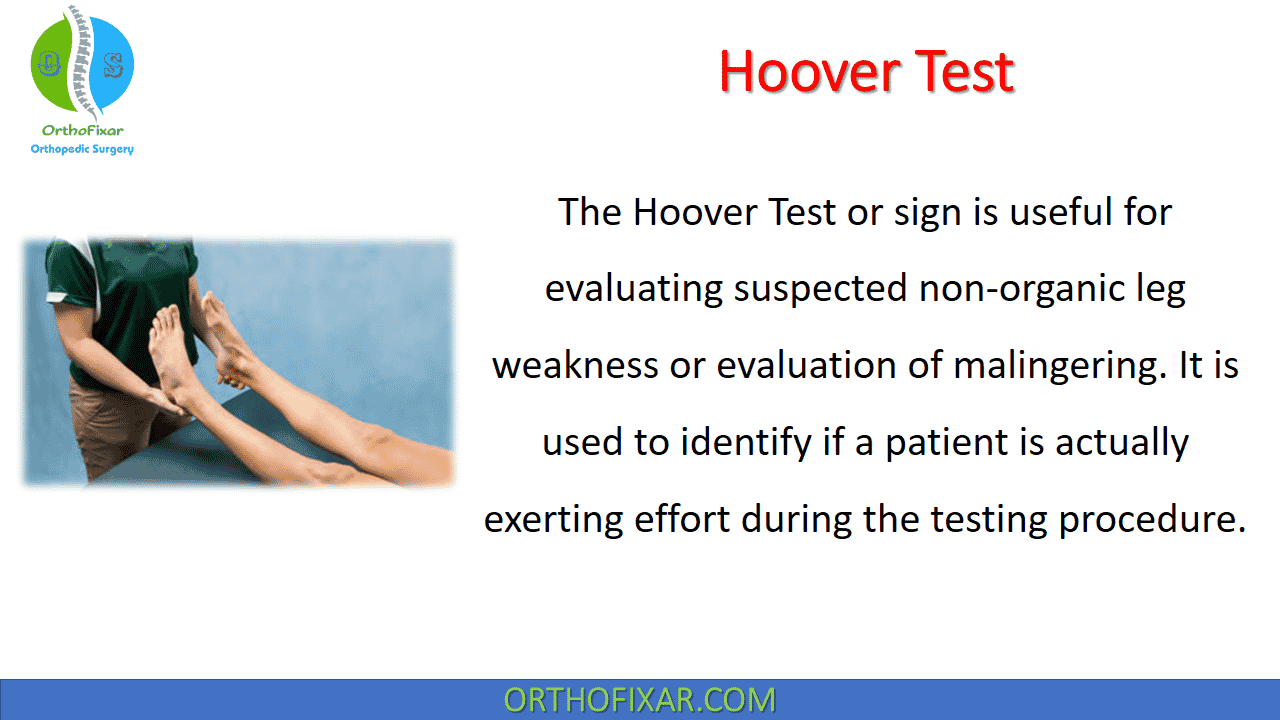
The Hoover Test is a clinical examination used to differentiate between organic and non-organic (functional or psychogenic) lower limb weakness. It helps determine whether the weakness in a patient’s leg is due to a true neurological lesion or a lack of effort (functional weakness).
How do you perform the Hoover Test?
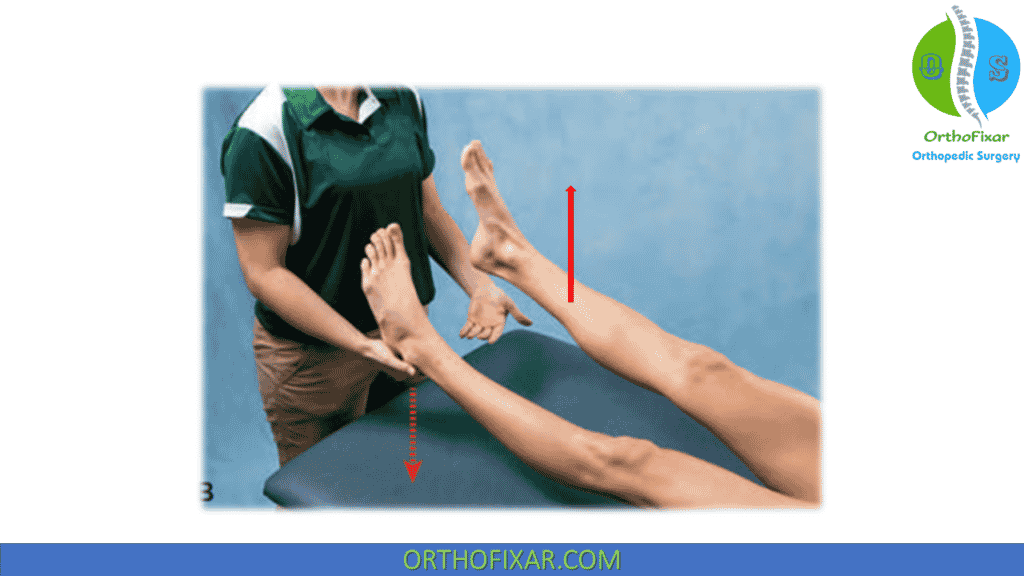
The patient relaxes in a supine position on the table, while the examiner is at the feet of the patient with the evaluator’s hands cupping the calcaneus of each leg.
The patient is asked to attempt an active straight leg raise (SLR) on the involved side.
See Also: Straight Leg Raise (Lasegue Test)

What does a positive Hoover sign mean?
If the patient does not lift the leg or the examiner does not feel pressure under the opposite heel, the patient is probably not really trying or may be malingering. If the lifted limb is weaker, pressure under the normal heel increases, because of the increased effort to lift the weak leg off the examination table. Often patients will report that they cannot raise the leg at all.
Both sides have to be compared for differences.
| Finding | Interpretation |
|---|---|
| Downward pressure on opposite heel | True (organic) weakness |
| No downward pressure | Functional (non-organic) weakness |

Reliability
In a cohort study on 337 patients presenting with suspected stroke, Hoover’s sign was moderately sensitive and very specific for a diagnosis of functional weakness. Further studies are required to assess inter-observer variability and performance of the test in larger numbers of patients with functional weakness.
- Sensitivity: 63%
- Specificity: 100%
Notes
Although the contemporary clinical use of the Hoover Test is to identify patients who may be malingering, its original purpose was to diagnose mild cases of hemiparesis. Patients with unilateral weakness would yield a positive test but would not be malingering.
An extension movement of one leg normally accompanies flexion of the other leg, as in walking.
In organic leg weakness, the downward pressure of the contralateral heel occurs when the patient tries to raise the weak leg, and the examiner can feel the extension pressure by placing a hand beneath the heel that remains on the bed. In nonorganic leg weakness, there is no downward pressure of the contralateral heel as the patient tries to raise the weak leg, but an extension movement of the “paralyzed” leg may be felt as the good leg is raised.
Hoover sign is the absence of the expected extension movement of the good leg on attempting to raise the bad leg and normal involuntary extension of the bad leg on raising the good leg.
The Hoover test is a classic procedure used to determine whether the individual is malingering during the performance of functional and selective tissue tests.
References
- Hoover CF. A new sign for the detection of malingering and functional paresis of the lower extremities. JAMA 1908;51:746–747.
- McWhirter L, Stone J, Sandercock P, Whiteley W. Hoover’s sign for the diagnosis of functional weakness: a prospective unblinded cohort study in patients with suspected stroke. J Psychosom Res. 2011 Dec;71(6):384-6. doi: 10.1016/j.jpsychores.2011.09.003. Epub 2011 Oct 6. PMID: 22118379. PubMed
- Arieff AJ The Hoover sign an objective sign of pain and/or weakness in the back or lower extremities. Trans Am Neural Assoc 1961 ;86:191 . PubMed
- Archibald, AC, and Wiechec, F: A reappraisal of Hoover’s test. Arch Phys Med Rehabil, 51:234, 1970. PubMed