Hart’s Sign is based on one of the earliest parental observations: one leg does not abduct as far as the other during diaper changes. Early recognition of Congenital Dislocation of the Hip (CDH)—now often referred to as Developmental Dysplasia of the Hip (DDH)—is essential to prevent long-term functional impairment. When diagnosis is delayed, parents and clinicians may begin to notice subtle but important asymmetries in the infant’s hip mobility.
When one hip is dislocated, the femur (thigh bone) “rides up” on the affected side, creating characteristic changes in the soft tissue appearance. This upward displacement results in asymmetry of the fat folds in two key areas:
- Gluteal folds: The creases beneath the buttocks may appear uneven, with the affected side showing different positioning or depth
- Upper thigh folds: The natural creases in the upper leg may be asymmetric, often with additional or deeper folds on the affected side
While asymmetric skin folds can occur in normal infants, their presence in combination with limited abduction strengthens suspicion for hip dysplasia and warrants further evaluation.
See Also: Developmental Dysplasia of the Hip
How to Perform Hart’s Sign?
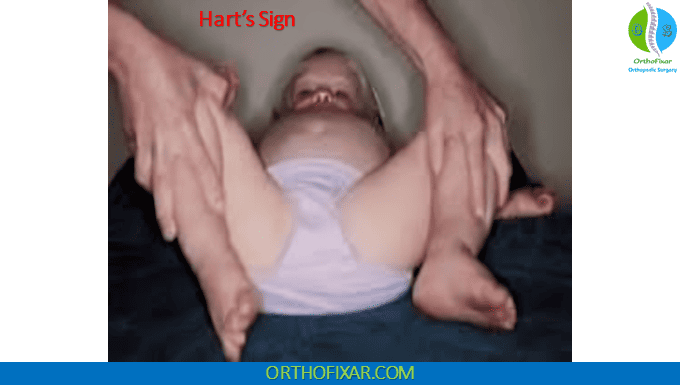
- Positioning the Child: The child is placed supine on the examination table. Both hips and knees are flexed to 90°, ensuring the pelvis remains stable.
- Passive Abduction: The examiner gently and simultaneously abducts both hips, observing:
- The degree of abduction on each side
- Any asymmetry in movement
- Early limitation of abduction on the affected side
- Observation of Soft Tissue Folds: In unilateral hip dislocation, the femoral head rides up on the affected side. This often produces:
- Asymmetry of gluteal and upper-thigh skin folds
- A higher or deeper crease on the involved side. These findings support the suspicion of hip instability or dislocation.
What does a Positive Hart’s Sign Mean?
A positive Hart’s Sign—typically demonstrated by restricted abduction on one side—is an important indicator of possible CDH/DDH. Although not diagnostic on its own, it strongly warrants further evaluation using:
- Ortolani and Barlow tests in newborns
- Ultrasound imaging in infants
- Pelvic radiographs in older babies
Early identification and treatment significantly improve hip development and reduce the need for surgical intervention later in life.
Key Takeaways
- Hart’s Sign is based on parental noticing that one leg abducts less during diaper changes.
- The test involves supine positioning, 90° hip/knee flexion, and simultaneous passive abduction.
- Asymmetry of movement and uneven thigh/gluteal folds are classic indicators of possible hip dislocation.
- Always follow a positive finding with proper imaging and specialist evaluation.
References & More
- LeVeau B. Hip. In: Richardson JK, Iglarsh ZA, eds. Clinical Orthopedic Physical Therapy. Philadelphia: WB Saunders; 1994
- Guille JT, Pizzutillo PD, MacEwan GD. Developmental dysplasia of the hip from birth to six months. J Am Acad Orthop Surg. 2000;8:232–242. Pubmed
- Orthopedic Physical Assessment by David J. Magee, 7th Edition.