The Harris Hip Score (HHS) is one of the most widely used orthopaedic outcome measures for hip disability and post-operative evaluation, especially following total hip arthroplasty (THA) or other hip-related procedures. It was developed to provide a standardized, clinician-administered scale to assess pain, function, range of motion, and deformity of the hip joint.
The Harris hip score can be used by a physician or a physiotherapist to study the clinical outcome of hip replacement.
What Is the Harris Hip Score (HHS)?
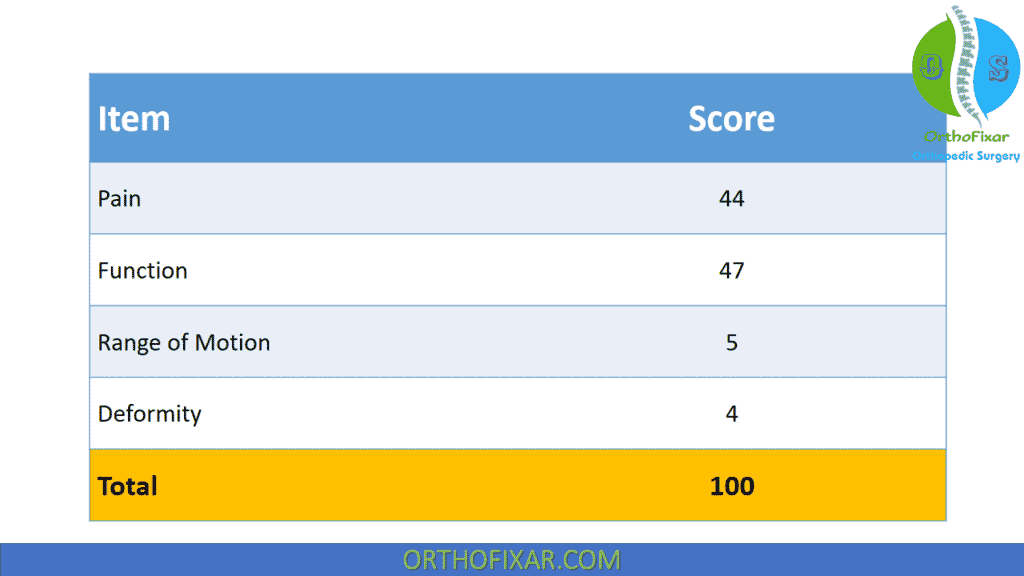
The Harris Hip Score is a 100-point clinician-reported scoring instrument originally developed in 1969 by Harris WH to evaluate patient outcomes after hip surgery, including arthroplasty and treatment of fractures.
Key features include:
- Pain: up to 44 points
- Function: up to 47 points
- Range of Motion: up to 5 points
- Deformity: up to 4 points
The higher the total Harris Hip Score, the lower the level of disability.
See Also: Hip Joint Osteoarthritis
Clinical interpretation generally follows these benchmarks:
| Score Range | Interpretation |
|---|---|
| 90–100 | Excellent |
| 80–89 | Good |
| 70–79 | Fair |
| <70 | Poor |
How is the HHS Administered?
The Harris Hip Score combines subjective patient feedback (pain and daily activities) with objective clinician measures (physical exam, leg length, range of motion).
- Patient Interview: Pain level, ability to walk, climb stairs, sit, and function in daily activities.
- Clinical Assessment: Hip range of motion measurements, gait evaluation, and deformity checks.
Because it involves clinician input, the HHS is classified as a clinician-reported outcome measure (ClinROM) rather than a purely patient-reported outcome measure (PROM).
Clinical Uses of the Harris Hip Score
✔︎ Assessing Surgical Outcomes
The HHS is often used before and after hip arthroplasty to quantify functional improvement and treatment success. It enables consistent comparison across patient groups and surgical techniques.
✔︎ Monitoring Rehabilitation
Orthopaedic specialists and physical therapists use HHS scores to track patient progress during post-operative rehabilitation and to detect potential complications or need for additional interventions.
✔︎ Research and Clinical Trials
Although developed for clinical use, the HHS is frequently reported in outcome studies of hip arthroplasty and hip pathology research.
Harris Hip Score Items
Pain:
| Pain Description | Score |
|---|---|
| None or ignores it | 44 |
| Slight, occasional, no compromise in activities | 40 |
| Mild pain, no effect on average activities, moderate pain with unusual activities, may take aspirin | 30 |
| Moderate pain, tolerable but makes concessions, some limitation of ordinary activity, occasional pain medicine stronger than aspirin | 20 |
| Marked pain, serious limitation of activity | 10 |
| Totally disabled, crippled, pain in bed, bedridden | 0 |
Function/ Gait
| Function | Description | Score |
|---|---|---|
| Distance Walked | Unlimited | 11 |
| 4–6 blocks | 8 | |
| 2–3 blocks | 5 | |
| Indoors only | 2 | |
| Unable to walk | 0 | |
| Limp | None | 11 |
| Slight | 8 | |
| Moderate | 5 | |
| Severe | 0 | |
| Support | None | 11 |
| Cane for long walks | 7 | |
| Cane most of the time | 5 | |
| One crutch | 3 | |
| Two canes | 2 | |
| Two crutches | 0 | |
| Not able to walk | 0 |
See Also: WOMAC Osteoarthritis Index
Function/ Activities
| Stairs | Normally without rail | 4 |
| Normally with rail | 2 | |
| In any manner | 1 | |
| Unable to do stairs | 0 | |
| Shoes & Socks | With ease | 4 |
| With difficulty | 2 | |
| Unable | 0 | |
| Sitting | Comfortable in ordinary chair 1 hr | 5 |
| On a high chair for 1⁄2 hr | 3 | |
| Unable to sit comfortably | 0 | |
| Enter Public Transportation | 1 |
Deformity
4 points for each of the following present
| <30° flexion contracture | 4 |
| <10° adduction contracture | 4 |
| <10° abduction contracture | 4 |
| <3.2 cm leg-length discrepancy | 4 |
Range of Motion
| Flexion | 0–45° (1.0 point per degree) + 0.6 points/degree from 45°–90° + 0.3 points/degree from 90°–110° |
| Abduction | 0–15° (0.8 points per degree) + 0.3 points/degree from 15°–20° |
| External Rotation (in ext) | 0–15° (0.4 points per degree) |
| Adduction | 0–15° (0.2 points per degree) |
References
- Harris, WH. Journal of Bone and Joint Surgery, 51-A(4):737–755, 1969.
- Söderman P, Malchau H. Is the Harris hip score system useful to study the outcome of total hip replacement? Clin Orthop Relat Res. 2001 Mar;(384):189-97. doi: 10.1097/00003086-200103000-00022. PMID: 11249165. Pubmed