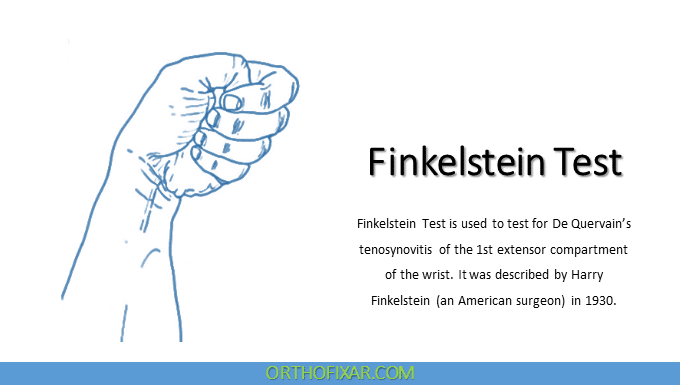
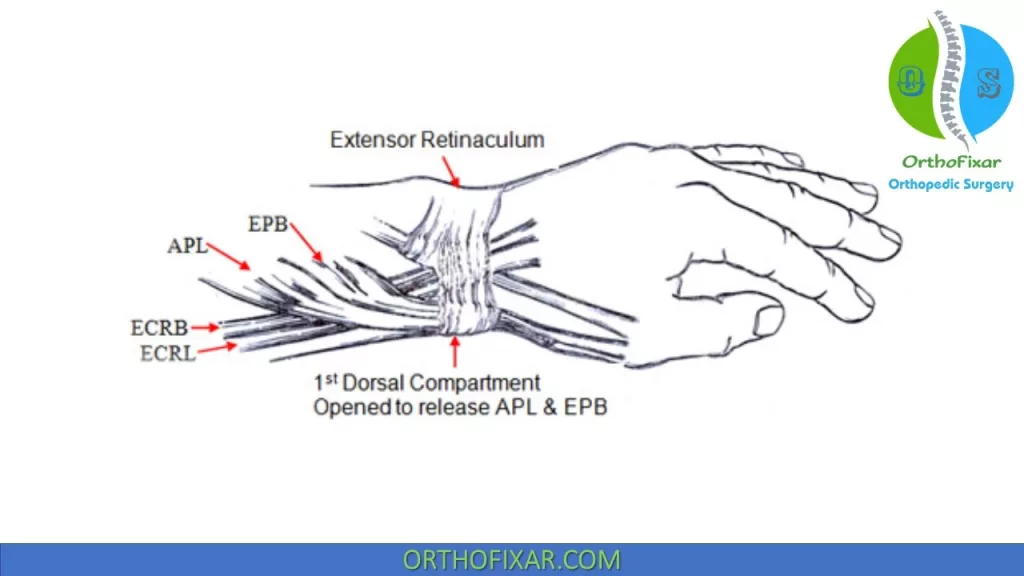
The Finkelstein Test is a commonly used clinical examination maneuver to diagnose De Quervain’s tenosynovitis, a stenosing tenosynovitis affecting the first extensor compartment of the wrist. This compartment contains the abductor pollicis longus (APL) and extensor pollicis brevis (EPB) tendons.
The test was first described in 1930 by Harry Finkelstein, an American surgeon, and remains one of the most reliable physical tests for De Quervain’s disease.
What is the Finkelstein Test Used For?
The Finkelstein Test is used to:
- Assess pain over the radial styloid
- Identify inflammation of the APL and EPB tendons
- Differentiate De Quervain’s tenosynovitis from other causes of radial wrist pain
How Do You Perform the Finkelstein test?
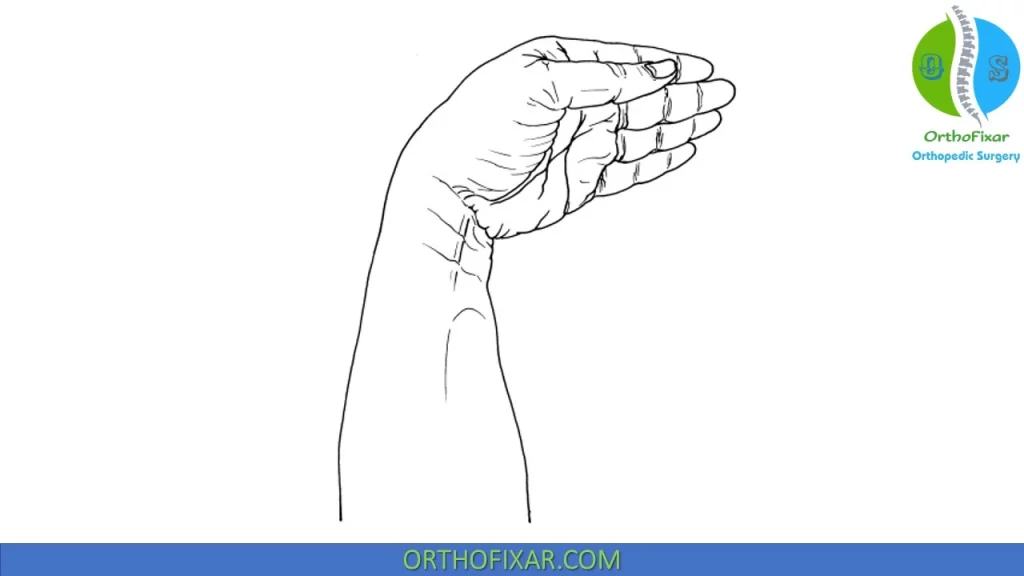
Standard Finkelstein Test
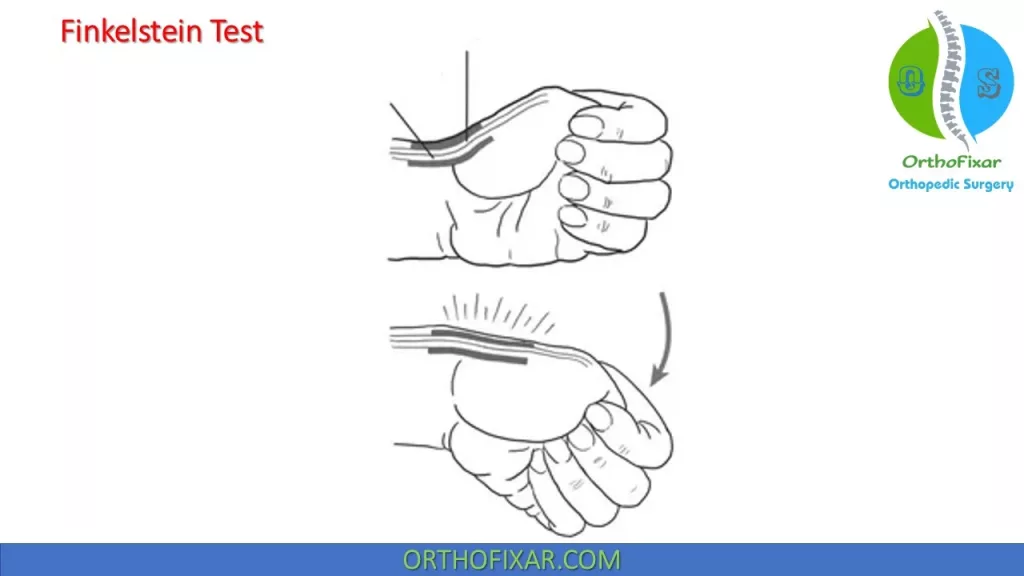
- The patient flexes the thumb into the palm.
- The fingers wrap around the thumb, forming a fist.
- The clinician then instructs the patient to ulnarly deviate the wrist.
Pain elicited over the radial aspect of the wrist suggests a positive Finkelstein Test.
Modified Finkelstein Test
In the modified version:
- The patient sits comfortably with the forearm unsupported.
- The patient actively ulnarly deviates the wrist.
- The clinician then grasps the thumb and passively flexes it into the palm.
This version is often better tolerated and may reduce false-positive results.
Finkelstein Test vs Eichhoff’s Test
Eichhoff’s Test is often confused with the Finkelstein Test and is performed by:
- Placing the thumb inside the palm
- Clenching the fingers tightly
- The examiner passively ulnarly deviates the wrist while stabilizing the forearm
Although similar, Eichhoff’s test tends to produce more discomfort, even in asymptomatic individuals.
Palpation During the Finkelstein Test
During either maneuver, the examiner may palpate over the APL and EPB tendons at the lateral radius to assess for:
- Tendon crepitus
- Nodularity
- Tendon snapping or popping
See Also: De Quervain’s tenosynovitis Injection
What Is a Positive Finkelstein Test?
A positive Finkelstein Test is defined by:
- Sharp pain
- Crepitation
- Tenderness directly over the radial styloid
This pain indicates tenosynovitis of the abductor pollicis longus and extensor pollicis brevis tendons.
Because the maneuver may cause discomfort in healthy individuals, comparison with the unaffected side is essential. The test is considered positive only if the patient’s typical symptoms are reproduced.
Finkelstein Test accuracy
A study comparing the Finkelstein Test and Eichhoff’s Test found that:
- Finkelstein Test specificity: 100%
- Eichhoff’s Test specificity: 89%
This supports the Finkelstein Test as the more specific examination for De Quervain’s disease.
Clinical Notes and Examination Tips
- Mild discomfort during ulnar deviation can occur in normal wrists.
- If De Quervain’s disease is suspected but pain is absent, ask the patient to radially deviate the wrist against resistance.
- Always perform the Finkelstein Test bilaterally for comparison.
- Applying pressure over the index metacarpal during deviation helps avoid confusion with thumb joint pathology.
EPB Entrapment and Incomplete Release Test
A variation of the Finkelstein Test can help identify incomplete surgical release in patients with persistent symptoms:
- Fully abduct the abductor pollicis longus (APL).
- Flex the thumb MCP joint to isolate the extensor pollicis brevis (EPB).
Pain during this maneuver suggests EPB entrapment in a separate sheath, known as EPB entrapment syndrome.
- Specificity: 50%
- Sensitivity: 81%
Muckard Test
The Muckard Test is another examination used to diagnose acute or chronic De Quervain’s tenosynovitis.
How to Perform the Muckard Test:
- Fingers extended
- Thumb adducted
- The patient actively ulnarly deviates the wrist
Severe pain over the radial styloid radiating into the thumb or forearm indicates inflammation of the APL and EPB tendons.
De Quervain’s Tenosynovitis
De Quervain’s tenosynovitis presents as pain along the radial wrist that worsens with:
- Radial deviation
- Ulnar deviation
- Performing the Finkelstein Test (often pathognomonic)
It results from synovial inflammation, commonly due to:
- Repetitive overuse
- Rheumatoid or inflammatory conditions
- Blunt trauma
Differential Diagnosis of Radial Wrist Pain
Conditions to differentiate from De Quervain’s disease include:
- First carpometacarpal (CMC) joint osteoarthritis
- Scaphoid fracture or nonunion
- Radiocarpal arthritis
- Wartenberg syndrome
- Intersection syndrome
Radiographic imaging and targeted joint examination aid in diagnosis.
FAQ
What is the Finkelstein Test?
The Finkelstein Test is a clinical examination used to diagnose De Quervain’s tenosynovitis by stressing the abductor pollicis longus and extensor pollicis brevis tendons at the wrist
How do you perform the Finkelstein Test?
The patient flexes the thumb into the palm and wraps the fingers around it to form a fist. The wrist is then ulnarly deviated. Pain over the radial styloid suggests a positive test.
What does a positive Finkelstein Test indicate?
A positive Finkelstein Test produces pain or crepitation over the radial styloid and indicates tenosynovitis of the abductor pollicis longus and extensor pollicis brevis tendons.
Is the Finkelstein Test painful in normal individuals?
Yes, mild discomfort may occur in healthy individuals. The test is considered positive only if the patient’s typical symptoms are reproduced and are greater than on the unaffected side.
What is the difference between Finkelstein Test and Eichhoff’s Test?
Both tests assess De Quervain’s tenosynovitis, but the Finkelstein Test is more specific and generally less painful than Eichhoff’s Test, which often causes discomfort even in normal wrists.
How accurate is the Finkelstein Test?
Studies have shown the test to have a specificity of up to 100%, making it more reliable than Eichhoff’s Test for diagnosing De Quervain’s disease.
What conditions can mimic a positive Finkelstein Test?
Conditions such as thumb carpometacarpal osteoarthritis, scaphoid fracture, radiocarpal arthritis, Wartenberg syndrome, and intersection syndrome can mimic De Quervain’s tenosynovitis.
Reference
- LIPSCOMB PR. Stenosing tenosynovitis at the radial styloid process (de Quervain’s disease). Ann Surg. 1951 Jul;134(1):110-5. doi: 10.1097/00000658-195107000-00013. PMID: 14838546; PMCID: PMC1802681. PubMed
- Som A, Wermuth HR, Singh P. Finkelstein Sign. [Updated 2021 Aug 15]. In: StatPearls [Internet]. Treasure Island (FL): StatPearls Publishing; 2021 Jan-. Available from: PubMed
- Wu F, Rajpura A, Sandher D. Finkelstein’s Test Is Superior to Eichhoff’s Test in the Investigation of de Quervain’s Disease. J Hand Microsurg. 2018 Aug;10(2):116-118. doi: 10.1055/s-0038-1626690. Epub 2018 Mar 20. PMID: 30154628; PMCID: PMC6103758. Pubmed
- Arons MS. de Quervain’s release in working women: a report of failures, complications, and associated diagnoses. J Hand Surg Am. 1987 Jul;12(4):540-4. doi: 10.1016/s0363-5023(87)80204-6. PMID: 2956316.
- Saplys R, Mackinnon SE, Dellon LA: The relationship between nerve entrapment versus neuroma complications and the misdiagnosis of de Quervain’s disease. Contemp Orthop 15:51, 1987.
- Williams JG: Surgical management of traumatic noninfective tenosynovitis of the wrist extensors. J Bone Joint Surg Br 59B:408, 1977.
- Louis DS: Incomplete release of the forst posterior (dorsal) compartment – a diagnostic test. J Hand Surg Am 12A:87, 1987.
- Clinical Tests for the Musculoskeletal System 3rd Edition.
- Dutton’s Orthopaedic Examination, Evaluation, And Intervention 3rd Edition.