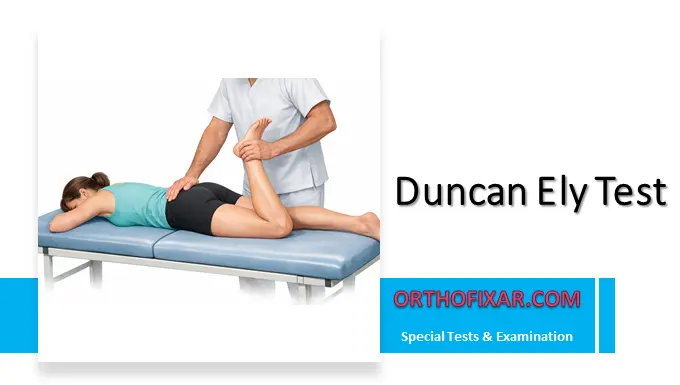
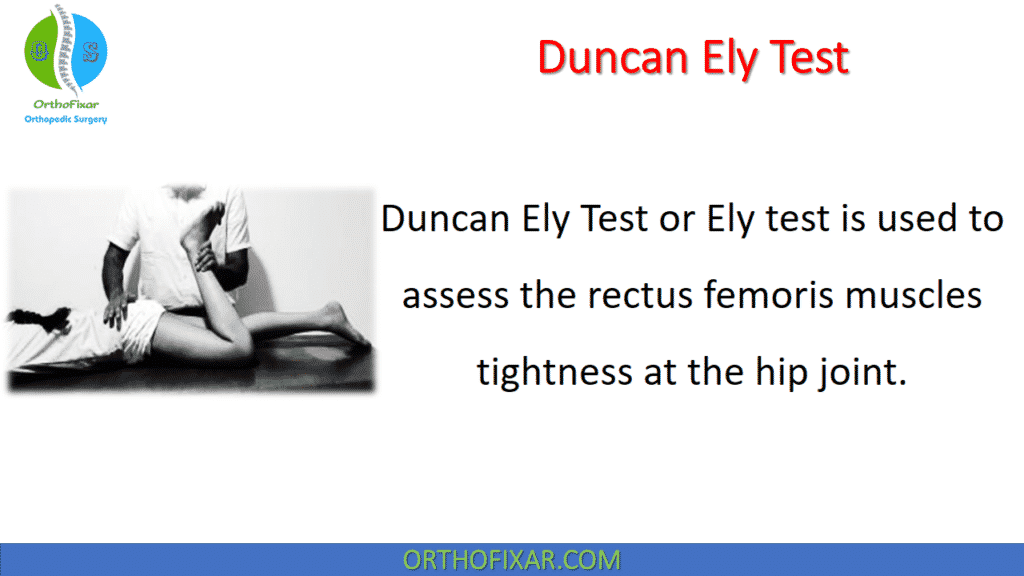
The Duncan Ely Test, also known as the Ely Test, is a widely used clinical examination in orthopedics and physical therapy to assess rectus femoris muscle tightness or spasticity. It is particularly relevant in evaluating patients with abnormal gait patterns, especially stiff-knee gait seen in neurological conditions such as Cerebral Palsy.
The Ely Test primarily evaluates the rectus femoris, a biarticular muscle that:
- Flexes the hip
- Extends the knee
Because it crosses both joints, tightness or spasticity in this muscle significantly affects knee flexion during gait, particularly in the swing phase.
How do you perform the Duncan Ely Test?
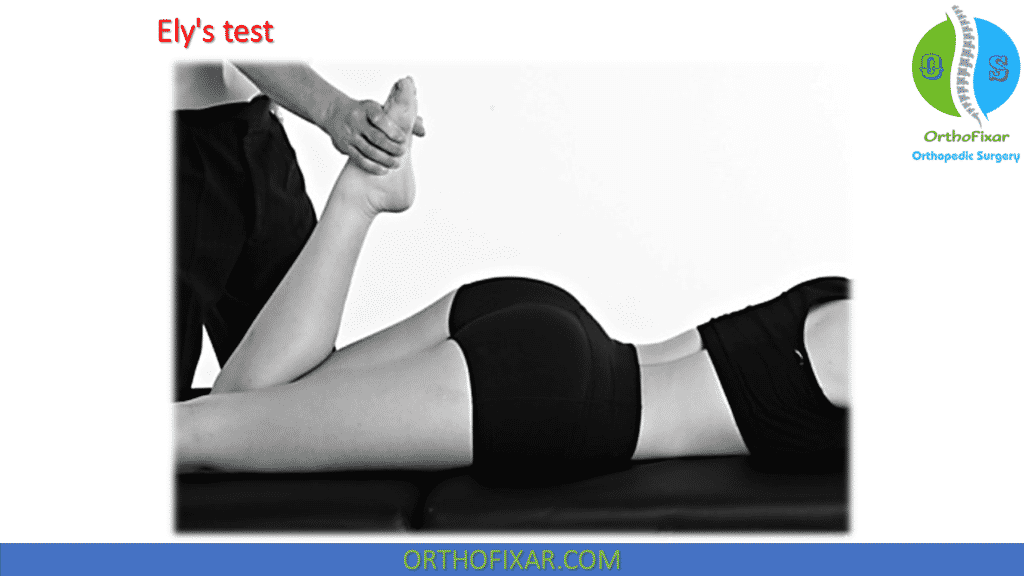
- The patient is positioned prone with knees kept in extension.
- Stabilize the patient’s pelvis (usually by placing a hand on the lower back).
- Grasp the patient’s ankle. Rapidly flex the knee, attempting to bring the heel toward the buttock.
- Compare both sides for symmetry.
Normally, there is no motion of the hip or pelvis while the knee flexes completely.
See Also: Thomas Test
What does a positive Ely Test Mean?
The test is considered positive if any of the following occur:
- Hip flexion or pelvic elevation during knee flexion
- Inability of the heel to reach the buttock
- Pain or resistance during movement
👉 This indicates:
- Rectus femoris tightness
- Or spasticity of the quadriceps muscle group
Test Reliability
The sensitivity and specificity of the Ely test were:
- Sensitivity: 56 to 59%.
- Specificity: 64-85%.
The Ely test was shown to have a good positive predictive value (i.e. the certainty about the presence of rectus spasticity in patients with a positive Ely test result) for rectus femoris dysfunction during gait.
Notes
The disadvantage of this test is that it is not specific for rectus femoris in patients with hip flexion contracture secondary to iliopsoas tightness.
Another method to assess the rectus femoris muscles tightness is the Rectus grab, where the patient is positioned supine, and the knee is rapidly flexed. If the examiner feels resistance to flexion, then the test is positive, and the rectus is spastic. The positive grab along with increased popliteal angle is an indication for distal hamstring lengthening with simultaneous rectus femoris transfer.
Rectus Femoris muscle crosses two joints, namely the hip and knee joints, and it acts as a flexor of the hip at the initial swing and an extensor of the knee. Normally, the knee flexes up to 60° in early swing. This knee flexion might get restricted in rectus tightness, which leads to difficulty in clearing the foot during the swing phase.
Clinical Tips
- Always stabilize the pelvis to avoid false positives
- Perform the test bilaterally for comparison
- Use in conjunction with:
- Gait analysis
- Electromyography (EMG)
- Other muscle length tests
Related Anatomy
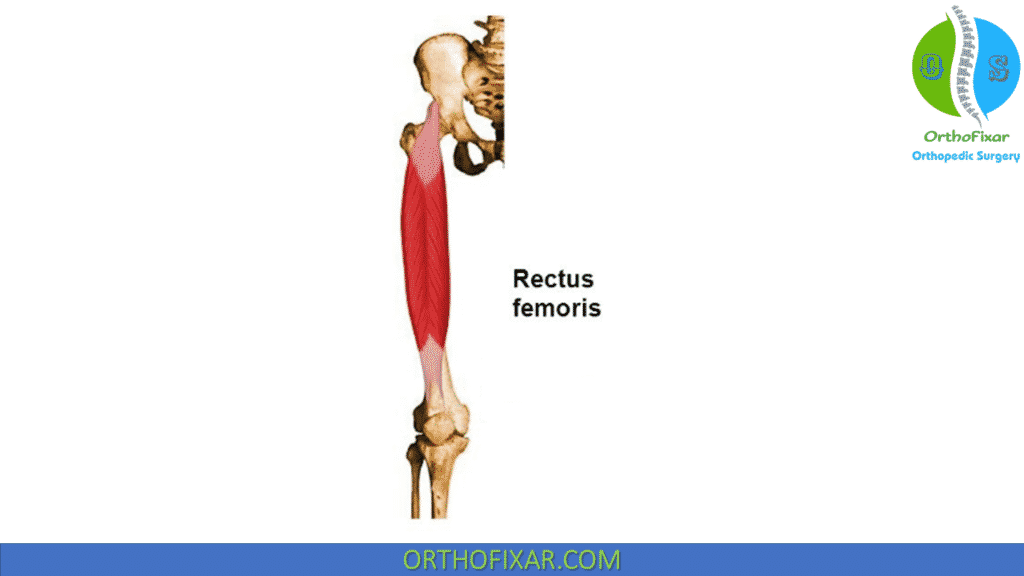
The rectus femoris muscle, one of the four quadriceps muscles, is a two-joint muscle that arises from two tendons: one, the anterior or straight, from the anterior inferior iliac spine (AIIS); the other, the posterior or reflected, from a groove above the brim of the acetabulum.
The rectus femoris combines movements of flexion at the hip and extension at the knee. It functions more effectively as a hip flexor when the knee is flexed, as when a person kicks a ball.
The line of pull of the rectus femoris, with respect to the patella, is at an angle of about 5 degrees with the femoral shaft.
See Also:
References
- Marks MC, Alexander J, Sutherland DH, Chambers HG. Clinical utility of the Duncan-Ely test for rectus femoris dysfunction during the swing phase of gait. Dev Med Child Neurol. 2003 Nov;45(11):763-8. doi: 10.1017/s0012162203001415. PMID: 14580132.
- Lee, S.Y., Sung, K.H., Chung, C.Y., Lee, K.M., Kwon, S.-S., Kim, T.G., Lee, S.H., Lee, I.H. and Park, M.S. (2015), Reliability and validity of the Duncan-Ely test for assessing rectus femoris spasticity in patients with cerebral palsy. Dev Med Child Neurol, 57: 963-968. https://doi.org/10.1111/dmcn.12761
- The line of pull of the rectus femoris, with respect to the patella, is at an angle of about 5 degrees with the femoral shaft.
- Dutton’s Orthopaedic Examination, Evaluation, And Intervention 3rd Edition.