The Dix Hallpike maneuver is a bedside diagnostic test used to identify benign paroxysmal positional vertigo (BPPV), the most common cause of peripheral vertigo. It remains the gold standard test for posterior canal BPPV, enabling clinicians to distinguish benign vestibular disorders from serious central causes of vertigo.
Benign positional paroxysmal vertigo (BPPV) is one of the most common causes of vertigo, where patients experience vertigo in brief episodes lasting less than 1 minute, triggered by changes in head position and return to total normalcy between episodes. It affects approximately 2.4% of the population during their lifetime.
Clinical Importance
The Dix Hallpike maneuver is essential because:
- It differentiates peripheral vertigo (BPPV) from central causes (e.g., stroke)
- It allows rapid bedside diagnosis
- It enables immediate treatment using repositioning maneuvers (e.g., Epley)
Failure to correctly evaluate vertigo may miss serious pathology—up to 15% of ED vertigo cases have life-threatening causes.
Anatomical Basis
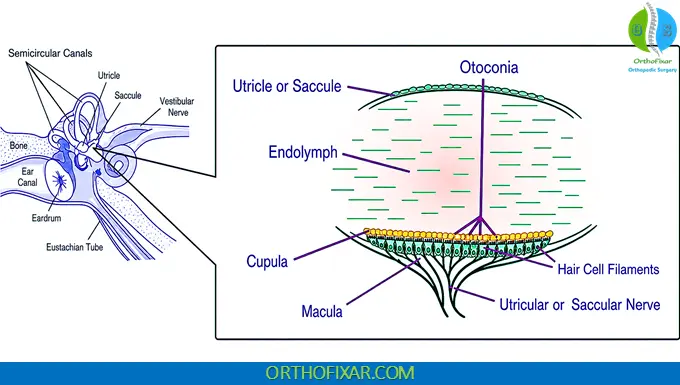
BPPV occurs due to displaced otoliths (calcium carbonate crystals) within the semicircular canals, most commonly the posterior canal (85–95%).
When the head moves, these particles shift, causing abnormal stimulation of hair cells → false sensation of rotation (vertigo).
How to Perform the Dix Hallpike Maneuver Test?
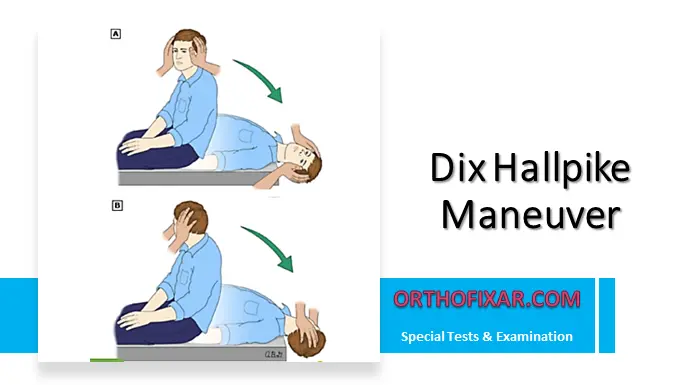
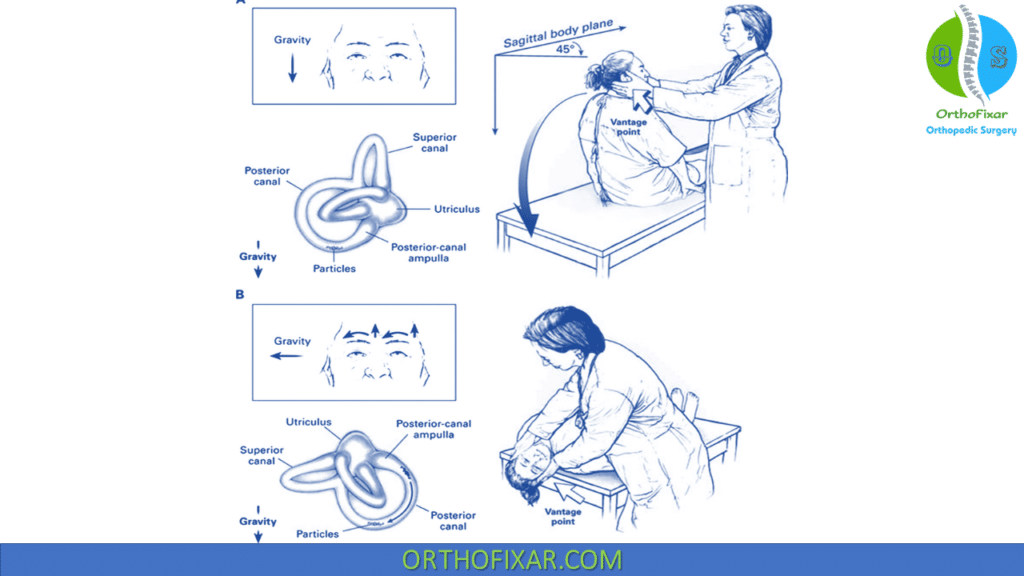
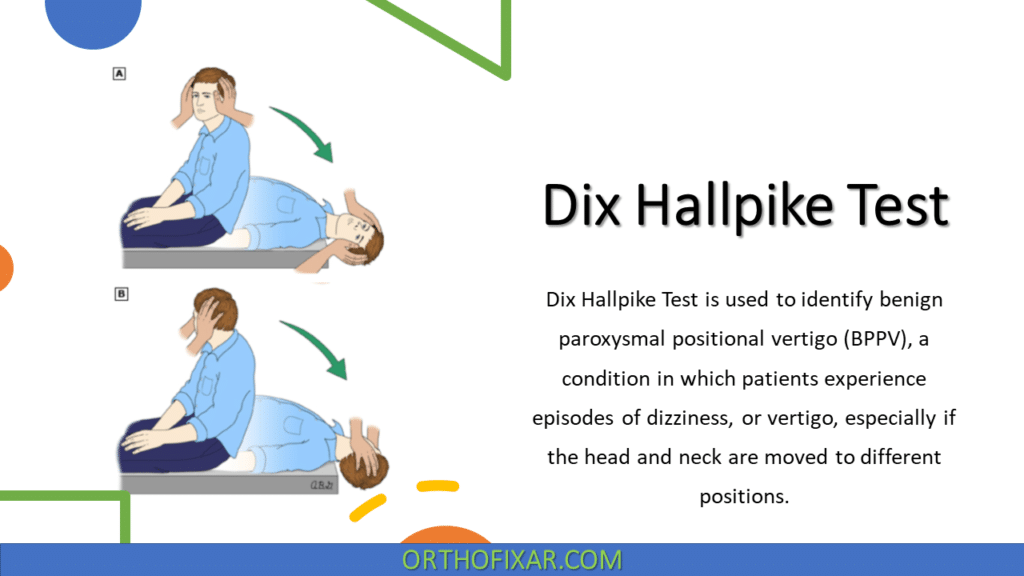
- The Dix Hallpike Test is performed by having the patient long-sit on a plinth with the head rotated approximately 30° to 45°.
- The examiner stands behind the patient with one hand supporting the head/ neck and the other hand supporting the trunk.
- The patient is then assisted into a supine position with the patient’s head slightly below the horizontal plane, and the position is maintained for 30 to 60 seconds.
- The test is performed with the head rotated to both sides starting with the unaffected side.
- Observe for Nystagmus Vertigo symptoms.
See Also: Coordination Tests
What does a positive Dix Hallpike Maneuver mean?
Signs of dizziness and nystagmus (involuntary eye movement) are considered a positive test. The affected ear is the ear closest to the examiner (i.e., lower ear).
Characteristic Nystagmus
- Torsional (rotatory)
- Up-beating
- Directed toward the affected ear
Interpretation
| Finding | Interpretation |
|---|---|
| Torsional + up-beating nystagmus | Posterior canal BPPV |
| No nystagmus but symptoms present | Possible BPPV (repeat test) |
| Persistent or non-fatigable nystagmus | Suggests central cause |
| Down-beating nystagmus | Consider cerebellar pathology |
The Epley Maneuver and Semont Maneuver are exercises that may be prescribed to relieve the dizziness caused by benign paroxysmal positional vertigo (BPPV).
See Also: Balance Tests
Indications
Perform the Dix Hallpike maneuver in patients with:
- Episodic vertigo lasting <1 minute
- Symptoms triggered by:
- Rolling in bed
- Looking up/down
- Sudden head movement
- Symptom-free intervals between episodes
These features strongly suggest posterior canal BPPV.
Contraindications
The Dix Hallpike maneuver requires rapid neck extension and rotation, so avoid it in:
Absolute Contraindications
- Cervical spine instability
- Acute neck trauma
- Cervical disc prolapse
- Vertebrobasilar insufficiency
- Carotid sinus syncope
- Arnold–Chiari malformation
Relative Contraindications
- Severe cervical spondylosis
- Limited neck mobility
- Advanced rheumatoid arthritis
These conditions may require modified testing techniques.
Clinical Pearls
- Always rule out central vertigo before testing
- Use Frenzel or video goggles to enhance detection of nystagmus
- Warn patients about transient vertigo and nausea
- Positive test → proceed directly to Epley maneuver
References & More
- Orthopedic Physical Assessment by David J. Magee, 7th Edition.
- Talmud JD, Coffey R, Hsu NM, et al. Dix-Hallpike Maneuver. [Updated 2023 Jul 19]. In: StatPearls [Internet]. Treasure Island (FL): StatPearls Publishing; 2024 Jan-. Available from: Pubmed
- Talmud JD, Coffey R, Hsu NM, Edemekong PF. Dix-Hallpike Maneuver. 2023 Jul 19. In: StatPearls [Internet]. Treasure Island (FL): StatPearls Publishing; 2024 Jan–. PMID: 29083696. Pubmed
- Brandt T, Strupp M. General vestibular testing. Clin Neurophysiol. 2005 Feb;116(2):406-26. doi: 10.1016/j.clinph.2004.08.009. PMID: 15661119. Pubmed
- Evren C, Demirbilek N, Elbistanlı MS, Köktürk F, Çelik M. Diagnostic value of repeated Dix-Hallpike and roll maneuvers in benign paroxysmal positional vertigo. Braz J Otorhinolaryngol. 2017 May-Jun;83(3):243-248. doi: 10.1016/j.bjorl.2016.03.007. Epub 2016 Apr 22. PMID: 27170347; PMCID: PMC9444768. Pubmed