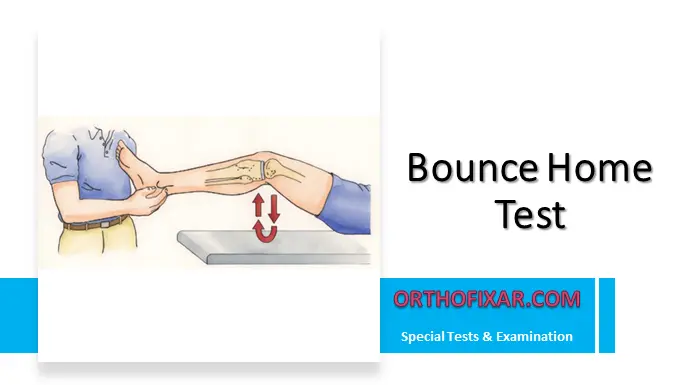
The Bounce Home Test is used to assess intra-articular pathology of the knee, particularly meniscal tears. It evaluates the ability of the knee to achieve full passive extension and the quality of the end feel during extension.
The Bounce Home Test is designed to detect:
- Mechanical blocks to full knee extension
- Suspected meniscal tears, especially bucket-handle lesions
- Other intra-articular obstructions such as loose bodies (less common).
See Also: Knee Meniscus Tear
How to Perform the Bounce Home Test?
- The patient lies in the supine position on the examination table. Both lower limbs should be relaxed, with the quadriceps fully at rest.
- The examiner stands at the foot of the examination table. One hand cups the heel of the patient’s foot, allowing full control of the lower limb. The examiner does not apply force to the tibia or femur other than guiding motion.
- The examiner passively fully flexes the patient’s knee. The knee is then passively allowed to extend, either slowly and smoothly or in one quick, relaxed movement (as described by Oni)
- The patient must remain relaxed throughout the maneuver.
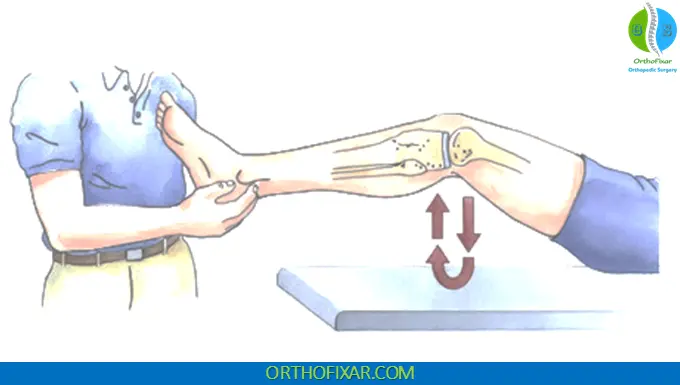
Positive Bounce Home Test Findings
The Bounce Home Test is considered positive if one or more of the following are present:
- Incomplete knee extension
- A rubbery or springy end feel (“springy block”)
- Sharp pain occurring at the joint line during extension
- Pain that may radiate up or down the leg when the knee is allowed to extend quickly.
Clinical Interpretation
- A springy block to extension strongly suggests mechanical obstruction within the knee.
- The most common cause of this block is a torn meniscus.
- Bucket-handle meniscal tears are particularly associated with loss of extension.
- Sudden pain during rapid extension further increases suspicion of a meniscal lesion.
Limitations of the Test
- The test is not specific to meniscal tears alone.
- Pain inhibition or guarding may affect results.
- This test should always be interpreted in conjunction with:
- McMurray Test
- Thessaly Test
- Joint line tenderness
- Imaging when indicated
References & More
- Orthopedic Physical Assessment by David J. Magee, 7th Edition.
- Oni O. The knee jerk test for diagnosis of torn meniscus. Clin Orthop. 1985;193:309. PubMed