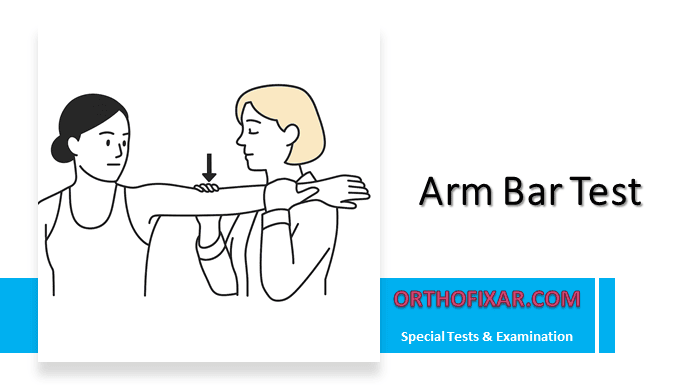
The Arm Bar Test, also known as the Posteromedial Impingement Test, is used to evaluate posterior impingement syndrome in the elbow joint. This condition commonly affects athletes involved in overhead throwing activities, where repetitive extension and valgus stress can lead to impingement of the posteromedial aspect of the olecranon against the olecranon fossa.
How to Perform the Arm Bar Test?
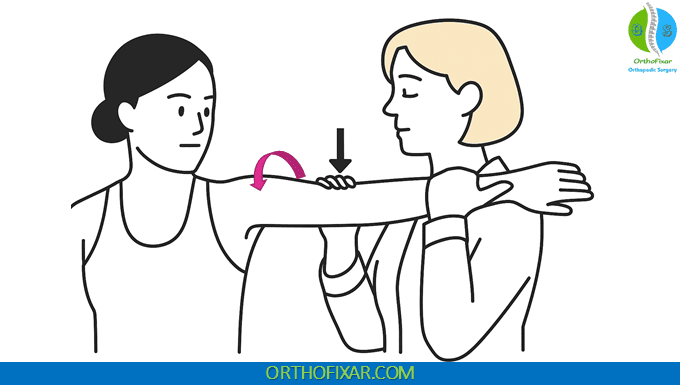
The patient stands upright and places the hand of the affected arm on the examiner’s shoulder. The positioning is crucial for accurate testing:
- Elbow: Fully extended
- Shoulder: Medially rotated
- Thumb orientation: Pointing downward
The examiner applies a downward force on either:
- The olecranon process, or
- The distal humerus
This maneuver simulates forced elbow extension, recreating the mechanical stress that occurs during the late cocking and early acceleration phases of throwing.
See Also: Elbow Anatomy
What does a Positive Arm Bar Test Mean?
A positive Arm Bar Test is indicated by:
- Pain reproduction: Particularly along the posteromedial aspect of the olecranon
- Location specificity: Pain should be localized to the posterior and medial regions of the elbow
- Quality of pain: Often described as deep, aching discomfort
Patients with posterior impingement may also demonstrate:
- Limited extension: Inability to achieve full elbow extension
- Extension lag: Mechanical block to complete extension due to impingement
Clinical Significance
The Arm Bar Test helps identify posterior impingement, which results from:
- Repetitive microtrauma during overhead activities
- Impingement between the olecranon tip and the olecranon fossa
- Associated with valgus extension overload syndrome in throwing athletes
Diagnostic Considerations
While a positive test suggests posterior impingement, clinicians should consider:
- Differential diagnosis: Rule out other causes of posterior elbow pain
- Imaging correlation: Plain radiographs may show olecranon spurring or loose bodies
- Functional assessment: Evaluate throwing mechanics and overhead activities
Clinical Pearls
- The test is most sensitive when the shoulder is properly positioned in medial rotation
- Pain should be specific to the posteromedial olecranon region rather than diffuse elbow discomfort
- Consider the patient’s activity level and sport participation when interpreting results
- A negative test does not completely rule out posterior impingement, as symptoms may be position-dependent
The Arm Bar Test serves as a valuable screening tool in the clinical assessment of posterior elbow impingement, particularly in overhead athletes presenting with posterior elbow pain and extension limitations.
References & More
- Zwerus EL, Somford MP, Maissan F, et al. Physical examination of the elbow, what is the evidence? A systematic literature review. Br J Sports Med. 2017;51:1–9. PubMed
- Redler LH, Watling JP, Ahmad CS. Five points on physical examination of the throwing athlete’s elbow. Am J Orthop. 2015;44(1):13–18. PubMed
- Hsu SH, Moen TC, Levine WN, et al. Physical examination of the athlete’s elbow. Am J Sports Med. 2012;40:699–708. PubMed
- Orthopedic Physical Assessment by David J. Magee, 7th Edition.