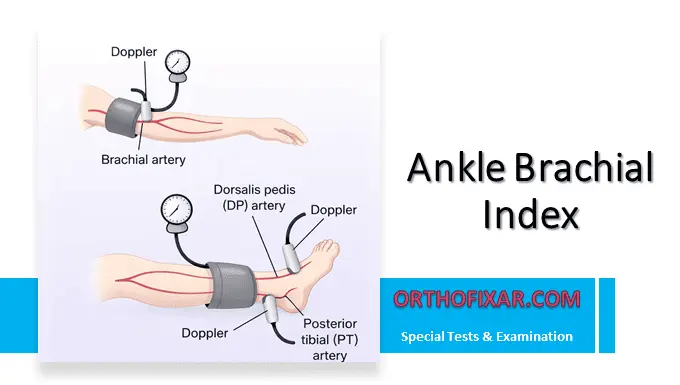
The ankle brachial index test (ABI test) is a simple, reliable, and noninvasive bedside test used to diagnose peripheral arterial disease (PAD) and assess systemic atherosclerotic burden. It compares systolic blood pressure at the ankle with that of the arm, providing a quantitative measure of lower extremity arterial perfusion.
An ABI value below 0.90 is considered abnormal and is strongly associated with PAD, increased cardiovascular risk, and all-cause mortality.
What Is the Ankle Brachial Index?
The ankle–brachial index is defined as the ratio of the systolic blood pressure at the ankle to the systolic blood pressure at the brachial artery.
Because PAD is a manifestation of systemic atherosclerosis, ABI testing evaluates not only limb ischemia but also overall cardiovascular risk.
See Also: Radial Pulse Location
Why the ABI Matters in Peripheral Arterial Disease
Peripheral arterial disease affects millions worldwide and is frequently underdiagnosed, particularly in asymptomatic patients. ABI testing allows clinicians to:
- Detect PAD before critical ischemia develops
- Stratify cardiovascular risk
- Guide early preventive and therapeutic interventions
An abnormal ABI is associated with:
- Myocardial infarction
- Stroke
- Cardiovascular mortality
Importantly, PAD is often silent; ABI provides objective evidence even in patients without classic claudication.
Indications for ABI Testing
Patients at Increased Risk (ACCF/AHA Recommendations)
ABI measurement is recommended in patients with:
- Age ≥65 years
- Age ≥50 years with:
- Diabetes mellitus
- History of smoking
- Exertional leg symptoms
- Nonhealing lower extremity wounds
- Known atherosclerotic disease (coronary, carotid, renal)
Screening Controversy: USPSTF Position
The U.S. Preventive Services Task Force (USPSTF) does not recommend routine PAD screening in asymptomatic adults, citing insufficient evidence to determine the balance of benefits and harms (I statement).
In contrast, ACCF/AHA practice guidelines support ABI measurement in at-risk populations, emphasizing its role in cardiovascular risk reduction rather than mass screening.
Equipment Required for ABI Measurement
- Blood pressure cuffs (appropriate size)
- Handheld vascular Doppler ultrasound
- Ultrasound gel
- Sphygmomanometer
- Quiet, warm examination room
Patient Preparation Before ABI Test
Proper preparation improves accuracy:
- Patient rests supine for at least 10 minutes
- Warm environment to prevent vasoconstriction
- Avoid smoking, caffeine, or exercise before testing
- Remove tight clothing from arms and ankles
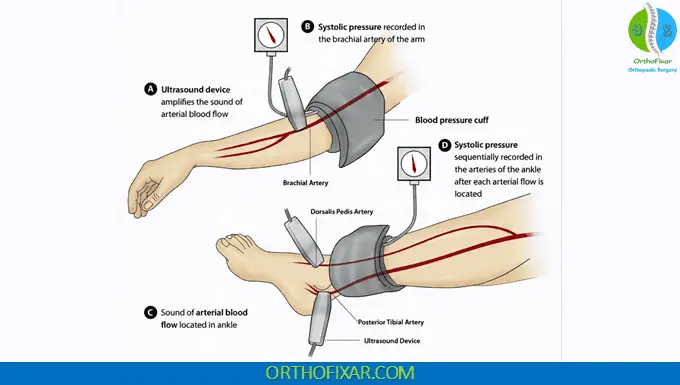
Measuring Brachial Systolic Pressure
- Place blood pressure cuffs on both arms
- Use Doppler to locate the brachial artery pulse
- Inflate the cuff 20 mmHg above the last audible pulse
- Slowly deflate and record the pressure at which the pulse reappears
- Obtain two readings per arm
- Average the values for each arm
Measuring Ankle Systolic Pressure
- Place cuffs just above the malleoli
- Use Doppler to identify:
- Inflate the cuff 20 mmHg above pulse disappearance
- Slowly deflate and record systolic pressure
- Obtain two readings per artery per leg
- Average the values
How to Calculate the Ankle Brachial Index
ABI Formula
- Right ABI
Highest averaged ankle pressure (DP or PT) ÷ highest averaged brachial pressure (right or left) - Left ABI
Highest averaged ankle pressure (DP or PT) ÷ highest averaged brachial pressure (right or left)
Online and office-based ABI calculators may be used to reduce calculation errors.
Interpretation of ABI Values
| ABI Value | Interpretation |
|---|---|
| 0.90–1.30 | Normal |
| 0.60–0.89 | Mild PAD |
| 0.40–0.59 | Moderate PAD |
| <0.39 | Severe PAD |
| >1.30 | Noncompressible arteries (arterial calcification) |
ABI values above 1.30 suggest stiff, calcified arteries, commonly seen in diabetes mellitus and chronic kidney disease, requiring alternative testing such as the toe–brachial index (TBI).
Diagnostic Accuracy of the ABI
The ABI is highly specific and reproducible:
- Specificity: ~99%
- Sensitivity: 15–20%
- Positive predictive value: >80%
- Negative predictive value: >80%
Despite modest sensitivity in early disease, it’s extremely high specificity makes an abnormal ABI strongly diagnostic for PAD.
Limitations and Pitfalls of ABI Test
- Reduced sensitivity in early PAD
- False-normal values in arterial calcification
- Noncompressible arteries in diabetes and CKD
- Operator-dependent technique
ABI should be interpreted in the context of symptoms and clinical findings.
Management of Patients With Abnormal ABI
First-Line Therapy (ACCF/AHA Guidelines)
For patients with PAD and intermittent claudication:
- Supervised exercise therapy (strongly recommended)
- Smoking cessation
- Lipid-lowering therapy
- Optimal blood pressure and glycemic control
- Antiplatelet therapy
Randomized clinical trials show significantly greater pain-free walking distance with supervised exercise compared to unsupervised programs.
Additional Management Strategies
- Meticulous foot care
- Proper footwear, especially in diabetic patients
- Revascularization in selected cases
- Multidisciplinary vascular care
ABI in Clinical Practice: Key Takeaways
- ABI Test is a powerful bedside diagnostic tool
- Identifies PAD and predicts cardiovascular risk
- Simple, inexpensive, and office-friendly
- Best used in patients at increased risk
- Should guide early preventive intervention
FAQ
What is a normal ankle brachial index?
A value between 0.90 and 1.30 is considered normal.
Is the ABI test reliable?
Yes. It is highly reproducible with a specificity of approximately 99%.
Can ABI be performed in the office?
Absolutely. It requires minimal equipment and training.
Why can ABI be falsely elevated in diabetes?
Medial arterial calcification prevents full vessel compression.
When is toe–brachial index preferred?
When ABI is >1.30 or arteries are noncompressible.
References & More
- McClary KN, Massey P. Ankle Brachial Index. [Updated 2023 Jan 16]. In: StatPearls [Internet]. Treasure Island (FL): StatPearls Publishing; 2025 Jan-. Available from: Pubmed
- Cáceres-Farfán L, Moreno-Loaiza M, Cubas WS. Ankle-brachial index: more than a diagnostic test? Arch Peru Cardiol Cir Cardiovasc. 2021 Dec 31;2(4):254-262. doi: 10.47487/apcyccv.v2i4.168. PMID: 37727667; PMCID: PMC10506545. Pubmed
- Guirguis-Blake JM, Evans CV, Redmond N, et al. Screening for Peripheral Artery Disease Using the Ankle-Brachial Index: An Updated Systematic Review for the U.S. Preventive Services Task Force [Internet]. Rockville (MD): Agency for Healthcare Research and Quality (US); 2018 Jul. (Evidence Synthesis, No. 165.) 1, Introduction. Available from: Pubmed
- Bickley, L. S., Szilagyi, P. G., Hoffman, R. M., & Soriano, R. P. (2021). Bates’ guide to physical examination and history taking, 12e.
- American College of Cardiology Foundation / American Heart Association (ACCF/AHA) PAD Guidelines