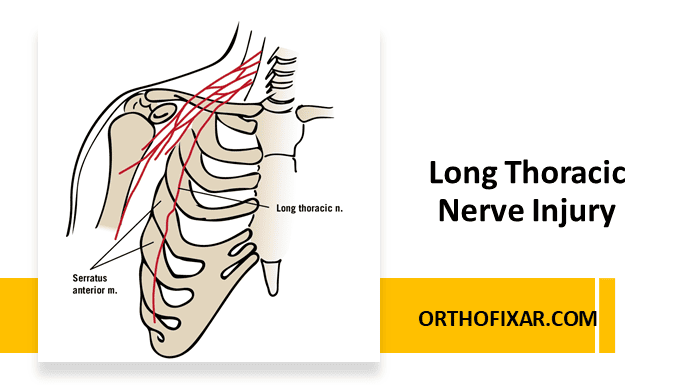
Long Thoracic Nerve Injury is an uncommon but significant etiology for scapular dysfunction. This nerve is mainly derived from the C5, C6, and C7 roots of the brachial plexus, and it supplies the serratus anterior muscle, which is essential for protraction and stabilization of the scapula against the thoracic wall.
Etiology of Long Thoracic Nerve Injury
The injury to the long thoracic nerve might occur through:
- Repeated microtrauma from continuous overhead activities (e.g., labor, weightlifting, sports)
- Weight on your shoulders, such as with backpacks or shoulder straps
- Sudden traction injuries (e.g. arm in hyperabduction) or blunt trauma
- Penetrating wounds in the lateral thoracic wall or axilla
Common mechanisms include vigorous upper limb exertion (shoveling, chopping wood, or forceful stretching) and less frequently, iatrogenic causes such as surgical procedures in the axillary region.
Symptoms & Sign
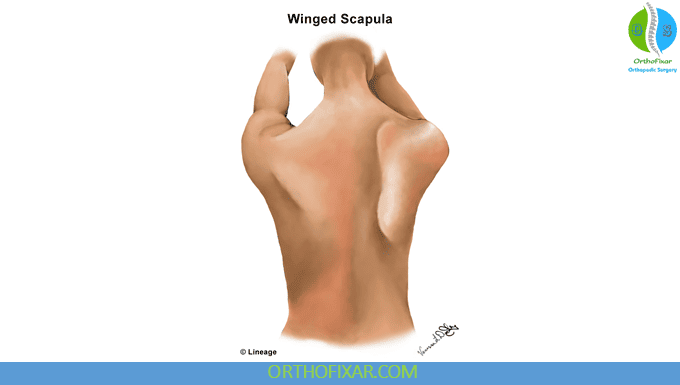
The hallmark of long thoracic nerve injury is the serratus anterior muscle paralysis which results in:
- Scapular winging, characterized by medial border prominence when the patient pushes against resistance (e.g., wall push-up test).
- Weakness and pain during forward flexion of the extended arm.
- Difficulty elevating the arm above 90° due to impaired scapular upward rotation and stabilization
See Also: Scapular Winging Test
Diagnosis
The Long Thoracic Nerve Injury Diagnosis is done by:
- Observation of scapular winging during active movements
- Electromyography (EMG) to confirm denervation of serratus anterior and rule out other neuropathies (e.g., spinal accessory nerve injury)
- Imaging (e.g., MRI) when structural lesions or compressive masses are suspected
Prognosis and Management
Most cases of Long Thoracic Nerve Injury improve with conservative treatment, including activity modification, scapular stabilization exercises, and physiotherapy. Recovery can be protracted, often taking up to 2 years for full reinnervation. In persistent cases with functional impairment beyond 12–24 months, surgical options such as muscle transfer procedures (pectoralis major transfer) may be considered.
Key Points for Practice
- Recognize the association with repetitive overhead or heavy-load activities
- Distinguish long thoracic nerve injury from other causes of scapular winging (e.g., spinal accessory nerve palsy, dorsal scapular nerve injury)
- Counsel patients on the prolonged recovery course and importance of rehabilitation
References & More
- Safran MR. Nerve injury about the shoulder in athletes, part 2: long thoracic nerve, spinal accessory nerve, burners/stingers, thoracic outlet syndrome. Am J Sports Med. 2004 Jun;32(4):1063-76. doi: 10.1177/0363546504265193. PMID: 15150060. Pubmed
- Aval SM, Durand P Jr, Shankwiler JA. Neurovascular injuries to the athlete’s shoulder: Part I. J Am Acad Orthop Surg. 2007 Apr;15(4):249-56. doi: 10.5435/00124635-200704000-00008. PMID: 17426296. Pubmed
- Orthopedic Physical Assessment by David J. Magee, 7th Edition.