A complete blood count (CBC) is one of the most frequently ordered lab tests in medicine, and it appears in almost every clinical scenario you will encounter as a student. It measures red blood cells, white blood cells, and platelets, giving a fast snapshot of oxygen delivery, immune activity, and clotting capacity. This guide gives you a clear, repeatable method for Complete Blood Count Interpretation so you can move from raw numbers to useful clinical meaning.
Why Complete Blood Count Interpretation Is a Core Skill
A CBC is cheap, fast, and widely available, which is exactly why it is ordered so often. That frequency also makes it easy to skim past abnormal values.
Strong interpretation skills help you spot anemia, infection, inflammation, and bleeding risk before other tests come back.
- It guides the very first clinical decisions, such as whether to transfuse, culture, or observe.
- It helps you decide which follow-up test is worth ordering next.
- It teaches pattern recognition, which is the foundation of clinical reasoning.
- It appears constantly on exams, so fluency saves you time and stress.
- It builds confidence when you present patients during rounds.
What a CBC Actually Measures
A standard CBC reports three cell lines, and each line answers a different clinical question. When you interpret a CBC, always read the three lines separately before you try to connect them.
The Red Blood Cell Line
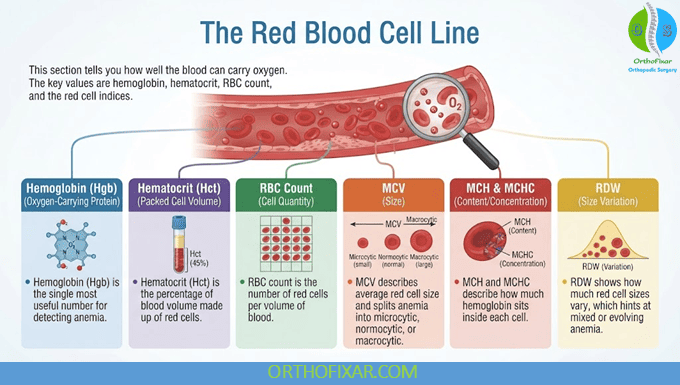
This section tells you how well the blood can carry oxygen. The key values are hemoglobin, hematocrit, RBC count, and the red cell indices.
- Hemoglobin (Hgb) is the single most useful number for detecting anemia.
- Hematocrit (Hct) is the percentage of blood volume made up of red cells.
- RBC count is the number of red cells per volume of blood.
- MCV describes average red cell size and splits anemia into microcytic, normocytic, or macrocytic.
- MCH and MCHC describe how much hemoglobin sits inside each cell.
- RDW shows how much red cell sizes vary, which hints at mixed or evolving anemia.
The White Blood Cell Line
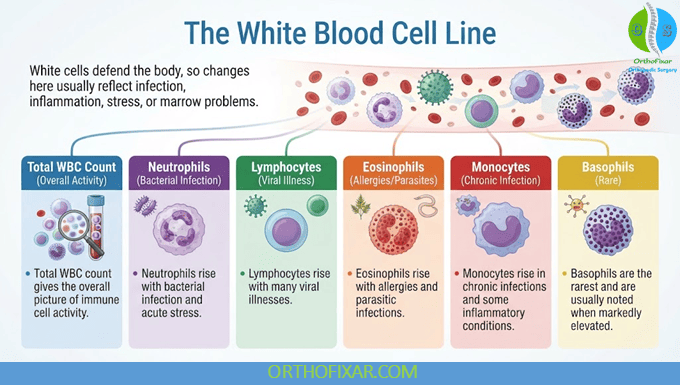
White cells defend the body, so changes here usually reflect infection, inflammation, stress, or marrow problems.
- Total WBC count gives the overall picture of immune cell activity.
- Neutrophils rise with bacterial infection and acute stress.
- Lymphocytes rise with many viral illnesses.
- Eosinophils rise with allergies and parasitic infections.
- Monocytes rise in chronic infections and some inflammatory conditions.
- Basophils are the rarest and are usually noted when markedly elevated.
The Platelet Line
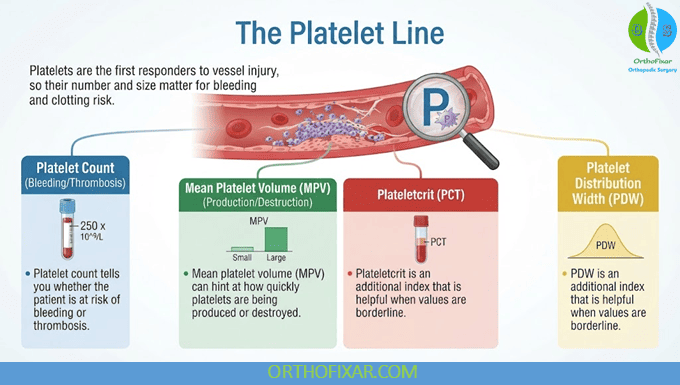
Platelets are the first responders to vessel injury, so their number and size matter for bleeding and clotting risk.
- Platelet count tells you whether the patient is at risk of bleeding or thrombosis.
- Mean platelet volume (MPV) can hint at how quickly platelets are being produced or destroyed.
- Plateletcrit and PDW are additional indices that are helpful when values are borderline.
CBC Reference Values at a Glance
Reference ranges differ slightly between laboratories, so always use the range printed on the report you are reading. The table below shows typical adult values for orientation only.
| Test | What It Reflects | Typical Adult Range | When High | When Low |
|---|---|---|---|---|
| Hemoglobin | Oxygen-carrying capacity | About 13.5–17.5 g/dL (men), 12.0–15.5 g/dL (women) | Polycythemia, dehydration, chronic hypoxia | Anemia, blood loss, marrow suppression |
| Hematocrit | Red cell volume fraction | About 41–53% (men), 36–46% (women) | Dehydration, polycythemia | Anemia, overhydration, bleeding |
| MCV | Average red cell size | About 80–100 fL | B12 or folate deficiency, alcohol, hypothyroidism | Iron deficiency, thalassemia, chronic disease |
| MCH | Hemoglobin per red cell | About 27–33 pg | Macrocytosis | Iron deficiency, thalassemia |
| WBC count | Immune cell activity | About 4.0–11.0 ×10⁹/L | Infection, inflammation, stress, leukemia | Viral illness, marrow failure, drug effect |
| Neutrophils | Bacterial defense | About 40–70% of WBCs | Bacterial infection, steroids, stress | Viral infection, chemotherapy, autoimmune disease |
| Lymphocytes | Viral and immune response | About 20–45% of WBCs | Viral illness, chronic lymphocytic leukemia | Steroids, HIV, severe stress |
| Platelets | Primary hemostasis | About 150–450 ×10⁹/L | Reactive thrombocytosis, inflammation, iron deficiency | Immune destruction, marrow failure, drugs, sepsis |
A Step-by-Step Approach to Complete Blood Count Interpretation
Follow the same order every time, and your reading becomes fast and reliable. The sequence below works well for both real patients and exam questions.
Step 1: Confirm the Reference Range
- Check the laboratory’s own range, because units and thresholds vary.
- Note the patient’s age, sex, and pregnancy status, since each shifts normal values.
- Compare against the patient’s own previous results when they exist.
Step 2: Look at Hemoglobin and Hematocrit First
- Decide within seconds whether the patient is anemic, normal, or polycythemic.
- Remember that hematocrit usually tracks hemoglobin at roughly three times its value.
- Consider hydration status, because dehydration can mask anemia.
Step 3: Classify with the MCV
- Low MCV points toward iron deficiency, thalassemia, or chronic disease.
- Normal MCV points toward acute blood loss, kidney disease, or anemia of chronic disease.
- High MCV points toward B12 or folate deficiency, alcohol use, or hypothyroidism.
Step 4: Review the WBC and Differential
- Ask whether the total count is high, normal, or low.
- Then ask which cell line is responsible for the change.
- A left shift with immature forms suggests an acute process rather than a chronic one.
Step 5: Check the Platelets Last
- Confirm the count is truly low rather than a clumping artifact.
- Look for a pattern alongside the other cell lines, which can suggest marrow involvement.
- Ask whether the patient has any bleeding or bruising that fits the number.
Treat every CBC as a set of trends rather than a single snapshot, because one value rarely tells the whole story.
Common Patterns Students Should Recognize
Pattern recognition is where interpretation becomes genuinely useful. The combinations below cover most routine situations.
- Microcytic anemia with high RDW: most often iron deficiency.
- Microcytic anemia with normal RDW: consider thalassemia trait.
- Macrocytic anemia with low B12: suspect deficiency or malabsorption.
- High neutrophils with a left shift: think bacterial infection.
- High lymphocytes with normal neutrophils: think viral illness.
- Pancytopenia: low red cells, white cells, and platelets together raise concern for marrow disease.
- Isolated thrombocytopenia: often immune-mediated, drug-related, or infectious.
- Elevated hemoglobin with high hematocrit: consider dehydration before diagnosing polycythemia.
Pitfalls That Trip Up Students
Even careful readers make avoidable mistakes. Knowing the traps in advance keeps your interpretation honest.
- Reading numbers without the clinical context, which leads to overdiagnosis.
- Ignoring hydration status, which can hide or exaggerate anemia.
- Forgetting that pregnancy, altitude, and smoking shift normal values.
- Overreading a single mildly abnormal value in an otherwise healthy patient.
- Failing to check whether a low platelet count is a clumping artifact.
- Assuming a normal CBC rules out serious illness.
- Using adult ranges for children, who have genuinely different norms.
Clinical correlation is not an optional extra in Complete Blood Count Interpretation; it is the step that turns numbers into decisions.
How to Practise and Get Faster
Interpretation improves with repetition, and there are simple ways to build that repetition deliberately.
- Read five CBCs a day and write one sentence of interpretation for each.
- Cover the diagnosis and predict it from the CBC alone, then check yourself.
- Compare old and new results for the same patient to learn how trends move.
- Build a personal one-page summary of reference ranges you use most.
- Present CBC findings out loud to practise clear, concise communication.
- Review cases where your prediction was wrong, since those teach the most.
Conclusion
Complete Blood Count Interpretation becomes manageable once you follow a consistent order: confirm the ranges, check hemoglobin and hematocrit, classify with the MCV, review the differential, and finish with platelets. Each cell line answers a distinct question, and the real insight comes from combining the pattern with the patient in front of you. Practise deliberately, respect the clinical context, and treat trends as more meaningful than isolated numbers. With time, reading a CBC will feel less like decoding and more like reading a short, familiar story.
Frequently Asked Questions
What does a complete blood count actually measure?
A CBC measures the number, size, and some physical characteristics of red blood cells, white blood cells, and platelets. It reports hemoglobin, hematocrit, red cell indices, a total white cell count with an optional differential, and a platelet count. Together these values describe oxygen delivery, immune activity, and clotting capacity.
Which value in a CBC is the most important?
There is no single most important value, but hemoglobin is usually read first because it answers whether the patient can carry enough oxygen. After that, the MCV and the white cell differential add the most clinical information. Platelets complete the picture by addressing bleeding risk.
How do I know whether a CBC result is abnormal?
Compare each value against the reference range printed on the report, because ranges differ between laboratories and populations. Then judge how far outside the range the value sits and whether it fits the clinical picture. A mildly abnormal value in an otherwise well patient often means far less than a moderate abnormality in a sick one.
What does a high MCV mean?
A high MCV means the average red blood cell is larger than normal, which is called macrocytosis. Common causes include vitamin B12 deficiency, folate deficiency, alcohol use, hypothyroidism, and some medications. A high MCV is a prompt to look at the blood film and check vitamin levels.
What is the difference between a CBC and a CBC with differential?
A basic CBC reports counts and indices for the three cell lines. A CBC with differential adds a breakdown of the white cells into neutrophils, lymphocytes, monocytes, eosinophils, and basophils, either as percentages or absolute numbers. The differential is what allows you to distinguish bacterial from viral patterns.
Can a CBC diagnose anemia on its own?
A CBC can confirm that anemia is present and can classify it by cell size, but it rarely identifies the exact cause by itself. Iron studies, vitamin levels, a blood film, and the clinical history are usually needed. Think of the CBC as the starting point rather than the answer.
Why does the white cell count rise during infection?
White cells, especially neutrophils, are recruited from the marrow and circulation to fight pathogens. That recruitment raises the measured count, often alongside immature forms known as a left shift. The pattern of which cell line rises helps narrow the likely cause.
What does a low platelet count mean?
A low platelet count means the patient has a higher risk of bruising and bleeding if the value falls far enough. Causes include increased destruction, reduced production in the marrow, consumption during illness, and drug effects. Always confirm the count is real rather than a clumping artifact before acting on it.
Can I interpret a CBC without the patient’s history?
You can describe the abnormalities, but you cannot interpret them meaningfully without context. Age, sex, pregnancy, hydration, medications, and recent illness all change how a value should be read. Always pair the numbers with the clinical picture before drawing conclusions.
How can students improve at Complete Blood Count Interpretation?
Practise with real reports regularly and write a short interpretation each time, then compare it with the final diagnosis or your supervisor’s reading. Focus on pattern recognition across the three cell lines rather than memorising individual numbers. Over time, this habit builds speed, accuracy, and genuine clinical confidence.