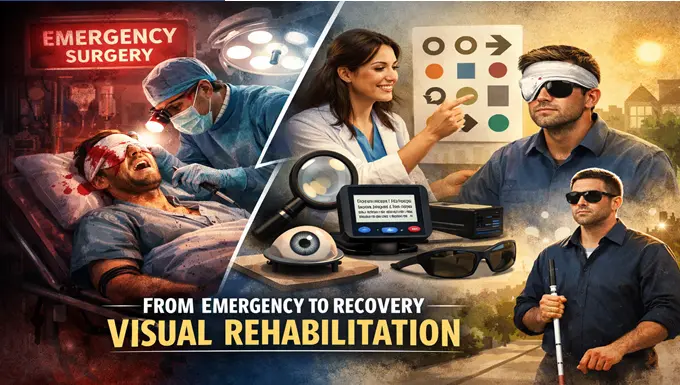
When you hear about a serious eye injury, your mind immediately jumps to something dramatic. Basically, you picture lots of blood, screaming, ERs, and an emergency surgery where they’re dealing with a frantic patient and are trying to save the eye before it’s too late. Very dramatic.
While there is SOME truth to this, and the initial medical care is very important, that’s only the beginning of the story.
The first thing to do is always to stabilize the eye and get it out of immediate danger. Then comes the next phase, which isn’t so much about medicine – it’s more about rebuilding the patient’s usable vision and building back their confidence, it’s about Visual Rehabilitation.
This article will focus on that ‘next phase’.
Turn Acute Care into Functional Recovery
When we’re at the ‘post-acute’ phase, this means that all the immediate medical risks are fully under control (the eye is stable). This means that the focus goes from immediate fixing to figuring out.
What this means is that rehabilitation doesn’t start until a few weeks or even months after the injury, once the ophthalmologist gives the okay that the eye is healed enough to start with the training.
The goal is different now, and the main purpose is to help the patient use their vision again in their daily life.
Usually, there’s a team of experts working together on this, and their work has 3 objectives:
- to protect the vision that remained.
- to prevent any further decline.
- to teach the patient new and practical ways to see.
This is a very personal process for the patient because the way they cope with the changes in their vision (are they frustrated, are they hopeful, etc.) has a big impact on how successful therapy is.
Naturally, some injuries are harder to recover from than others, and that has to be taken into account. If the damage is serious or jagged, the healing process is messy and pretty unpredictable. Complications (e.g., severe swelling, infection, etc.) are common, and what’s worse is that they can appear much later.
Because of this, the entire rehabilitation plan can’t be a straight path to be followed, but instead it needs to be highly adaptable. And it must be designed in such a way that any changes can be done super quickly – you don’t want to lose time here because even a short wait time could lead to impaired/lost sight.
Another important factor here is HOW the injury happened in the first place.
Injuries like a chemical splash, a sharp piece of wood hitting the eye, or a bite from a dog can all cause this kind of complicated damage that doesn’t heal quickly.
For the patient, it means they need to face a new reality.
Rehab teaches them new skills, but they also deal with lost work; they might have to deal with the circumstances of how the injury happened (e.g., it could’ve been a irresponsible dog owner who decided that walking their dog without a leash is a good idea.
In this case, the injured party will surely have to contact a dog bite eye injury lawyer to see how best to handle this case. It’s not just lost wages; it’s about accountability, plus don’t think that all this recovery isn’t expensive – someone must pay for it – and if you were attacked, then it definitely shouldn’t be you.
Main Elements of Visual Rehabilitation
Visual Rehabilitation doesn’t mean one treatment or one doctor.
The patient needs to be able to have a whole set of new tools and skills when they’re done, which means rehabilitation has to be very customized.
Visual Rehabilitation & Rebuilding Skills
In case the vision is impaired in some way, we then aren’t focusing on trying to make the eyes see more, but rather to work with what we currently have and train the brain to adapt.
A therapist will walk the patient through different exercises that were made specifically to improve the way the brain interprets the signals coming from the eyes. This work focuses on skills like judging distance and detecting contrast.
As effective and useful as this work is, it’s very important to be realistic.
These exercises don’t reverse the original injury, and the only goal is to make the most out of the vision the patient still has.
Optical Aids & Assistive Technology
This area covers all tools and devices that can improve the remaining vision for the patient.
There’s a lot to work with here, from simple handheld magnifiers to text-to-speech software. What the therapist chooses depends on what kind of injury the patient has suffered and on which tasks are the most important in their daily life.
Getting the right device is only step one, though.
You also have to teach the patient how to use the device for the device to be effective.
Prosthetics & Cosmetic Solutions
If the vision cannot be restored, then rehabilitation focuses on things like ocular prosthetics (e.g., artificial eye), which are designed to match the patient’s natural eye’s look and movement.
The purpose of this prosthetic is purely cosmetic as it provides no vision.
The patient needs to be educated/trained on how to use the prosthetics, plus there needs to be ongoing care in case there are any infections or issues with the device.
Conclusion
If you were to say, “Visual rehabilitation is basically about the patient learning to live their life in a new way”, you wouldn’t be wrong. It’s a process that’s slow and is oftentimes frustrating, and depending on the severity of eye damage, it could also change dramatically, because someone with impaired vision and someone with 100% lost vision have two COMPLETELY different lives ahead of them.
When you talk about visual rehabilitation success rates, we aren’t looking at restoring 20/20 vision. The focus lies in numerous small wins that add up to a huge success that will help rebuild independence and confidence in the patient.


555
555
555
555
555
if(now()=sysdate(),sleep(15),0)
1 waitfor delay ‘0:0:15’ —
4oRtmcPT’ OR 24=(SELECT 24 FROM PG_SLEEP(15))–
555’||DBMS_PIPE.RECEIVE_MESSAGE(CHR(98)||CHR(98)||CHR(98),15)||’