A clicking knee during walking is usually harmless and often reflects normal joint mechanics rather than damage. The sound you hear is typically gas shifting inside the joint, a tendon or ligament gliding over a bony landmark, or the kneecap tracking across the groove of the thigh bone. What matters far more than the click itself is whether it comes with pain, swelling, instability, or locking. This article explains the common reasons knees click when walking, how a clinician distinguishes harmless noise from a warning sign, and what you can realistically do about it.
What That Clicking Sound Actually Is
Most clicking is what clinicians call crepitus, a broad term for the crackling, popping, or grating sensations people notice in a joint. In a healthy knee, the joint surfaces are smooth and lubricated, but they are not silent. Movement can create small pressure changes and tissue shifts that produce an audible click.
The key clinical point is this: a knee that clicks but feels stable, moves well, and does not hurt is rarely a problem. A knee that clicks and also gives way, swells, or hurts in a specific spot deserves a proper assessment.
- Gas release: dissolved gases in joint fluid form a small bubble that pops when joint pressure changes, similar to knuckle cracking.
- Tendon or ligament gliding: the iliotibial band or a tendon can snap lightly over a bony bump as the knee bends and straightens.
- Kneecap tracking: the patella slides through the femoral groove, and slight variations in muscle pull can create a click.
- Soft tissue catching: a fold of the joint lining (plica) or a small fat pad can catch briefly during movement.
Why Your Knee Clicks When Walking Specifically
Walking is a repetitive cycle of bending and straightening under body weight, which is why clicking often shows up during gait rather than at rest. Each step loads the knee through a predictable range, and the tissues around the joint move in a repeating pattern.
If you notice a click at the same point in each step, that timing is a useful clue. It usually points to a specific structure moving over a landmark rather than to cartilage damage, which tends to produce more diffuse grinding.
Common Mechanical Causes During Gait
- Patellofemoral clicking: the kneecap catches slightly as it enters or exits the groove, often felt just below or around the kneecap.
- Iliotibial band snapping: a painless (or sometimes painful) snap on the outer knee as the band passes over the femoral condyle.
- Meniscal movement: a small, stable meniscal tear or a loose edge can click as the knee rotates through a step.
- Ligament tension changes: the collateral ligaments tighten and slacken through the gait cycle, occasionally producing a click.
- Joint fluid pressure shifts: normal pressure changes inside the joint can create a single pop at the start of walking after sitting.
When Clicking Is Normal and When It Is Not
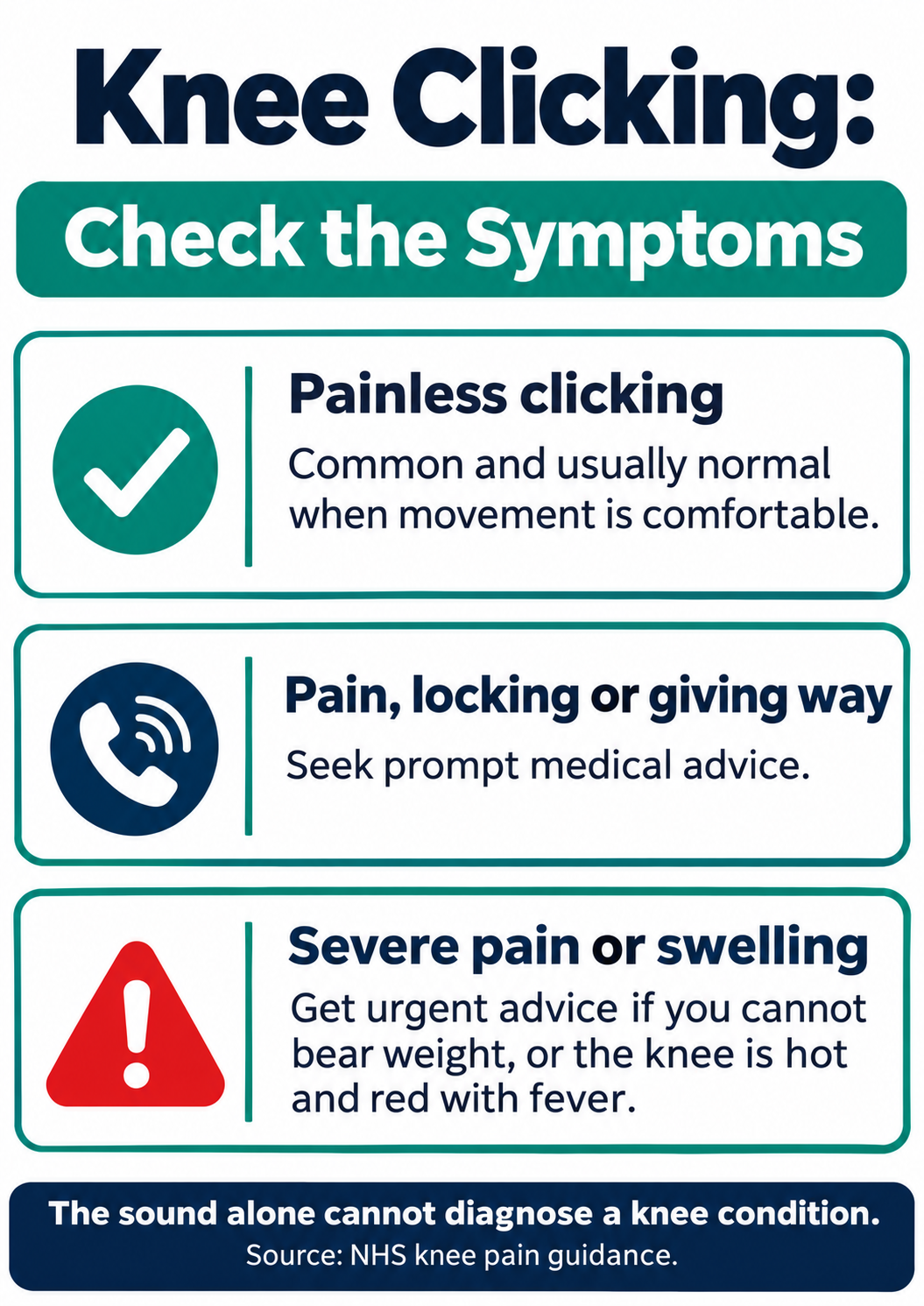
The distinction is not the sound itself but the company it keeps. A click with no pain, no swelling, full movement, and no sense of giving way is generally benign. A click that arrives with any of the red flags below should be reviewed by a clinician.
- Pain: sharp or aching pain at the moment of the click or afterward.
- Swelling: new or recurring fluid in the knee after walking.
- Giving way: the knee buckles or feels untrustworthy.
- Locking: the knee briefly catches and cannot fully straighten or bend.
- Grinding with pain: a rough, grating sensation combined with discomfort.
- Rapid change: clicking that suddenly worsens or changes character after an injury.
Comparing the Main Causes of a Clicking Knee
This table summarizes how the most common causes typically present, so you can see how clinicians begin to separate them. It is a guide for understanding, not a substitute for examination.
| Cause | Typical Sound or Feel | Common Location | Usual Pain Pattern |
|---|---|---|---|
| Gas or fluid pressure | Single soft pop | Whole joint | No pain |
| Patellofemoral tracking | Click or crunch | Around or under kneecap | Pain with stairs, squatting |
| Iliotibial band snapping | Sharp snap | Outer knee | Often painless, sometimes tender |
| Meniscal tear | Click with rotation | Inner or outer joint line | Pain with twisting, catching |
| Osteoarthritis | Grinding, grating | Whole joint | Aching, stiffness after rest |
| Loose body | Click with locking | Variable | Intermittent catching |
How a Physical Therapist Assesses a Clicking Knee
Assessment starts with your history: when the click began, what makes it better or worse, and whether it ever hurts. Then the clinician watches you walk, because gait reveals a lot about how the knee is loaded and where the click occurs in the step cycle.
Hands-on testing checks joint stability, meniscal integrity, kneecap mobility, and soft tissue tension. Imaging is only ordered when the history and examination suggest a structural problem that would change management.
- Gait observation: watching foot position, knee alignment, and timing of the click.
- Range of motion: checking for full extension and flexion without catching.
- Special tests: meniscal and ligament tests to rule in or out specific injuries.
- Strength testing: particularly the quadriceps and gluteal muscles that control knee alignment.
- Palpation: locating exactly where the click is felt and whether it is tender.
Practical Steps to Reduce a Clicking Knee
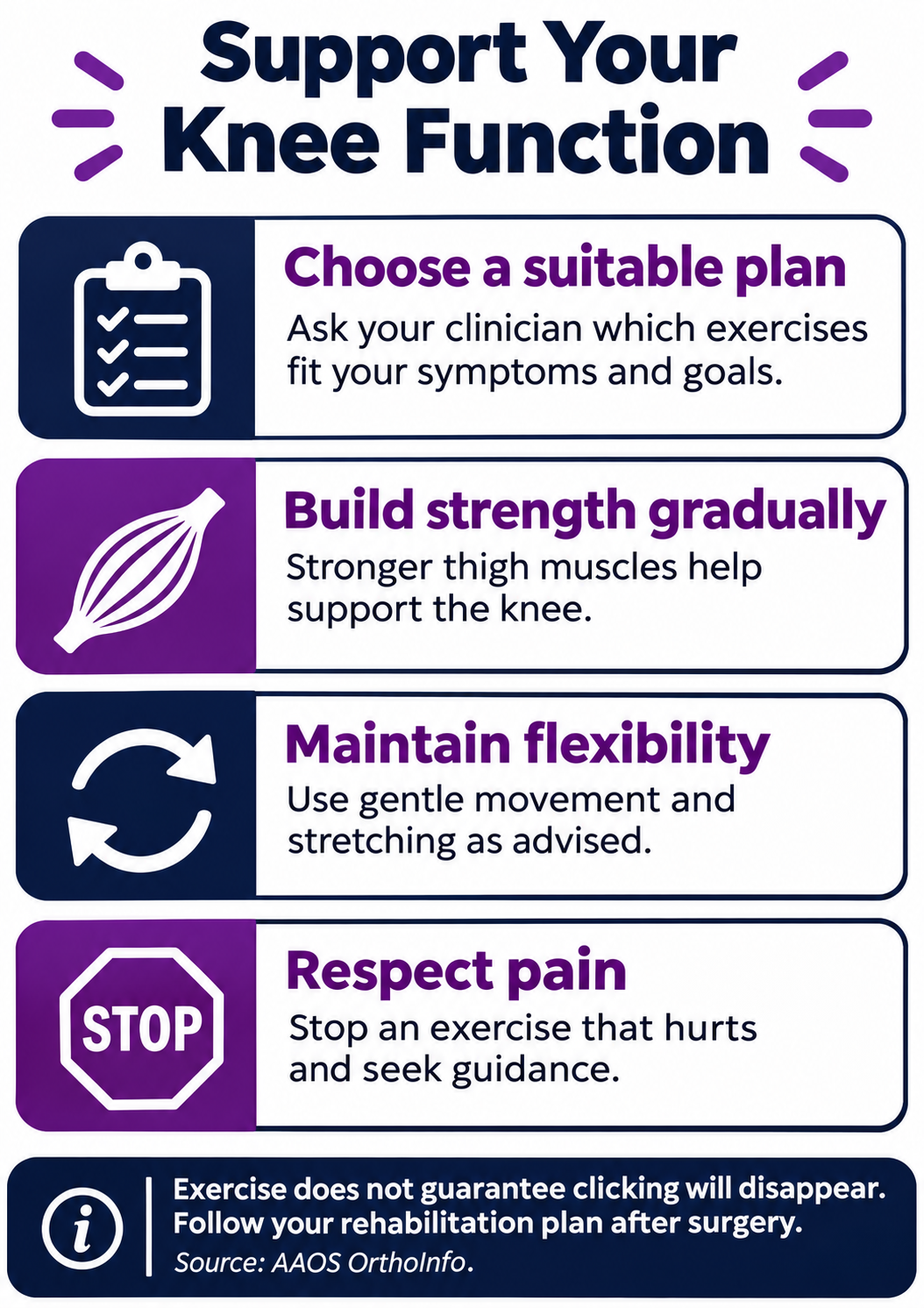
If your knee clicks without pain, you do not need to eliminate the sound. The goal is to keep the joint strong, mobile, and well controlled, which often reduces the click as a side effect.
For clicking that comes with mild discomfort, targeted strengthening and load management usually help more than rest. The quadriceps and hip muscles are the main controllers of knee position during walking.
- Strengthen the quadriceps: straight-leg raises, seated knee extensions, and controlled step-downs.
- Train the hip muscles: side-lying leg raises and single-leg balance work to control knee alignment.
- Maintain range of motion: gentle knee bending and straightening to keep the joint moving smoothly.
- Manage load: build walking distance gradually rather than suddenly doubling it.
- Check footwear: supportive shoes reduce excessive pronation that can alter knee tracking.
Exercises That Often Help a Clicking Knee
These are general starting points, not a prescription. If an exercise causes pain that lingers beyond a day, scale it back or seek guidance from a licensed physical therapist.
Quadriceps Strengthening
- Straight-leg raise: lie on your back, tighten the thigh, and lift the leg a short distance, holding briefly.
- Terminal knee extension: with a band behind the knee, straighten the last few degrees against resistance.
- Wall sit: hold a shallow squat against a wall for short, controlled intervals.
Hip and Balance Work
- Side-lying abduction: lift the top leg while keeping the pelvis stable.
- Single-leg stance: stand on one leg near a counter for safety, building time gradually.
- Step-downs: lower slowly from a low step, keeping the knee aligned over the foot.
What Not to Worry About
Many people fear that clicking means their cartilage is wearing away. That belief is understandable but not accurate on its own. Plenty of healthy knees click, and plenty of damaged knees are silent.
What matters is the overall picture: pain, swelling, function, and stability. If those are fine, the click is usually just part of how your knee moves.
In clinical practice, the patients who worry most about clicking are often the ones with the least to worry about. The ones who need attention are those who mention a click almost in passing while describing pain, swelling, or a knee that gives way.
When to Seek Professional Help
Book an assessment if the click is new after an injury, comes with pain or swelling, or if the knee locks or gives way. These signs suggest a structural issue that benefits from early evaluation.
For general information on knee conditions and when to seek care, the American Academy of Orthopaedic Surgeons patient information library is a reliable starting point. If you are looking for a licensed clinician, the American Physical Therapy Association find-a-PT directory can help you locate one.
Conclusion
Most knee clicking during walking is normal joint mechanics, not a sign of damage. The sound itself matters far less than whether it comes with pain, swelling, locking, or instability. If your knee is quiet in every other way, keep it strong and mobile, and let the click be. If it is not, get it checked by a qualified clinician.
Frequently Asked Questions
Is a clicking knee when walking something to worry about?
Usually not. A painless click with full movement and no swelling is common and generally harmless. It becomes a concern when it is accompanied by pain, swelling, locking, or a feeling that the knee gives way.
Why does my knee click only when I walk and not at other times?
Walking loads the knee in a repetitive pattern of bending and straightening under body weight. That pattern can cause a tendon, ligament, or the kneecap to move over a bony landmark at a consistent point in each step, producing a click you do not notice at rest.
Does knee clicking mean I have arthritis?
No. Clicking alone does not indicate arthritis. Osteoarthritis is more typically associated with aching pain, stiffness after rest, and a grinding sensation. A painless click in an otherwise healthy knee is not evidence of arthritis.
Can weak muscles cause a clicking knee?
Weak quadriceps and hip muscles can affect how the kneecap tracks and how the knee is controlled during walking. Strengthening these muscles often reduces clicking that is related to poor control, though it does not guarantee the sound will disappear entirely.
Should I stop walking if my knee clicks?
Not if walking is comfortable. Walking is generally good for knee health. If the click is painful or the knee swells afterward, reduce distance or intensity and seek an assessment rather than stopping activity completely.
What does a clicking sound with pain mean?
A click with pain can point to a meniscal issue, kneecap tracking problem, or another structural cause. It is worth having a clinician examine the knee to identify the source and guide appropriate treatment.
Can a knee click after surgery?
Yes. Clicking after knee surgery can occur as tissues heal and scar tissue remodels, or as joint mechanics adjust. If the click is new, painful, or accompanied by swelling, it should be reviewed by your surgical team or physical therapist.
Are there exercises that stop knee clicking?
Exercises cannot guarantee the click will stop, but strengthening the quadriceps and hip muscles and maintaining range of motion can improve knee control and often reduce clicking related to muscle weakness or poor tracking.
When should I see a doctor for a clicking knee?
See a doctor if the clicking began after an injury, is painful, is accompanied by swelling, or if the knee locks or gives way. These signs suggest a problem that benefits from early evaluation.
Is it normal for both knees to click?
Yes. Clicking in both knees is common and often reflects normal joint mechanics. Symmetrical, painless clicking is generally not a cause for concern, but a new or painful click in either knee should be assessed.