TENS therapy is a drug-free way to ease some types of pain using mild electrical pulses delivered through pads placed on the skin. It is widely used for muscle aches, joint pain, nerve-related discomfort, and recovery after injury or surgery, but it works best as part of a broader pain plan rather than as a stand-alone cure. This guide explains how TENS therapy works, what it can and cannot do, how to use a unit safely at home, and when you should avoid it.
What Is TENS Therapy?
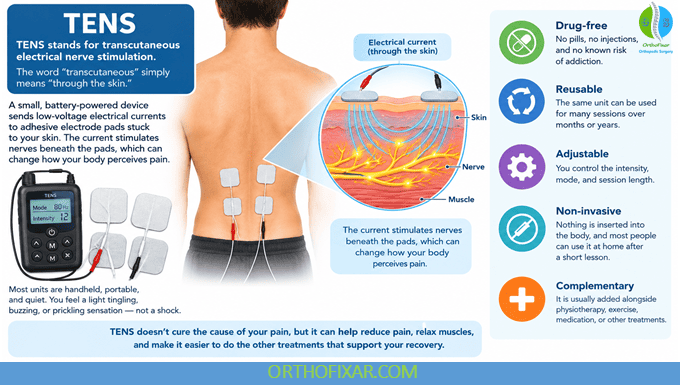
TENS stands for transcutaneous electrical nerve stimulation. The word “transcutaneous” simply means “through the skin.”
A small, battery-powered device sends low-voltage electrical currents to adhesive electrode pads stuck to your skin. The current stimulates nerves beneath the pads, which can change how your body perceives pain.
Most units are handheld, portable, and quiet. You feel a light tingling, buzzing, or prickling sensation — not a shock.
- Drug-free: no pills, no injections, and no known risk of addiction.
- Reusable: the same unit can be used for many sessions over months or years.
- Adjustable: you control the intensity, mode, and session length.
- Non-invasive: nothing is inserted into the body, and most people can use it at home after a short lesson.
- Complementary: it is usually added alongside physiotherapy, exercise, medication, or other treatments.
Because TENS therapy acts on nerve signaling rather than on the source of the pain, it does not treat the underlying cause of a condition. It changes the pain experience, which is still meaningful for many people.
How TENS Therapy Works
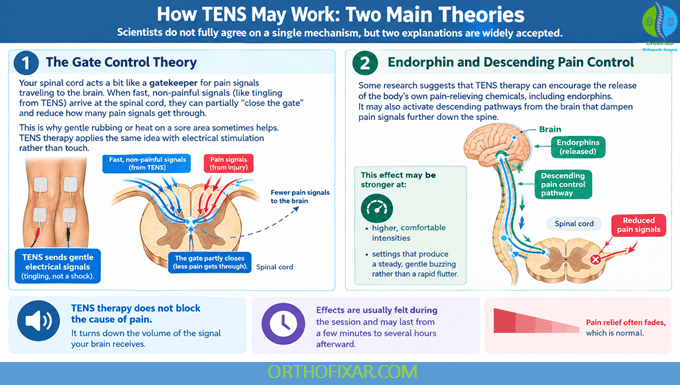
Scientists do not fully agree on a single mechanism, but two explanations are widely accepted.
The Gate Control Theory
Your spinal cord acts a bit like a gatekeeper for pain signals traveling to the brain. When fast, non-painful signals (like tingling from TENS) arrive at the spinal cord, they can partially “close the gate” and reduce how many pain signals get through.
This is why gentle rubbing or heat on a sore area sometimes helps. TENS therapy applies the same idea with electrical stimulation rather than touch.
Endorphin and Descending Pain Control
Some research suggests that TENS therapy can encourage the release of the body’s own pain-relieving chemicals, including endorphins. It may also activate descending pathways from the brain that dampen pain signals further down the spine.
This effect may be stronger at higher, comfortable intensities and with settings that produce a steady, gentle buzzing rather than a rapid flutter.
TENS therapy does not block the cause of pain. It turns down the volume of the signal your brain receives.
Effects are usually felt during the session and may last from a few minutes to several hours afterward. Pain relief often fades, which is why regular repeat sessions are common.
Common Uses of TENS Therapy
TENS therapy is most often used for pain that is stable, localized, and musculoskeletal or nerve-related.
- Low back pain: a common reason people buy a home unit, though results vary a lot between individuals.
- Neck and shoulder tension: often used alongside stretching and posture work.
- Knee osteoarthritis: sometimes used to take the edge off pain before or after activity.
- Muscle strains and sports soreness: may help you move more comfortably during recovery.
- Post-surgical pain: some hospitals and clinics use TENS as an add-on to reduce discomfort and medication needs.
- Diabetic peripheral neuropathy: used by some patients for burning or tingling in the feet, with mixed results.
- Menstrual cramps: a low-cost option some people find helpful.
- Arthritis pain in the hands or hips: useful during flare-ups for short-term relief.
- Labour pain: used in some maternity settings as a non-drug comfort measure.
TENS therapy is less likely to help pain caused by an active infection, a fracture that has not healed, or a condition that urgently needs medical treatment. It should never delay a proper diagnosis.
Electrode Placement: Where to Put the Pads
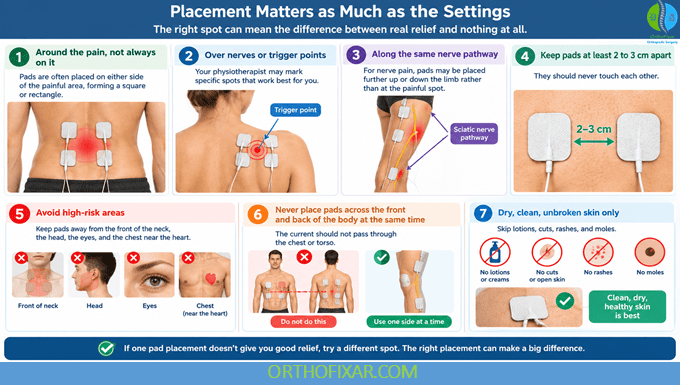
Placement matters as much as the settings. The right spot can mean the difference between real relief and nothing at all.
- Around the pain, not always on it: pads are often placed on either side of the painful area, forming a square or rectangle.
- Over nerves or trigger points: your physiotherapist may mark specific spots that work best for you.
- Along the same nerve pathway: for nerve pain, pads may be placed further up or down the limb rather than at the painful spot.
- Keep pads at least 2 to 3 cm apart: they should never touch each other.
- Avoid the front of the neck, the head, the eyes, and the chest near the heart: these areas carry unnecessary risk.
- Never place pads across the front and back of the body at the same time: the current should not pass through the chest or torso.
- Dry, clean, unbroken skin only: skip lotions, cuts, rashes, and moles.
If one placement does not help after a few tries, changing pad position slightly is often more useful than turning the intensity up.
Types of TENS Units and Common Modes
Most modern devices offer several modes. Understanding the difference helps you choose the right one for your pain.
| Mode | Sensation You Feel | Typical Use | Common Session Length |
|---|---|---|---|
| Conventional (high frequency) | Fast, steady tingling or buzzing | General aches, muscle pain, everyday flare-ups | 20 to 60 minutes |
| Low frequency (acupuncture-like) | Slower, stronger pulsing that feels like tapping | Chronic pain, longer-lasting relief attempts | 20 to 45 minutes |
| Burst | Bursts of pulses with pauses between them | People who find continuous high frequency uncomfortable | 20 to 45 minutes |
| Modulated | Changing rhythm and intensity | Reducing nerve “habituation,” where the body stops noticing the signal | 20 to 60 minutes |
| Interferential (usually clinic-based) | Deep, even tingling across a larger area | Broader areas such as the back or shoulder | 15 to 30 minutes |
Some units also include EMS (electrical muscle stimulation), which causes visible muscle contractions. EMS is a different treatment with different goals, so do not assume it works the same way as TENS therapy.
How to Use a TENS Unit at Home
A short, consistent routine gives you the best chance of judging whether TENS therapy helps you.
- Read the manual for your specific device. Settings and safety warnings differ between brands.
- Clean and dry the skin. Remove oils, sweat, and lotion where the pads will go.
- Attach the pads firmly. Replace them when they stop sticking properly, as poor contact causes uneven current.
- Start at zero intensity. Then increase slowly until you feel a clear but comfortable tingling.
- Do not push through pain. Stronger is not better. If it stings, burns, or feels sharp, turn it down.
- Set a timer. Most sessions last 20 to 60 minutes. Stop sooner if the skin becomes irritated.
- Check your skin afterward. Mild redness under the pads is common and should fade. Blisters or a rash mean you should stop and reassess.
- Keep a simple log. Note the placement, mode, intensity, and how much relief you got. This helps you and your clinician spot patterns.
Never use a TENS unit while driving, operating machinery, or in water such as a bath or shower. Turn the device off before removing the pads.
Who Should Avoid TENS Therapy
TENS therapy is generally well tolerated, but it is not suitable for everyone. Always check with a doctor or physiotherapist first if any of the following apply to you.
- Pacemaker, implanted defibrillator, or other implanted electronic device: electrical current can interfere with how these devices work.
- Pregnancy: avoid use over or near the abdomen and pelvic area unless a clinician specifically advises it.
- Epilepsy or a seizure disorder: discuss with your doctor before using any electrical stimulation.
- Heart problems or an irregular heartbeat: avoid use on the chest and discuss use elsewhere first.
- Over the front of the neck or the head: current here may affect blood pressure, swallowing, or the voice.
- Over the eyes, mouth, or broken skin: keep pads on intact, healthy skin.
- Over areas with poor sensation: including numb feet from advanced neuropathy, because you may not feel a burn developing.
- During pregnancy-related or undiagnosed abdominal pain: get the pain assessed before trying any device.
- People who cannot communicate discomfort: supervision is essential for children and anyone with cognitive impairment.
If you cannot feel the tingling clearly, that is a reason for extra caution — not a reason to turn the dial up.
Stop using the device immediately and seek medical advice if you notice a burn, a persistent rash, a sudden increase in pain, or any unusual symptom such as dizziness or palpitations.
Limitations of TENS Therapy
Being realistic about what TENS therapy can do helps you avoid disappointment and wasted money.
- Evidence is mixed. Reviews of TENS for chronic low back pain, neck pain, and knee arthritis show inconsistent results, partly because studies use different settings and pad placements.
- Relief is often temporary. Many people get relief only during and shortly after a session.
- It does not fix the cause. TENS will not heal a torn ligament, reverse arthritis, or remove a disc problem.
- Response varies widely. Some people feel clear benefit, others feel nothing at all, and it is hard to predict who is who in advance.
- Nerve habituation. With continuous use, the nervous system may stop responding to the same signal, so switching modes or placements can help.
- Not a substitute for movement. Staying active, building strength, and addressing posture usually matter more for long-term improvement.
- Cost adds up. Replacement pads and a good-quality unit are ongoing expenses.
- Rare skin reactions. Some people react to adhesive or gel, especially with long or frequent sessions.
European and international guidance generally treats TENS as an option to consider for some pain conditions, not as a first-line treatment for every type of pain.
Practical Tips for Getting Better Results
- Use it early in a flare-up. TENS often works best before pain becomes severe.
- Pair it with activity. Some people use TENS before a walk or physiotherapy session so they can move more comfortably.
- Give it a fair trial. Try several sessions with different placements before deciding it does not work.
- Change modes. Rotating between conventional and burst modes can reduce habituation.
- Keep intensity comfortable. A strong, unpleasant current is not more effective.
- Protect your skin. Rotate pad positions slightly and take breaks between sessions.
- Store pads properly. Reseal them on their backing film and keep them away from heat and dust.
- Tell your clinician what you are doing. TENS should be part of a documented pain plan, not a secret experiment.
- Reassess regularly. If it has not helped after a few weeks of sensible use, it may not be the right tool for you.
Final Thoughts
TENS therapy is a low-risk, drug-free option that helps some people take the edge off certain types of pain, especially musculoskeletal and post-surgical discomfort. It is easy to use at home, but it is not a cure, and results vary from person to person. Used with realistic expectations, proper pad placement, and professional guidance, it can be a useful addition to a broader pain management plan — and if it does not help you, that is normal and worth discussing with your clinician rather than forcing it.
Frequently Asked Questions About TENS Therapy
Is TENS therapy safe to use every day?
For most healthy adults, daily use is considered safe as long as the skin stays intact and you follow the device instructions. Keep sessions to a sensible length, usually 20 to 60 minutes, and take breaks between them. If you develop redness that does not fade, irritation, or a rash, stop and let your skin recover before using it again. If you have any heart condition, implanted device, or seizure disorder, speak to your doctor before regular use.
How quickly does TENS therapy work?
Many people notice a change within the first few minutes of a session, especially in conventional mode. For others, it takes a few sessions with adjusted pad placement and settings before any benefit appears. The relief is often temporary and may last from a short while to several hours. If nothing changes after several properly performed sessions, it is reasonable to conclude that TENS therapy is not helping your particular pain.
Can TENS therapy replace pain medication?
No. TENS therapy is a complementary tool, not a replacement. Some people find they need less medication when TENS is part of their routine, but this should only be decided with your prescribing doctor. Never stop or reduce prescribed medication on your own, and never use TENS to avoid getting a pain that needs assessment checked out.
Why does my TENS unit stop feeling effective after a while?
This is called habituation. Your nervous system gradually stops responding to the same unchanging signal. Common fixes include switching modes, slightly moving the pads, changing the frequency, or taking a break for a day or two. Some devices include a modulated mode that automatically varies the signal to help prevent this.
Where should I not place TENS electrodes?
Avoid the front of the neck, the head, the eyes, the mouth, and the chest across the heart. Do not place pads on broken, irritated, or numb skin, and never run current across the front and back of your body at the same time. Avoid the abdomen and pelvic area during pregnancy unless a clinician has advised otherwise.
Can I use TENS therapy while pregnant?
Many clinicians advise against using TENS over the abdomen or pelvis during pregnancy unless specifically recommended. TENS is used in some maternity settings for labour pain under professional supervision. If you are pregnant, ask your midwife or doctor before using a home unit anywhere on your body.
Does a stronger setting give better pain relief?
Not necessarily. The goal is a clear, comfortable tingling sensation you can tolerate easily. A current that feels sharp, burning, or painful can irritate nerves and skin without improving results. If you need more relief, adjusting pad placement or changing modes is usually more effective than simply increasing the intensity.
How long do the electrode pads last?
It depends on how often you use them and how well you store them. Many pads last through roughly ten to twenty sessions before the adhesive weakens. Replace them when they stop sticking firmly, because poor contact causes uneven current and less effective treatment. Always reseal them on their backing film after use.
Can TENS therapy help nerve pain such as diabetic neuropathy?
Some people with nerve pain report benefit, but research results are mixed and responses vary widely between individuals. Nerve pain often needs a broader approach that may include medication, foot care, and blood sugar management. If you have reduced sensation in your feet, TENS should only be used under clinical guidance because you may not feel a burn developing.
When should I see a doctor instead of using TENS?
Seek medical advice if your pain is new, severe, or getting worse, or if it comes with numbness, weakness, weight loss, fever, or problems with bladder or bowel control. TENS therapy should never delay assessment of a symptom that could point to something serious. If a doctor has already assessed you and cleared you for home use, then TENS can be a reasonable part of your plan.