Skier’s thumb is a tear or stretch of the ulnar collateral ligament, the band of tissue on the inside of the thumb that keeps it stable when you pinch or grip. It happens most often when the thumb is forced outward and backward during a fall — which is why skiers, snowboarders, and anyone holding a pole, racket, or leash gets it. The good news is that most partial tears heal well with a brace and hand therapy, while complete tears often need surgery to restore a firm pinch. This guide covers how the injury happens, how to recognize it, how doctors grade it, and what recovery realistically looks like.
What Is Skier’s Thumb?
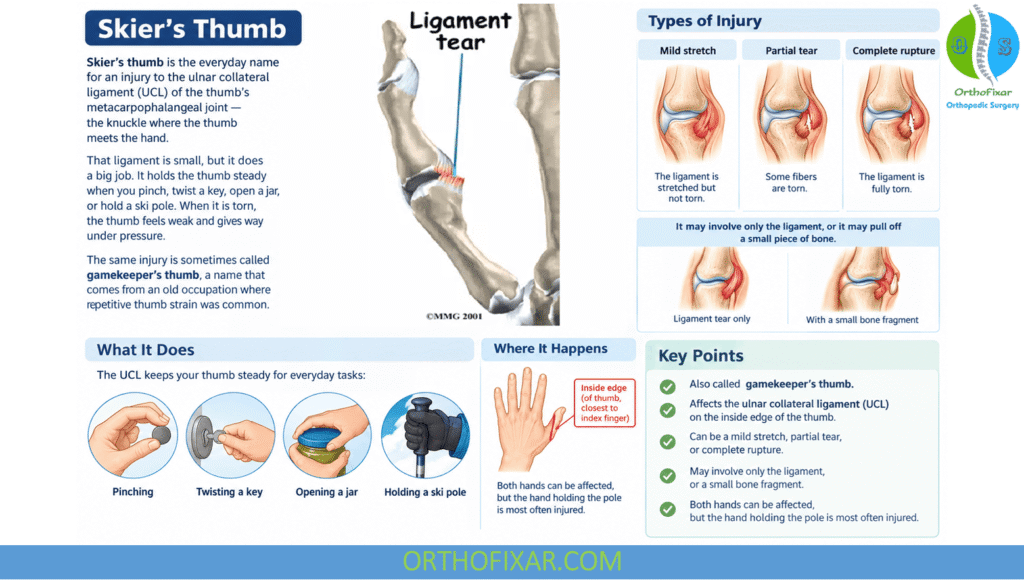
Skier’s thumb is the everyday name for an injury to the ulnar collateral ligament (UCL) of the thumb’s metacarpophalangeal joint — the knuckle where the thumb meets the hand.
That ligament is small, but it does a big job. It holds the thumb steady when you pinch, twist a key, open a jar, or hold a ski pole. When it is torn, the thumb feels weak and gives way under pressure.
The same injury is sometimes called gamekeeper’s thumb, a name that comes from an old occupation where repetitive thumb strain was common.
- It affects the ligament on the inside edge of the thumb, closest to the index finger.
- It can be a mild stretch, a partial tear, or a complete rupture.
- It may involve only the ligament, or it may pull off a small piece of bone.
- Both hands can be affected, but the hand holding the pole is most often injured.
How This Injury Usually Happens
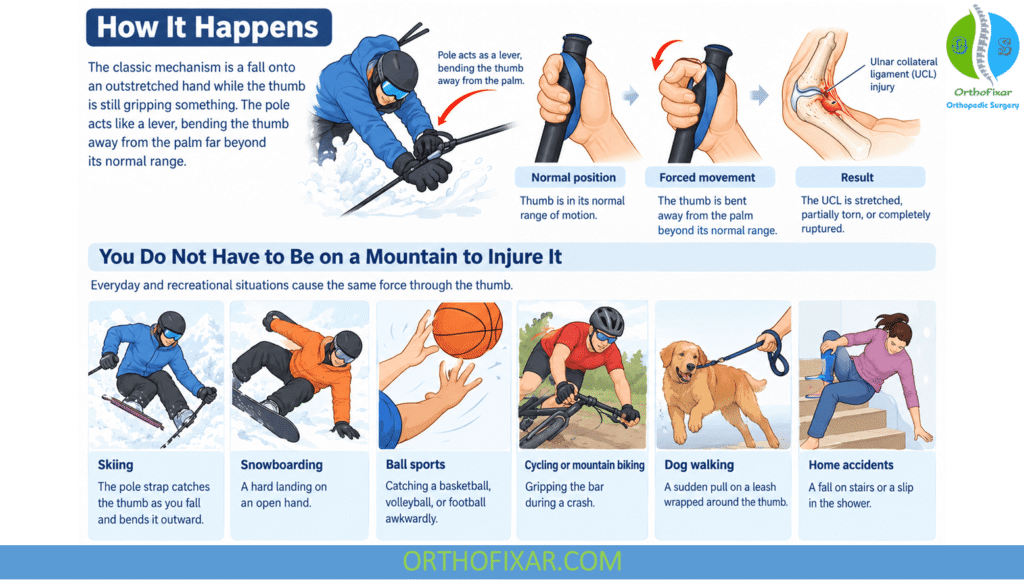
The classic mechanism is a fall onto an outstretched hand while the thumb is still gripping something. The pole acts like a lever, bending the thumb away from the palm far beyond its normal range.
You do not have to be on a mountain to injure it. Everyday and recreational situations cause the same force through the thumb.
- Skiing — the pole strap catches the thumb as you fall and bends it outward.
- Snowboarding — a hard landing on an open hand.
- Ball sports — catching a basketball, volleyball, or football awkwardly.
- Cycling or mountain biking — gripping the bar during a crash.
- Dog walking — a sudden pull on a leash wrapped around the thumb.
- Home accidents — a fall on stairs or a slip in the shower.
Because the ligament is under tension at the moment of impact, the tear often happens instantly. Many people hear or feel a pop.
Symptoms: What You Might Notice
Pain and swelling at the base of the thumb are the most common early signs. They usually appear within hours of the injury.
The tell-tale sign is instability. When the ligament no longer holds, the thumb joint shifts when you pinch or push against something.
- Pain on the inner side of the thumb joint, near the web space.
- Bruising that develops over one or two days.
- Swelling that makes the joint look puffy.
- Weakness when pinching a key, zip, pen, or jar lid.
- A feeling that the thumb is slipping or giving way.
- Difficulty holding a ski pole, racket, or grocery bag.
- Tenderness directly over the ligament when pressed.
If your thumb feels unstable when you pinch a key or turn a doorknob, that is your cue to have it examined rather than wait it out.
Grades of a UCL Thumb Injury
Doctors grade these injuries by how much of the ligament is torn and how much the joint moves under stress. The grade guides treatment more than the amount of pain does.
| Grade | What Happens to the Ligament | Typical Joint Stability | Usual Treatment Path |
|---|---|---|---|
| Grade 1 (mild sprain) | Ligament is stretched with microscopic tears | Stable, no abnormal laxity | Brace, ice, activity modification, hand therapy |
| Grade 2 (partial tear) | Part of the ligament fibers are torn | Mildly lax but firm endpoint on stress testing | Thumb spica cast or brace for several weeks, then therapy |
| Grade 3 (complete tear) | Ligament is fully ruptured, sometimes with a bony avulsion | Clearly unstable, no firm endpoint | Surgery is often recommended, especially for athletes and heavy hand users |
A special situation is the Stener lesion, where the torn ligament end folds back and gets trapped above a tendon. It cannot heal on its own and requires surgery.
How Doctors Diagnose It
Diagnosis starts with a conversation about how the injury happened, followed by a careful hands-on exam. The mechanism of injury is often as informative as the imaging.
- Your doctor presses along the ligament to find the point of maximum tenderness.
- The joint is gently stressed sideways to check for laxity and a firm endpoint.
- Both thumbs are compared, since natural looseness varies between people.
- X-rays rule out a fracture or show a bony avulsion.
- Ultrasound or MRI can confirm a complete tear or a Stener lesion.
- Examination may be repeated after the swelling settles for a clearer picture.
Getting an accurate grade matters. A missed complete tear can lead to long-term weakness and arthritis-like pain at the base of the thumb.
Treatment Options
Treatment depends on the grade, your hand demands, and how soon you need to return to sport or work. The goal is a thumb that pinches firmly and does not hurt.
Non-Surgical Treatment
Grade 1 and 2 injuries are usually managed without an operation. The key is protecting the ligament long enough for it to heal, then rebuilding strength.
- Relative rest from the activity that caused the injury.
- Ice and elevation in the first days to reduce swelling.
- A thumb spica brace or cast that keeps the joint in a healing position.
- Over-the-counter pain relief if your doctor approves it.
- Hand therapy once the brace comes off, focusing on grip and pinch strength.
- Gradual return to sport with taping or bracing for extra support.
When Surgery Is Needed
A complete tear, a Stener lesion, a large bony avulsion, or ongoing instability after bracing often points toward surgery. Repair is usually done through a small incision over the ligament.
- The ligament is reattached to the bone, sometimes with a small anchor or stitch.
- Bone fragments are fixed back into place if they are large enough.
- After surgery, a cast or splint protects the repair for several weeks.
- Hand therapy starts early for the wrist and fingers, then progresses to thumb motion.
- Full return to contact sport usually takes longer than non-surgical care.
The repair is only half the job — the strengthening and graded return that follow are what determine how well the thumb performs long term.
Recovery Timeline and Rehabilitation
Healing follows a predictable pattern, though everyone moves at a slightly different pace. Pain-free motion usually comes before full strength.
- First days to two weeks: swelling and pain settle, protection begins.
- Two to six weeks: the ligament heals in a brace or cast; light finger motion is encouraged.
- Six to twelve weeks: motion and gentle strengthening return under guidance.
- Three to six months: grip and pinch strength build toward normal.
- Beyond that: confidence and fine control return with sport-specific practice.
Surgical recovery generally runs longer, with the brace or cast phase extended and therapy adjusted to protect the repair.
Returning to Sport and Daily Life
Going back too soon is the most common reason for a re-injury. A staged return protects the healing ligament and rebuilds trust in the thumb.
- You can usually manage light daily tasks early, avoiding heavy pinching and twisting.
- Driving may need to wait if your grip or reaction time is affected.
- Gym work can continue with modified exercises that avoid thumb loading.
- Return to skiing, climbing, or racket sports once strength and stability are near normal.
- Taping or a supportive brace during early return can add confidence.
- Report any new giving-way feeling to your therapist right away.
Prevention Tips
You cannot control every fall, but you can reduce how much force reaches your thumb.
- Do not loop pole straps around your wrist if you tend to fall; use a releasable grip.
- Let go of the pole rather than gripping through a fall.
- Keep your hands and forearms strong with regular grip training.
- Use a supportive glove or brace if you have had a previous thumb injury.
- Warm up before hard sessions, especially in cold weather.
The Bottom Line
Skier’s thumb is a common but very treatable injury. The key is recognizing that instability — not just pain — is the warning sign that needs attention. Mild sprains usually recover with a brace and therapy, while complete tears often do best with surgery followed by structured rehabilitation. Get an accurate diagnosis early, follow the rehab plan patiently, and most people return to their sport with a strong, reliable pinch.
Frequently Asked Questions
Can skier’s thumb heal on its own?
A mild sprain or partial tear can often heal without surgery, as long as the joint is protected in a brace and the ligament is not displaced. A complete tear, especially with a Stener lesion, will not heal reliably on its own and usually needs a surgical repair.
How long does it take to recover from a torn thumb ligament?
Partial tears treated with bracing often feel much better within four to six weeks, with full strength returning over two to three months. After surgery, protection lasts several weeks and a full return to contact sport may take four to six months or more.
Do I need an MRI for skier’s thumb?
Not always. A careful physical exam and X-rays answer most questions. MRI or ultrasound is useful when the exam is unclear, when a complete tear or Stener lesion is suspected, or when surgery is being considered.
What is a Stener lesion?
It is a complete tear where the end of the ligament folds back and becomes trapped above a tendon in the thumb. Because the torn ends are no longer touching, the ligament cannot heal by itself and surgery is required.
Can I keep skiing with skier’s thumb?
Only if your doctor or therapist clears you. Continuing to ski with an unstable thumb risks turning a partial tear into a complete one. If you do return early, use a rigid supportive brace and avoid pole straps.
Will I need a cast or a brace?
Most non-surgical cases are treated with a thumb spica brace or cast that holds the joint in a healing position. The choice and duration depend on the grade of the injury and how well the thumb is healing.
Is surgery always better for a complete tear?
For most active people and anyone who needs a strong pinch for work or sport, yes. Some low-demand patients with a complete tear may manage with bracing, but they often keep some weakness and instability.
How soon can I use my hand after surgery?
Light use of the fingers and wrist often starts within days, guided by your surgeon and therapist. Gripping, pinching, and lifting are introduced gradually over several weeks to protect the repair.
What happens if skier’s thumb is not treated?
An untreated complete tear can lead to lasting weakness, a thumb that gives way, and pain at the base of the joint. Over time, the instability can contribute to joint wear and stiffness.
Does hand therapy really make a difference?
Yes. Therapy restores motion, rebuilds pinch and grip strength, and guides a safe return to activity. Skipping it is one of the most common reasons people feel their thumb never quite gets back to normal.