Preventing hip dislocation after replacement surgery comes down to a few simple habits: respect the movement limits your surgeon gives you, build strength in the muscles around the new joint, and use your precautions consistently during the first weeks of healing. Most dislocations are not caused by a single big mistake. They happen when a small, repeated movement pushes the new ball out of the socket before the surrounding tissues have healed. The good news is that with the right plan, this risk drops sharply.
This guide covers the positions to avoid, safe ways to move and sleep, and the daily habits that protect your new hip for the long term.
Why Hip Dislocation Happens After Replacement Surgery
A hip replacement works like a ball and socket. During surgery, the worn ball at the top of the thigh bone is replaced with an implant, and the socket is fitted with a smooth cup. Until the capsule and muscles around the joint heal and tighten, the new ball can slip out of the cup if it is pushed at an awkward angle or into a position the joint does not yet tolerate.
Several factors influence how much risk you carry.
- Surgical approach: The direction the surgeon used to reach the hip changes which movements are riskier in the early weeks.
- Implant design: Some heads and cups are more stable than others, and larger head sizes generally resist dislocation better.
- Muscle strength: Weak hip and buttock muscles allow the joint to move further than it should.
- Healing tissue: The soft tissue envelope needs weeks to re-form and provide support.
- Previous surgery: Revision procedures and prior hip operations can leave less supportive tissue.
- Patient factors: Flexibility, body habits, and some neurological conditions can play a role.
- Following precautions: The single factor most within your control.
The first weeks after surgery are not about testing your range of motion. They are about letting the joint capsule heal around the new implant.
Your First Weeks: Positions to Avoid
Your surgeon will give you a specific set of restrictions, often called hip precautions. They usually apply for a defined period after surgery, and then are relaxed step by step.
The Three Movements That Cause Most Dislocations
Most early dislocations involve one of three movements, sometimes combined.
- Bending the hip too far. Deep flexion, such as pulling your knee toward your chest or bending past 90 degrees.
- Turning the leg inward. Internal rotation, where the knee and foot rotate toward the other leg.
- Crossing the midline. Adduction, where the operated leg moves across the center of your body.
For example, sitting on a low sofa forces the hip past 90 degrees. Twisting to reach a phone on the side table while your foot stays planted rotates the leg inward. Leaning over to put on a sock can combine all three at once.
Safe Ways to Move, Sit, and Sleep
Getting In and Out of Bed
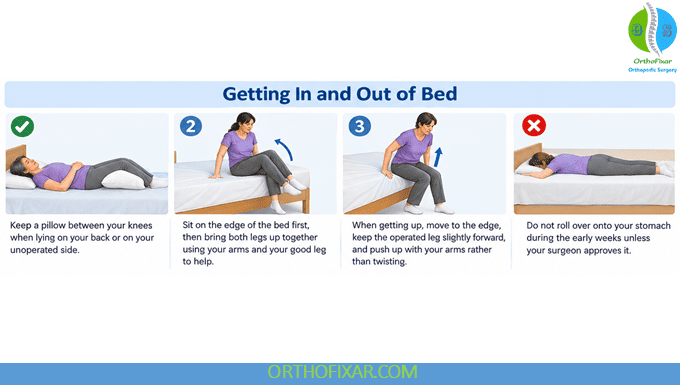
- Keep a pillow between your knees when lying on your back or on your unoperated side.
- Sit on the edge of the bed first, then bring both legs up together using your arms and your good leg to help.
- When getting up, move to the edge, keep the operated leg slightly forward, and push up with your arms rather than twisting.
- Do not roll over onto your stomach during the early weeks unless your surgeon approves it.
Sitting and Standing
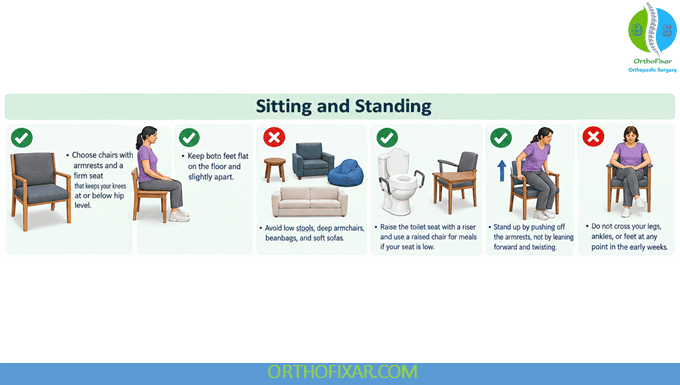
- Choose chairs with armrests and a firm seat that keeps your knees at or below hip level.
- Keep both feet flat on the floor and slightly apart.
- Avoid low stools, deep armchairs, beanbags, and soft sofas.
- Raise the toilet seat with a riser and use a raised chair for meals if your seat is low.
- Stand up by pushing off the armrests, not by leaning forward and twisting.
- Do not cross your legs, ankles, or feet at any point in the early weeks.
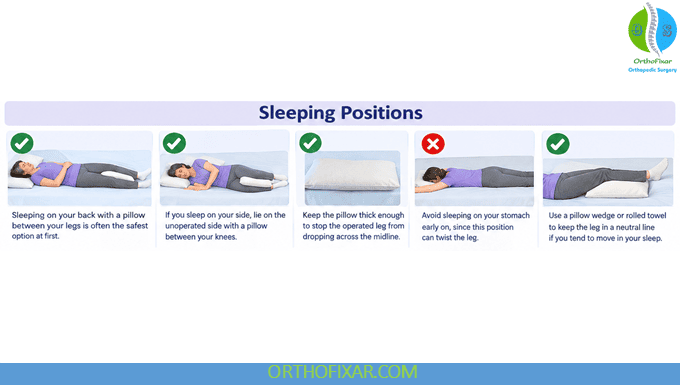
Sleeping Positions
- Sleeping on your back with a pillow between your legs is often the safest option at first.
- If you sleep on your side, lie on the unoperated side with a pillow between your knees.
- Keep the pillow thick enough to stop the operated leg from dropping across the midline.
- Avoid sleeping on your stomach early on, since this position can twist the leg.
- Use a pillow wedge or rolled towel to keep the leg in a neutral line if you tend to move in your sleep.
If you are unsure whether a movement is safe, the answer is usually to wait and ask rather than to try it.
Precautions by Surgical Approach and Implant Type
The table below shows the general pattern of precautions linked to common surgical approaches. Your own instructions always take priority over any general guidance.
| Surgical Approach | Movements Usually Restricted Early On | General Sleep Guidance | Typical Duration |
|---|---|---|---|
| Posterior | Deep flexion past 90 degrees, internal rotation, crossing the midline, crossing legs | Back sleeping or on the unoperated side with a pillow between the knees | Often several weeks, then gradually relaxed |
| Lateral and anterolateral | Extreme external rotation, excessive hip extension, wide twisting movements | Back sleeping with a pillow between the legs | Varies, often shorter than posterior precautions |
| Direct anterior | Extreme external rotation, strong hip extension, aggressive stretching backward | Back sleeping with a pillow under the knees for comfort | Varies, some surgeons relax precautions quickly |
| Revision or complex surgery | Usually the full set of precautions, often for longer | Strict back sleeping or side sleeping with firm support | Longer than a first-time replacement |
Implant choice matters too. Larger femoral head sizes and certain dual mobility designs are generally more resistant to dislocation, which may allow a less restrictive recovery. Smaller heads and some constrained liners may call for tighter limits. Ask your surgeon which category your implant falls into.
Daily Habits That Protect Your New Hip
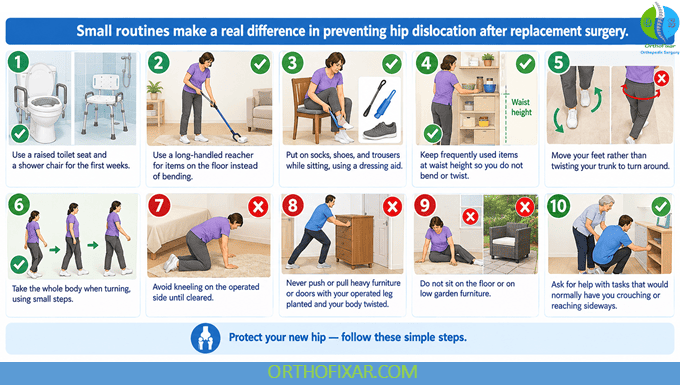
Small routines make a real difference in preventing hip dislocation after replacement surgery.
- Use a raised toilet seat and a shower chair for the first weeks.
- Use a long-handled reacher for items on the floor instead of bending.
- Put on socks, shoes, and trousers while sitting, using a dressing aid.
- Keep frequently used items at waist height so you do not bend or twist.
- Move your feet rather than twisting your trunk to turn around.
- Take the whole body when turning, using small steps.
- Avoid kneeling on the operated side until cleared.
- Never push or pull heavy furniture or doors with your operated leg planted and your body twisted.
- Do not sit on the floor or on low garden furniture.
- Ask for help with tasks that would normally have you crouching or reaching sideways.
How Physical Therapy Lowers Your Risk
Strengthening the muscles around the hip is one of the most reliable long-term protections. Strong gluteal and core muscles guide the joint and reduce the chance of it travelling into a risky position.
- Follow your prescribed exercise program rather than inventing your own.
- Focus on gluteal, quadriceps, and core work.
- Progress gradually and stop if you feel a sharp catch or clunk.
- Avoid aggressive stretching that pushes the hip into end range.
- Swimming and cycling are usually gentler options once cleared.
- Ask your therapist to check your walking pattern; limping loads the joint unevenly.
- Keep exercising after formal therapy ends, since strength fades quickly without use.
When to Contact Your Care Team
Get medical help promptly if you notice any of the following.
- Sudden severe pain in the hip or groin.
- A feeling that the hip has shifted, slipped, or popped out of place.
- The leg suddenly looks shorter or turns outward.
- You cannot bear weight on the leg when you could before.
- New numbness, tingling, or weakness in the leg or foot.
- Swelling, redness, or warmth around the incision with fever.
- A loud click or clunk followed by inability to move the hip normally.
A dislocated hip is usually reduced in an emergency department or operating room, often under sedation. It is painful, but it is treatable. Calling early is always better than waiting.
Conclusion
Preventing hip dislocation after replacement surgery is mostly about patience and consistency. Respect the movement limits you were given, use the right equipment at home, sleep with proper knee support, and keep strengthening the muscles that stabilise the joint. Most people who follow their precautions recover without any dislocation at all. As healing progresses and your surgeon relaxes the restrictions, you can gradually return to normal movement with confidence.
Frequently Asked Questions
How long do hip precautions usually last?
Most surgeons ask patients to follow precautions for a set period after surgery, commonly a few weeks, and then relax them step by step. The exact timeline depends on your surgical approach, the implant used, and how your tissue is healing. Always follow the specific instructions from your own surgeon rather than a general rule.
Does everyone need hip precautions after replacement?
No. Some patients, particularly those with certain anterior approaches or more stable implant designs, are given very few restrictions. Others, especially after revision surgery, need stricter rules for longer. Your precautions reflect your individual anatomy and procedure, so do not compare your plan with someone else’s.
Can I sleep on my side after hip replacement?
Many patients can sleep on the unoperated side early on, with a firm pillow between the knees to keep the operated leg from dropping across the midline. Sleeping on the operated side is often more comfortable later in recovery. Ask your surgeon when side sleeping on the operated side is allowed.
Is it ever safe to cross my legs again?
Once precautions are lifted and your hip has healed, many people can cross their legs without problems. However, some surgeons advise avoiding it long term, especially if you have a smaller implant head or a history of instability. Clarify this with your care team at your follow-up visits.
What does a dislocated hip feel like?
Typical signs include sudden severe pain, an inability to move or bear weight on the leg, and a visible change in the leg’s position, such as it turning outward or appearing shorter. Some people feel a distinct pop or clunk. Any of these symptoms needs urgent medical assessment.
Can I have sex after hip replacement?
Yes, but timing and positioning matter. Most surgeons advise waiting until you are comfortable and cleared, and recommend positions that avoid deep hip flexion and crossing the midline. Talk openly with your surgeon or physiotherapist, since they can give specific guidance based on your approach.
Does driving increase my dislocation risk?
Driving itself is less about dislocation and more about your ability to control the vehicle safely. Getting in and out of a low car, twisting in the seat, and sitting for long periods can all stress a healing hip. Wait until your surgeon confirms you are safe to drive and you can perform an emergency stop without hesitation.
Will exercise prevent dislocation?
Strength training helps a great deal, but it does not replace precautions during the early healing phase. Strong gluteal and core muscles improve joint control and stability over time, which lowers long-term risk. Do the exercises your therapist prescribes and avoid pushing into painful or extreme ranges.
What happens if my hip dislocates?
A dislocated hip is treated as an urgent problem. The hip is usually put back into place in an emergency department or operating room, often with sedation or anaesthesia. After reduction, you may need a period of stricter precautions and possibly imaging to check the implant. Recurrent dislocations may require further treatment.
How can I lower my risk in the years after surgery?
Keep your hip and core muscles strong, maintain a healthy body weight, avoid falls, and stay alert to movements that feel unstable. Wear supportive footwear, keep walking surfaces clear at home, and report any new clicking, catching, or giving-way sensation to your care team. Small ongoing habits protect the joint far longer than a short burst of effort.