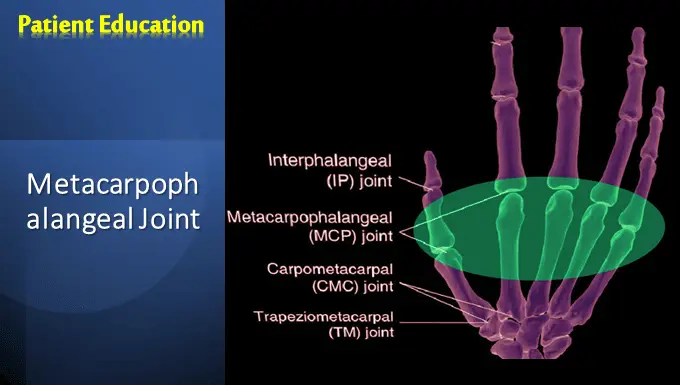
The metacarpophalangeal joint, often called the “knuckle”, is a crucial part of hand function. It connects your fingers to your palm and allows the fine movements needed for gripping, writing, and daily activities.
In this patient-focused guide, you’ll learn everything about the metacarpophalangeal joint, including its anatomy, why it’s sometimes described as a ball and socket joint, common problems, and when to seek medical care.
What Is the Metacarpophalangeal Joint?
The metacarpophalangeal joint (MCP joint) is the articulation between the metacarpal bones of the hand and the proximal phalanges of the fingers.
- You have five MCP joints—one for each finger
- They form the visible knuckles when you make a fist
- These joints act as a transition between the palm and fingers
These joints are essential for both strength and dexterity, allowing coordinated hand movements.
Is the MCP Joint a Ball and Socket Joint?
This is where things get interesting—and often misunderstood.
- The MCP joints of the fingers (2nd–5th digits) behave like shallow ball and socket joints
- The rounded head of the metacarpal acts as the “ball”
- The base of the proximal phalanx acts as the “socket”
This configuration allows multi-directional movement, although not as freely as true ball-and-socket joints like the shoulder.
What Is a Ball and Socket Joint?
A ball and socket joint is a type of synovial joint where a spherical bone fits into a cup-shaped socket, allowing movement in multiple planes.
- Examples: shoulder and hip
- Movements include rotation, abduction, adduction, and circumduction
👉 The MCP joint is often described as a modified or shallow ball and socket joint because it allows similar, but more limited, motions.
Anatomy of the Metacarpophalangeal Joint
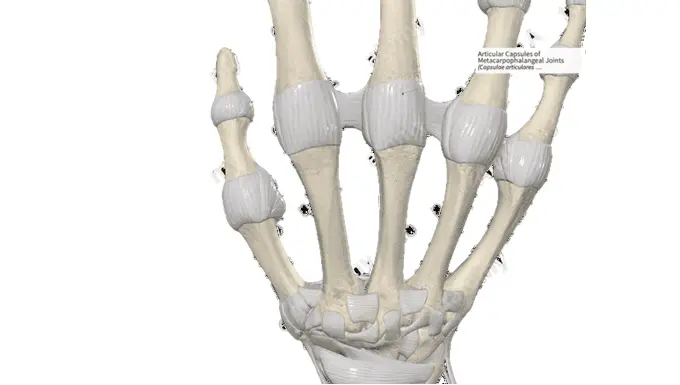
The MCP joint is a complex structure made of:
1. Bones
- Metacarpal head (convex surface)
- Proximal phalanx base (concave surface)
2. Cartilage
- Smooth hyaline cartilage covers joint surfaces
- Reduces friction and absorbs shock
3. Ligaments
- Collateral ligaments provide lateral stability
- Volar plate prevents hyperextension
4. Joint Capsule
- Encloses the joint and contains synovial fluid
This combination ensures a balance between mobility and stability, which is essential for hand function.
Movements of the MCP Joint
The metacarpophalangeal joint allows several important movements:
- Flexion – bending the fingers
- Extension – straightening the fingers
- Abduction – spreading fingers apart
- Adduction – bringing fingers together
- Circumduction – circular movement
These movements are possible because of its ball and socket–like structure, making it highly versatile.
Function: Why the MCP Joint Matters
Without the MCP joints, your hand would lose much of its function.
They are essential for:
- Power grip (holding objects firmly)
- Precision grip (writing, buttoning)
- Coordinated finger motion
- Shock absorption during hand use
In short, the MCP joint is central to both strength and fine motor control.
Common MCP Joint Problems
1. Arthritis
- Rheumatoid arthritis commonly affects MCP joints
- Causes swelling, pain, and deformity
- Helps distinguish RA from osteoarthritis
2. Ligament Injuries
- Often due to trauma or sports injuries
- Can cause instability or pain
3. Dislocation
- Occurs when the joint surfaces lose alignment
- May require reduction or surgery
4. Degenerative Changes
- Wear-and-tear damage over time
- Leads to stiffness and reduced motion
Symptoms of MCP Joint Disorders
You may notice:
- Pain at the knuckle
- Swelling or redness
- Stiffness or reduced motion
- Weak grip strength
- Visible deformity (in advanced cases)
Diagnosis
Doctors may use:
- Physical examination
- X-rays
- Ultrasound or MRI (for soft tissue evaluation)
- Blood tests (if inflammatory arthritis is suspected)
Treatment Options
Conservative Management
- Rest and activity modification
- Splinting
- Anti-inflammatory medications
- Physical therapy
Medical Treatment
- Disease-modifying drugs for rheumatoid arthritis
Surgical Treatment
- Ligament repair
- Joint reconstruction
- Arthroplasty (joint replacement in severe cases)
When Should You See a Doctor?
Seek medical advice if you have:
- Persistent pain or swelling
- Difficulty moving your fingers
- Joint deformity
- Injury with suspected dislocation
Early treatment can prevent long-term damage.
Key Takeaways
- The metacarpophalangeal joint connects your fingers to your hand
- It functions like a shallow ball and socket joint, allowing versatile movement
- It plays a vital role in both grip strength and fine motor skills
- Common conditions include arthritis, ligament injuries, and dislocations
- Early diagnosis and treatment improve outcomes
References & More
- Benson DC, Graefe SB, Varacallo MA. Anatomy, Shoulder and Upper Limb, Metacarpophalangeal Joints. [Updated 2023 Aug 14]. In: StatPearls [Internet]. Treasure Island (FL): StatPearls Publishing; 2026 Jan-. Available from: Pubmed
- Bouredoucen H, Boudabbous S, Poletti PA, Taihi L. Metacarpophalangeal Joints of the Long Fingers: Anatomy, Biomechanics, and Imaging Techniques. Eur J Radiol. 2026 Jan;194:112459. doi: 10.1016/j.ejrad.2025.112459. Epub 2025 Sep 30. PMID: 41187640. Pubmed
- Guillard G, Magnenat-Thalmann N. Ball-and-socket joint motion description using spherical medial representation. Annu Int Conf IEEE Eng Med Biol Soc. 2007;2007:4293-6. doi: 10.1109/IEMBS.2007.4353285. PMID: 18002951. Pubmed
- Minami A, An KN, Cooney WP 3rd, Linscheid RL, Chao EY. Ligamentous structures of the metacarpophalangeal joint: a quantitative anatomic study. J Orthop Res. 1984;1(4):361-8. doi: 10.1002/jor.1100010404. PMID: 6491785. Pubmed
- Egol KA. Handbook of fractures. 6th ed. Philadelphia: Lippincott Williams & Wilkins; 2019.