
Choosing the right cane can be the difference between moving with confidence and feeling unsure on your feet. This guide will help you understand the cane options available, how to fit one correctly to your body, and the safest ways to use it for better stability. You will find practical steps, clear examples, and common pitfalls to avoid, so you can make an informed decision that supports your daily mobility.
Why the Right Cane Matters
A cane is more than a simple support tool; it is an extension of your body that helps redistribute weight and improve balance. Using the wrong type or a poorly fitted cane can actually increase your risk of falling or cause new joint pain. That is why taking the time to choose wisely is so important.
- Reduces pressure on a painful hip, knee, or ankle by shifting weight to your upper body.
- Improves balance by widening your base of support and giving you a third point of contact with the ground.
- Helps you avoid overcompensating with your strong side, which can lead to muscle strain.
- Builds confidence during daily activities, especially if you are recovering from an injury or surgery.
- Allows you to stay independent longer without needing more heavy-duty mobility aids.
Types of Canes and How to Choose One
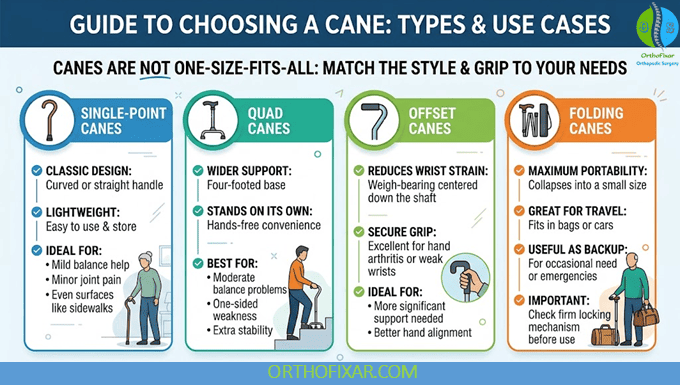
Canes are not one-size-fits-all. You need to match the style and grip to your balance ability, strength, and the kind of support you need. Here are the most common types and who they work best for.
Single-Point Canes
This classic cane has one tip at the bottom and a curved or straight handle. It is lightweight, easy to store, and ideal for people who only need a little extra balance help.
- Suit people with mild balance issues or minor joint pain.
- Best used on even surfaces like sidewalks or indoor floors.
- Available with ergonomic handles that reduce wrist pressure.
Quad Canes
A quad cane has a base with four small feet, giving you a much wider base of support. It stands on its own when you let go, which is helpful for people who cannot hold a cane while reaching for something.
- Best for people with moderate balance problems or weakness on one side.
- Provides extra stability but can be heavier and more awkward on stairs.
- Choose a narrow or wide base depending on your gait pattern.
Offset Canes
The offset cane has a straight handle that is positioned at an angle, channeling your body weight directly down the shaft. This design reduces strain on your wrist and offers a more secure grip for people with arthritis.
- Ideal for people who need more weight-bearing support.
- Great for those with weak wrists or hand arthritis.
- Provides better alignment than a curved hook handle.
Folding Canes
Folding canes are designed for portability. They collapse into sections and often come with a carry bag.
- Perfect for travelers or people who only need a cane occasionally.
- Make sure the locking mechanism feels firm and secure each time.
- Great as a backup cane kept in the car or at work.
| Cane Type | Best For | Considerations |
|---|---|---|
| Single-point cane | Mild balance or joint issues | Lightweight, but limited support |
| Quad cane | Moderate balance problems | More stable, heavier on stairs |
| Offset cane | Arthritis or weak wrists | Provides good weight distribution |
| Folding cane | Portability and occasional use | Check joint locks regularly |
How to Measure and Set the Correct Cane Height
The correct cane height is essential for maintaining good posture and preventing wrist, shoulder, or lower back strain. A cane that is too tall makes you lean to one side; one that is too short forces you to hunch over. Measuring takes less than a minute when you follow these steps.
- Stand in normal, everyday shoes with your shoulders relaxed and arms hanging at your sides.
- Ask someone to measure the distance from the crease of your wrist to the floor while your arm hangs naturally.
- Your wrist crease should be level with the top of the cane handle when you hold it loosely.
- If no one is available, hold the cane yourself and check that your elbow bends at about 15 to 20 degrees when you grip the handle.
- Adjust the cane by using the push-button or twist-lock mechanism. Make small changes, then retest.
- For easiest and safest use, the rubber tip should rest flat on the floor, and the cane handle should be at your wrist joint line.
A proper cane fit should feel like a natural extension of your arm. If you feel any strain in your shoulder or have to reach down or lean up, the height is not right.
How to Use a Cane Safely: The Right Technique
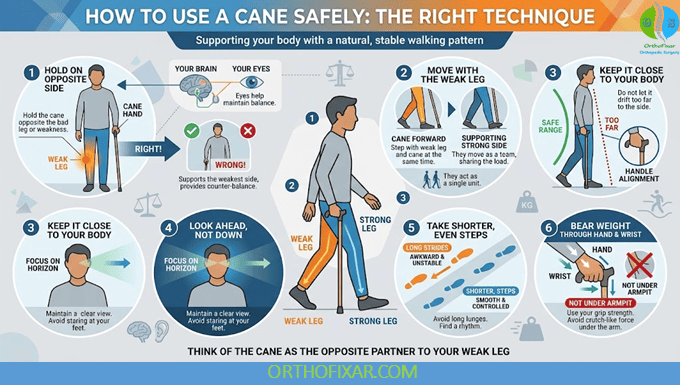
Holding the cane on the right side is just as important as the cane itself. Many people assume you should use the cane on the side that hurts, but doing the opposite gives you a much more natural and stable walking pattern. The cane should support the side of your body that is weakest or painful.
- Hold the cane in the hand opposite the side of your bad leg or weakness.
- When you step with the weak leg, move the cane forward at the same time as that leg.
- Keep the cane close to your body, not too far out to the side.
- Look ahead rather than down at your feet. Your eyes help your brain maintain balance.
- Take shorter, even steps instead of long lunging strides.
- Let the cane bear the weight through your hand and wrist, not under your armpit.
Think of the cane as the opposite partner to your weak leg. When the weak leg moves, the cane moves with it, and together they support the stronger side of your body.
How to Walk With a Cane on Stairs and Uneven Ground
Stairs are a common challenge, but the same basic rule applies: the good leg goes up first, and the bad leg goes down first. This pattern keeps your strong leg doing the most work when you need control.
- Going up stairs: step first with your stronger leg, then bring the weaker leg up, followed by the cane.
- Going down stairs: place the cane a step down, then your weaker leg, then your stronger leg.
- Always use a handrail if available, even if you also use a cane. Hold the rail with your free hand.
- On uneven ground or gravel, take slower steps and check the rubber tip is in good condition.
- When walking on a slope, tilt the cane tip slightly uphill to keep full contact with the ground.
- On slippery surfaces like wet tiles or ice, consider a cane with a swivel base or a carbide tip for extra grip.
Common Mistakes to Avoid
Even with a well-fitted cane, small habits can lead to poor posture or a fall. Pay attention to how you use the cane every time, and make adjustments if you notice discomfort or imbalance.
- Using the cane on the same side as the weak leg, which throws off your center of gravity.
- Setting the cane too low or too high, causing you to lean or slouch.
- Gripping the handle too tight, which tenses your whole arm and can increase pain.
- Letting the rubber tip wear down. A smooth tip greatly increases your risk of slipping.
- Relying on the cane for every step when you only need support intermittently. This can create bad habits.
- Leaving the cane lying flat instead of leaning it against a surface where it can fall and trip someone.
How to Care for Your Cane and Maintain Safety
Taking care of your cane is simple, but it helps prevent accidents and extends the life of your mobility aid. A few minutes of regular attention can keep your cane safe and effective.
- Check the rubber tip regularly for cracks, wear, or smooth patches. Change it if the tread is gone.
- Wipe the shaft with a damp cloth to remove dirt and oils from your hands.
- Tighten any screws or bolts on height-adjustable models every few weeks.
- Test the tip on various floors after replacing it to make sure it grips securely.
- For folding canes, inspect the lock buttons and joints for even slight bending.
- Store your cane in a dry place, away from extreme heat or cold, to prevent material damage.
Choosing and using a cane is a skill that protects your independence and keeps you moving safely. The right type, a proper fit, and correct technique all work together to provide the stability you need. If you are unsure about which cane suits your specific condition, speak with a physical therapist or occupational therapist. They can assess your walking pattern and help you make the best choice for your everyday routine.
Frequently Asked Questions
Which side should I hold a cane on?
Hold the cane in the hand opposite your weaker or more painful leg. This allows the cane and your affected leg to move together while your stronger leg supports your body weight. It also encourages a more natural and balanced walking motion.
How do I know if my cane is too short or too long?
If your cane is too short, you will feel like you are leaning forward or hunching. If it is too long, you will have to lift your shoulder or push the cane away from your body. A simple check is to stand with your arm relaxed and confirm the cane handle reaches the crease of your wrist.
Can I use a cane for just a few steps or recovery?
Yes, but you should still choose the correct height and type for your temporary needs. Even short-term use can strain your wrist or back if the cane is improperly fitted. It is better to invest a little time in fitting it properly from the first day.
What is the best cane for people with arthritis?
An offset cane with an ergonomic, molded handle is usually the best choice for arthritis. The offset design lets your grip stay neutral and directs weight straight down the shaft. Some handles are made from softer materials that are gentle on fingers and joints.
Is a quad cane safer than a single-point cane?
A quad cane offers a wider base and can stand on its own, which makes it safer for people with moderate balance problems. However, it may be more difficult to use on stairs and can be heavier. Your specific needs and environment matter more than the assumption that more feet mean more safety.
Should I use a cane if I only have mild knee pain?
Mild knee pain may still benefit from using a cane during long walks or when carrying something. The key is to use it on the opposite side of your body from the painful knee. This reduces the load on the knee joint and can prevent the pain from getting worse.
How many feet of the quad cane touch the floor at the same time?
All four feet of a quad cane touch the floor when you place it down. This creates a stable square base. It is important to lift the cane completely when taking a step, rather than dragging it, so all four feet land flat for even support.
Can I use a cane in place of a walker?
No. A cane provides limited support and a narrower base than a walker. If your balance is severe or you have weakness in both legs, a walker is usually the safer option. Talk to a physical therapist if you are unsure which aid your condition requires.
Why does my cane make a clicking sound?
A clicking sound often means that a height adjustment button or locking screw is slightly loose. Stop using the cane until you inspect the mechanism. Tighten all moving parts. If the click persists, the cane may have unsafe wear and need replacement.
How often should I change the rubber tip on my cane?
Replace the rubber tip once the tread becomes smooth or the edges start to wear down. This interval can happen in a few months if you walk a lot every day. The best approach is to inspect the tip monthly and check it on wet surfaces to see if it slips.