Knee pain from osteoarthritis has a way of quietly taking over daily life. People start avoiding stairs, cutting their walks short, and modifying their routines well before they ever sit down with a doctor about it. With more than 10 million Americans dealing with knee arthritis each year, the scale of this condition points to just how common and disruptive joint degradation really is.
When conservative treatments like physical therapy and over-the-counter pain medications stop working, one treatment that consistently comes up in orthopedic conversations is hyaluronic acid injections. Also known as viscosupplementation, this therapy bridges the gap between basic pain relief and invasive joint replacement surgery.
These specialized injections work by restoring the lubricating fluid that osteoarthritis gradually wears away from the inside of the knee joint. In this comprehensive guide, we will break down exactly how viscosupplementation works, what the clinical evidence shows regarding its effectiveness, and what patients should realistically expect from their treatment timeline.
What Are Hyaluronic Acid Injections?
Hyaluronic acid injections, frequently referred to as HA injections or knee gel shots, are a targeted form of injection therapy designed specifically to treat knee osteoarthritis. These injections contain a concentrated formulation of a substance that already occurs naturally in your synovial fluid, which is the thick, lubricating liquid found inside healthy joints.
The Food and Drug Administration has approved several distinct HA formulations for treating knee joint pain, stiffness, and mobility loss. Each brand delivers hyaluronic acid directly into the joint capsule, though they differ slightly in their molecular weight, origin, and required dosing schedules. The most commonly prescribed formulations include:
- Euflexxa
- Durolane
- Hyalgan
- Supartz
- Orthovisc
- Monovisc
Orthopedic specialists, sports medicine physicians, and rheumatologists often recommend this specific treatment pathway for patients who have not found adequate relief through nonsteroidal anti-inflammatory drugs (NSAIDs) or acetaminophen. It is crucial to understand that these injections work entirely differently from standard cortisone shots. While corticosteroid injections artificially suppress inflammation rapidly, hyaluronic acid addresses the mechanical friction problem inside the joint.
The Science: How Do They Help Knee Osteoarthritis?
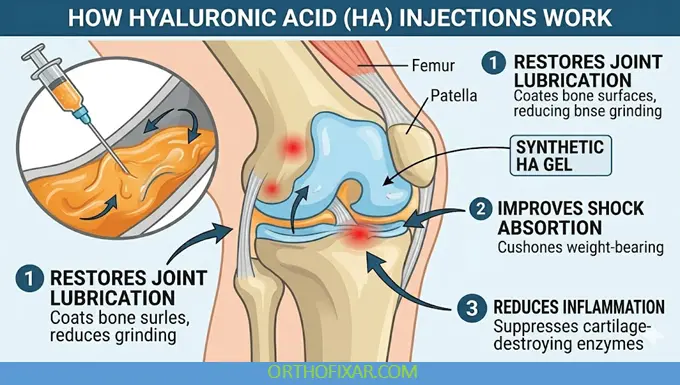
Hyaluronic acid injections improve joint mechanics by replenishing the slippery, protective fluid that degenerative osteoarthritis slowly strips away from the knee. The treatment restores the joint space, giving the bones the physical cushioning they need to articulate smoothly with less pain.
Restoring Essential Joint Lubrication
Osteoarthritis fundamentally breaks down the natural lubricant in the knee. In a healthy joint, synovial fluid keeps the femur and tibia from rubbing against one another. Without adequate fluid, every step creates micro-friction that progressively wears down the protective articular cartilage.
By injecting hyaluronic acid directly into the joint space, healthcare providers replace what osteoarthritis has destroyed. Clinical research from the European Alliance for Associations of Rheumatology supports this approach, demonstrating that viscosupplementation works by mimicking the biomechanical properties of the body’s own joint fluid.
Reducing Inflammation and Improving Shock Absorption
Beyond simple lubrication, hyaluronic acid injections work directly on the inflamed tissues inside the knee joint capsule. The thick, gel-like substance coats the rough, damaged joint surfaces and actively calms the localized inflammatory response.
According to clinical reviews published in the National Institutes of Health repository, the benefits of exogenous hyaluronic acid extend beyond physical cushioning. The substance actively decreases the cellular production of matrix metalloproteinases. These are specific, destructive enzymes responsible for breaking down cartilage in an osteoarthritic knee. By suppressing these enzymes, HA injections help protect the remaining cartilage from further rapid degradation.
| Mechanism of Action | Clinical Effect on the Knee Joint |
| Friction Reduction | Coats joint surfaces, reducing bone-on-bone grinding and decreasing localized swelling. |
| Enzyme Suppression | Suppresses matrix metalloproteinases, slowing the cartilage-destroying processes that drive arthritis. |
| Mechanical Cushioning | Restores the knee’s natural shock-absorbing capacity during weight-bearing activities. |
| Barrier Protection | Shields vulnerable cartilage lesions from further impact damage during daily physical activity. |
The Treatment Process: What to Expect
Medical guidelines on HA injections require careful patient evaluation. The American College of Rheumatology includes HA injections as a recognized treatment option, particularly for patients who cannot tolerate oral pain medications or who wish to delay surgery. Because recommendations vary slightly among medical boards, an individualized consultation with an orthopedic specialist is vital.
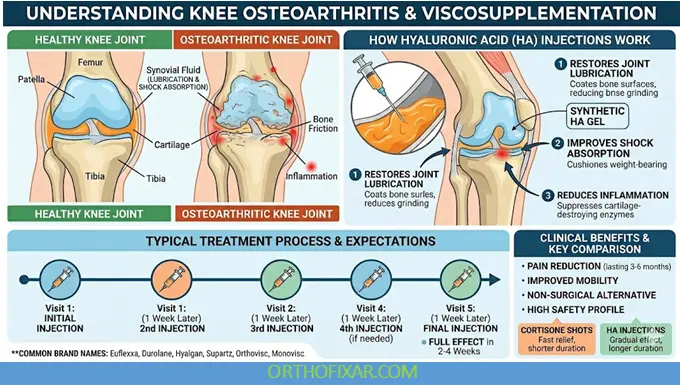
Most patients receive a series of three to five injections spaced exactly one week apart, though newer high-molecular-weight formulations may require only a single visit. A typical three-injection treatment cycle follows a highly structured clinical pathway.
| Treatment Phase | What Happens During the Appointment |
| Visit 1 (Initial Injection) | Patient consent, brief physical exam, joint aspiration if swelling is present, first injection, and a brief observation period. |
| Visit 2 (One Week Later) | Doctor checks for any localized reaction or stiffness, followed by the second targeted injection. |
| Visit 3 (One Week Later) | Final injection in the series, functional advice for home care, and a referral for physical therapy. |
| Follow-Up (Two Weeks Post-Cycle) | Clinical check-in to track early treatment response, assess pain reduction, and evaluate overall effectiveness. |
Major healthcare institutions routinely offer this injection therapy as a viable alternative to total knee arthroplasty or platelet-rich plasma (PRP) injections. Furthermore, hyaluronic acid injections are typically covered under Medicare Part B for qualifying patients who have documented their failure to respond to initial conservative treatments.
Effectiveness and Clinical Benefits
Hyaluronic acid injections deliver measurable, documented improvements for people suffering from mild to moderate knee osteoarthritis. It is important to note that while traditional corticosteroid injections provide rapid relief that fades within a few weeks, HA injections take slightly longer to reach peak efficacy, but the resulting relief often lasts up to six months.
The success of the treatment depends heavily on proper patient selection, the severity of the osteoarthritis, and individual healing responses. High-molecular-weight formulas tend to be thicker and more viscous, making them highly effective at preventing joint space narrowing over time.
| Benefit Category | Clinical Effectiveness Details |
| Pain Reduction | Clinical studies indicate 60 to 70 percent of patients report significantly decreased knee pain within two to three weeks. |
| Improved Mobility | Patients regain better range of motion and experience less morning stiffness after completing the treatment cycle. |
| Extended Relief Duration | Therapeutic benefits typically last three to six months per injection cycle, with some patients seeing relief for up to nine months. |
| Non-Surgical Alternative | Allows patients to actively manage their pain and avoid or significantly delay the need for total knee replacement surgery. |
| High Safety Profile | Systemic side effects remain incredibly minimal compared to daily oral medications, with allergic reactions occurring in less than 1 percent of cases. |
Conclusion
Hyaluronic acid injections work effectively by restoring vital joint lubrication, actively reducing internal inflammation, and drastically improving shock absorption in damaged, arthritic knees. For individuals struggling with knee osteoarthritis, this targeted viscosupplementation treatment offers real, measurable relief without the immediate need for surgical intervention.
By mimicking the body’s natural synovial fluid, these specialized injections allow patients to reclaim their mobility and improve their overall quality of life. Starting this treatment early in the arthritis progression can help protect the remaining joint structure, support a more active lifestyle, and provide a meaningful, long-term path forward in osteoarthritis management.
Frequently Asked Questions
What exactly are hyaluronic acid injections and how do they work?
Hyaluronic acid injections deliver a thick, gel-like substance directly into your knee joint. This substance perfectly mimics your body’s natural synovial fluid. By restoring this fluid, the injections cushion the joint, reduce painful bone-on-bone friction, and improve overall knee mechanics and mobility.
Are hyaluronic acid injections proven to help knee osteoarthritis?
Yes. Extensive clinical research and peer-reviewed studies indicate that these injections can significantly reduce knee pain and improve joint function for three to six months. They are most highly proven and effective in patients suffering from mild to moderate stages of knee osteoarthritis.
How long does it take for knee gel injections to start working?
Unlike cortisone shots which work in days, hyaluronic acid injections typically take two to four weeks to show maximum benefit. The gel needs time to fully coat the joint surfaces, integrate with the existing tissue, and suppress the inflammatory enzymes causing your pain.
Are viscosupplementation injections covered by Medicare and insurance?
In most cases, yes. The United States Veteran’s Administration and Medicare Part B generally cover hyaluronic acid injections for knee osteoarthritis, provided the patient meets specific clinical criteria, such as proving that basic physical therapy and oral pain relievers have failed to provide adequate relief.
Can I avoid knee replacement surgery by getting these injections?
While hyaluronic acid is not a permanent cure for osteoarthritis, it is an excellent tool for delaying surgery. Many patients use recurring injection cycles, combined with physical therapy and weight management, to push off knee replacement surgery for several years while maintaining a high quality of life.
Reference List
- American College of Rheumatology. Guidelines for the Medical Management of Osteoarthritis.
- National Institutes of Health. Viscosupplementation for Osteoarthritis of the Knee.
- Osteoarthritis Research Society International. OARSI guidelines for the non-surgical management of knee osteoarthritis.
- Arthritis Foundation. Hyaluronic Acid Injections for Osteoarthritis.
- Bert J, Kenney J, Sgaglione NA, McClelland S, Brophy R, Toth J, Ruane J, Ali Y, Arquette S, Dasa V, Lopes M. Viscosupplementation for Osteoarthritis of the Knee: A Key Opinion Leader Panel Discussion. J Manag Care Spec Pharm. 2018 Jun;24(6-a Suppl):S2-S8. doi: 10.18553/jmcp.2018.24.6-a.s2. PMID: 29851537; PMCID: PMC10408395. Link