Elbow arthritis is a joint condition in which the cartilage lining the elbow wears down or the joint lining becomes inflamed. The result is pain, stiffness, swelling, and a loss of smooth movement that can make everyday tasks surprisingly difficult. This article explains the different types of elbow arthritis, the symptoms that usually appear first, how the diagnosis is made, and the full range of treatment options — from home care and physiotherapy to injections and surgery.
What Is Elbow Arthritis?
The elbow is a hinge joint where three bones meet: the upper arm bone (humerus), the forearm bone on the thumb side (radius), and the other forearm bone (ulna). The ends of these bones are covered with smooth cartilage, and the whole joint is wrapped in a thin lining called the synovium.
When that cartilage thins or the synovium becomes inflamed, the joint can no longer glide smoothly. The body responds by producing extra fluid, thickening the joint capsule, and sometimes growing small bony spurs at the edges of the joint.
Over time, this cycle produces the classic pattern of elbow arthritis:
- Pain with movement, especially when pushing, pulling, or gripping.
- Stiffness that is worst after rest, such as in the morning or after sitting still.
- Swelling and a feeling of fullness inside the joint.
- Grinding, clicking, or a catching sensation when bending the arm.
- Gradual loss of the ability to fully straighten or fully bend the elbow.
Unlike hip or knee arthritis, elbow arthritis is less common because the elbow is not a weight-bearing joint. When it does happen, it often follows an old injury or an inflammatory disease elsewhere in the body.
Types of Elbow Arthritis
Doctors group elbow arthritis into a few main types, because each one behaves differently and responds to different treatments.
- Osteoarthritis: The wear-and-tear form. Cartilage gradually thins and bone spurs form around the joint edges. It often develops after years of heavy use, such as in construction work, throwing sports, or repetitive manual labor.
- Rheumatoid arthritis: An autoimmune disease in which the immune system attacks the joint lining. It tends to affect both elbows along with other joints, and it can cause marked swelling, warmth, and erosion of bone.
- Post-traumatic arthritis: Arthritis that appears months or years after a fracture, dislocation, or ligament injury around the elbow. It is one of the most common causes of elbow arthritis in younger and middle-aged adults.
- Psoriatic and other inflammatory types: Conditions linked to psoriasis or other systemic diseases can also inflame the elbow joint.
- Crystalline arthritis: Gout and pseudogout deposit crystals inside the joint, causing sudden, intense attacks of pain and swelling.
The table below gives a quick comparison of how these types usually behave.
| Type | Usual Cause | Typical Pattern | Common First Steps |
|---|---|---|---|
| Osteoarthritis | Long-term wear and heavy joint use | Gradual pain and stiffness, often in one elbow | Activity changes, physiotherapy, pain relief |
| Rheumatoid arthritis | Autoimmune inflammation of the joint lining | Both elbows, long morning stiffness, other joints involved | Disease-modifying medication, physiotherapy |
| Post-traumatic arthritis | Past fracture, dislocation, or ligament injury | Pain that returns long after the original injury | Physiotherapy, injections, sometimes surgery |
| Crystalline arthritis | Uric acid or calcium crystals in the joint | Sudden severe attacks with redness and swelling | Anti-inflammatory medication, trigger management |
Symptoms to Watch For
Elbow arthritis usually develops slowly, and the first symptoms are easy to blame on overuse or a pulled muscle. Knowing what to look for helps you seek the right care earlier.
- Pain at the back or outer side of the elbow that worsens when you push up from a chair, carry bags, or twist a door handle.
- Stiffness after rest that eases somewhat once you start moving the arm.
- Swelling or a warm feeling around the joint, especially in inflammatory types.
- A grinding or clicking sensation when you bend and straighten the arm.
- Loss of full straightening, which many people notice when they cannot rest the arm flat on a table.
- Weak grip or dropping objects, which may signal pain, muscle inhibition, or nerve irritation.
- Tingling or numbness in the little and ring fingers, which can point to pressure on the ulnar nerve at the elbow.
Symptoms that affect both elbows, come with morning stiffness lasting more than an hour, or appear alongside pain in the hands and wrists deserve a rheumatology review.
How Doctors Diagnose Elbow Arthritis
There is no single test for elbow arthritis. Diagnosis is built from your story, a careful examination, and targeted imaging.
- Medical history: When the pain started, which movements trigger it, whether you had a previous elbow injury, and whether other joints are affected.
- Physical examination: Checking the range of motion, feeling for swelling and bone spurs, testing grip strength, and assessing the stability of the joint.
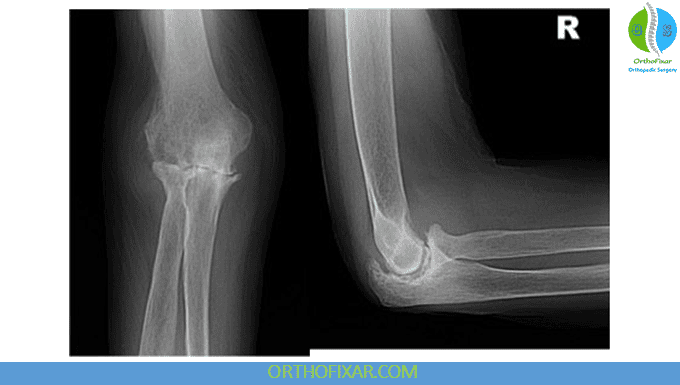
- X-rays: The first-line imaging test. They show joint space narrowing, bone spurs, and changes in the bone surface.
- Ultrasound: Useful for detecting fluid, inflammation of the joint lining, and nerve compression in real time.
- MRI or CT scans: Ordered when surgery is being considered or when the diagnosis is unclear, since they show cartilage, ligaments, and loose fragments in detail.
- Blood tests: Markers such as rheumatoid factor, anti-CCP antibodies, CRP, and ESR help identify inflammatory arthritis.
- Joint aspiration: Removing a small sample of joint fluid can confirm gout, pseudogout, or infection.
If an infection is suspected, this becomes urgent. A hot, swollen elbow with fever needs same-day medical assessment.
Treatment Options for Elbow Arthritis
Treatment is usually staged: the least invasive options first, and surgery only when simpler measures no longer control the pain or the loss of function.
The goal is rarely a completely silent elbow. The goal is an elbow that lets you do the things that matter to you with manageable pain.
Non-Surgical Care
- Activity modification: Reducing repetitive gripping, heavy lifting, and prolonged overhead work gives the joint a chance to calm down.
- Physiotherapy: Gentle range-of-motion exercises, stretching of the joint capsule, and strengthening of the muscles around the elbow and shoulder.
- Pain relief: Topical anti-inflammatory gels, oral anti-inflammatories, or simple painkillers, used as advised by your doctor.
- Bracing and supports: A soft elbow sleeve or hinged brace can reduce strain during specific tasks.
- Heat and cold: Heat before exercise to loosen stiffness, cold after activity to reduce swelling.
- Inflammatory arthritis medication: For rheumatoid and psoriatic arthritis, disease-modifying drugs are the foundation of treatment because they target the underlying inflammation.
- Injections: Corticosteroid injections can reduce pain and swelling in the short to medium term. Hyaluronic acid and platelet-rich plasma have been studied for elbow arthritis, but the evidence for them remains limited and they are not a guaranteed solution.
Surgical Options
Surgery is considered when pain is persistent, the joint is badly damaged, or you cannot use the arm for daily activities despite good non-surgical care. The type of operation depends on the pattern of damage and your age and activity level.
- Elbow arthroscopy: A keyhole procedure used to remove loose fragments, trim bone spurs, and clear out inflamed joint lining. Recovery is generally quicker than with open surgery.
- Radial head resection or replacement: Used when arthritis is concentrated at the radial head. Removing or replacing this small bone can restore rotation of the forearm.
- Interposition arthroplasty: A technique that places a tissue graft between the joint surfaces. It is sometimes chosen for younger, active patients who want to avoid a full replacement.
- Total elbow replacement: The joint surfaces are replaced with metal and plastic components. It reliably reduces pain, but it comes with lifting restrictions, so it is usually reserved for older or less physically demanding lifestyles.
- Nerve decompression: If the ulnar nerve is compressed, releasing it can relieve numbness and tingling in the hand.