You can usually sleep on your side after shoulder surgery, but not immediately and not in any position. The side you choose, the pillow setup you build, and the procedure you had all shape what is safe. Patients who sleep comfortably through the first few weeks tend to be the ones who planned their sleep position before surgery day rather than the night they came home from the hospital. This guide explains which side is safer, how to build a supportive pillow arrangement, when side sleeping becomes realistic, and which warning signs mean you should call your surgeon.
Why Sleep Position Matters More Than Most Patients Expect
Your shoulder repair is protected by sutures, anchors, or a sling in the early weeks, and gravity does not pause while you sleep. Rolling onto the operated side can load healing tissue in a direction your surgeon specifically asked you to avoid. That is why sleep positioning is part of the recovery plan, not a comfort afterthought.
Poor sleep carries a practical cost as well. Patients who sleep badly tend to move less during the day, perform fewer gentle range-of-motion exercises, and report more pain. Getting sleep right supports rehabilitation as much as any single exercise does. Sleep is when the body consolidates healing, and repeated sleep disruption can lower pain tolerance and make early therapy feel harder than it needs to be.
Which Side Should You Sleep On After Shoulder Surgery?
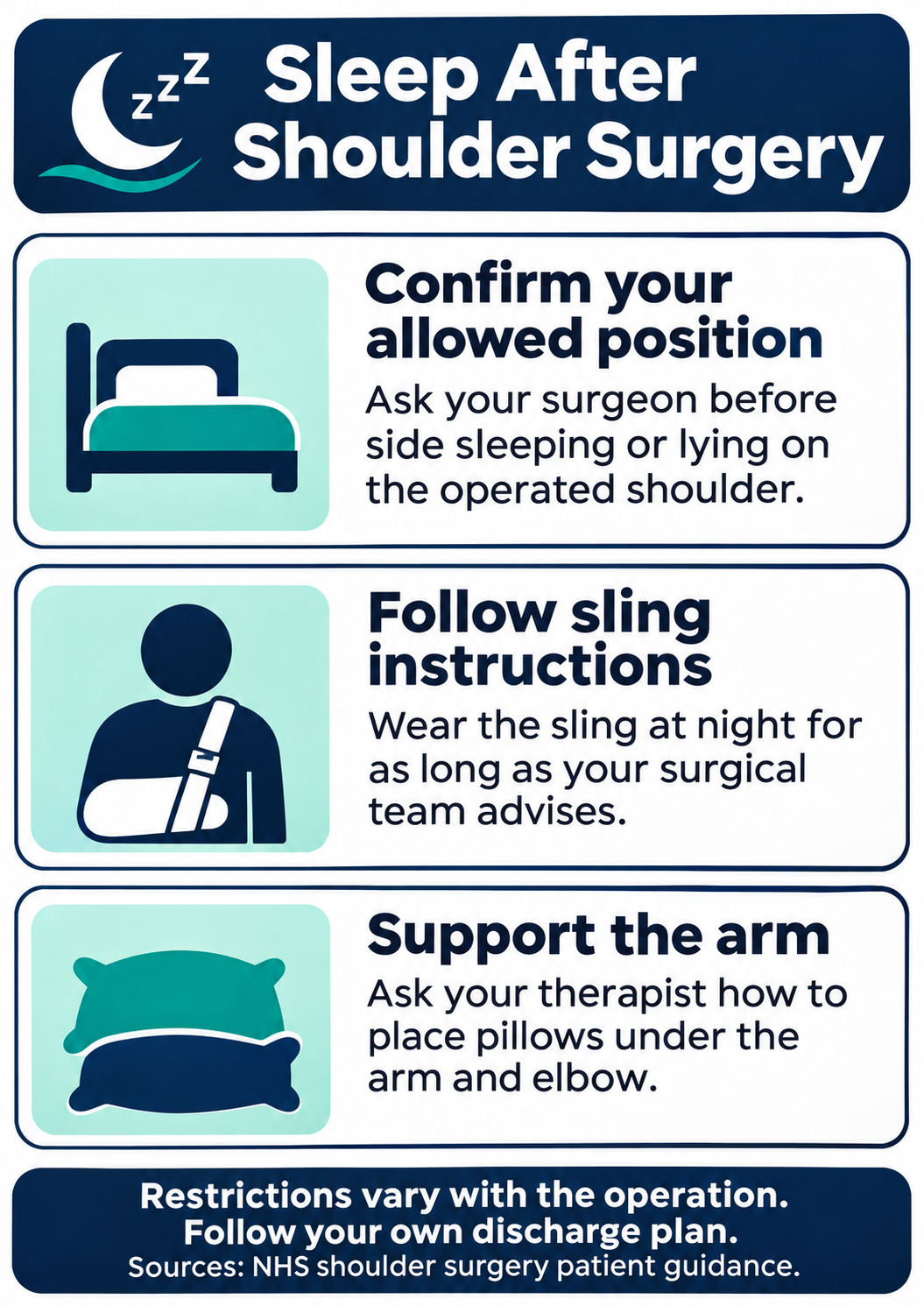
In most cases, the safest side to sleep on is the side opposite your operated shoulder. If your right shoulder was repaired, sleep on your left side with the right arm supported in front of you. If your left shoulder was repaired, sleep on your right side.
Side sleeping on the non-operated side works because it keeps the surgical shoulder elevated and unloaded. The arm rests forward on a pillow rather than hanging down or being compressed under your body. This position also keeps the shoulder in a relatively neutral alignment instead of letting it roll backward, which can strain the front of the joint.
- Right shoulder surgery: sleep on your left side, with the right arm propped forward on a pillow.
- Left shoulder surgery: sleep on your right side, with the left arm propped forward.
- Both shoulders operated: back sleeping with pillows under both arms is usually the practical choice.
- Rotator cuff repair with a strict sling protocol: follow your surgeon’s sling instructions at night, even while side sleeping.
When Can You Actually Start Side Sleeping?
There is no single universal timeline, and any specific date should come from your surgeon. What can be explained is how the decision is usually made: it depends on the procedure, the tissue quality found during surgery, and your surgeon’s protocol.
Many surgeons ask patients to sleep in a sling or on their back for the first several weeks after a rotator cuff repair. Others allow side sleeping on the unaffected side earlier, provided the operated arm is well supported. Simpler procedures, such as some arthroscopic cleanups, and shoulder replacements often follow different, sometimes looser, sleep rules. The size and location of a tear matter too: a small debridement and a large full-thickness repair do not place the same demands on healing tissue.
- Ask at your pre-op appointment: “What sleep position is allowed, and for how long?”
- Ask whether you must wear the sling in bed, and in which position.
- Ask what counts as a safe roll onto the operated side, if it is ever allowed.
- Write the answer down, because the first week at home is not the time to rely on memory.
How to Set Up Your Bed for Side Sleeping
The goal is simple: keep the operated arm supported, slightly forward, and close to the level of your shoulder. A pillow arrangement that does this takes a few minutes to build and makes a real difference to comfort and safety.
Here is a setup commonly recommended to patients who are cleared for side sleeping on the unaffected side:
- Place a medium pillow between your knees to keep your hips and spine aligned.
- Place a pillow in front of your chest and rest the operated forearm on it, elbow bent and hand near shoulder height.
- Add a small rolled towel under the operated elbow if the arm tends to drift down.
- Keep the operated shoulder slightly forward, not rolled back behind your body.
- Use a pillow behind your back to stop you rolling onto the operated side during the night.
A body pillow or a long pregnancy-style pillow can replace several of these at once. Some patients also find a sling with a pillow attachment helpful, though this should be cleared with your surgical team first. Mattress firmness matters as well: a very soft mattress lets the body sink and the operated shoulder slope downward, so you may need a firmer pillow to compensate.
Back Sleeping: The Reliable Backup Plan
Back sleeping is the position most surgeons recommend for the first weeks, and it is worth making it comfortable rather than fighting it. Elevating your upper body slightly on a wedge or stacked pillows reduces the pull on the healing shoulder and can ease swelling.
If you struggle to stay on your back, try these adjustments:
- Prop your head and upper back at a gentle incline, not flat.
- Place a pillow under the operated arm so the elbow is supported at roughly shoulder height.
- Use pillows along both sides of your body to create a nest that limits rolling.
- Keep the room dark and cool, and avoid screens in bed if you are struggling to fall asleep.
Many patients find back sleeping uncomfortable for the first week and then adapt. If pain is the reason you cannot settle, that is a conversation for your surgeon or physical therapist, not something to push through silently.
Comparison Table: Sleep Positions After Shoulder Surgery
Use this table as a quick reference. Your surgeon’s instructions always take priority over general guidance.
| Sleep Position | Typical Suitability | Key Support Needed | Main Risk to Watch |
|---|---|---|---|
| Side, non-operated side | Often allowed once your surgeon clears it | Pillow in front for the operated arm; pillow between knees | Arm drifting down or rolling forward too far |
| Side, operated side | Usually avoided in early recovery | Not recommended without explicit clearance | Direct compression and twisting of the repair |
| Back with arm support | Common early recommendation | Wedge or pillows; pillow under the operated arm | Rolling onto the operated side during sleep |
| Reclined or semi-upright | Sometimes used for comfort or swelling | Wedge, recliner, or adjustable bed | Neck strain if head support is poor |
| Stomach | Generally avoided | Not practical for most shoulder repairs | Shoulder rotation and arm overhead position |
The Sling Question at Night
Whether you wear your sling in bed is a surgeon-specific decision. Some protocols require it for several weeks, including at night, while others allow it off once you are settled. Do not guess.
If you are told to wear the sling overnight, check that the strap is not digging into your neck and that your hand is supported. A poorly fitted sling can cause more sleep disruption than the shoulder itself. Your clinic or therapist can usually adjust the fit in a few minutes. If the sling includes an abduction pillow, confirm with your care team whether it stays on during sleep or comes off.
Practical Tips for Sleeping Better in the First Weeks
Sleep after shoulder surgery is often broken for the first week or two, and that is normal. Planning around it helps more than trying to force eight uninterrupted hours.
- Take pain medication as prescribed, timed so it is working when you go to bed.
- Nap during the day when you can; sleep debt makes pain feel worse.
- Keep a small pillow or rolled towel within reach in case you need to reposition at night.
- Avoid alcohol, which disrupts sleep and can interact with pain medication.
- Do your gentle exercises earlier in the day rather than right before bed.
- If you wake in pain, sit up, support the arm, and let the pain settle before trying again.
- Keep a consistent bedtime routine and a cool, dark room to help your body adjust to an unfamiliar sleeping position.
When to Call Your Surgeon
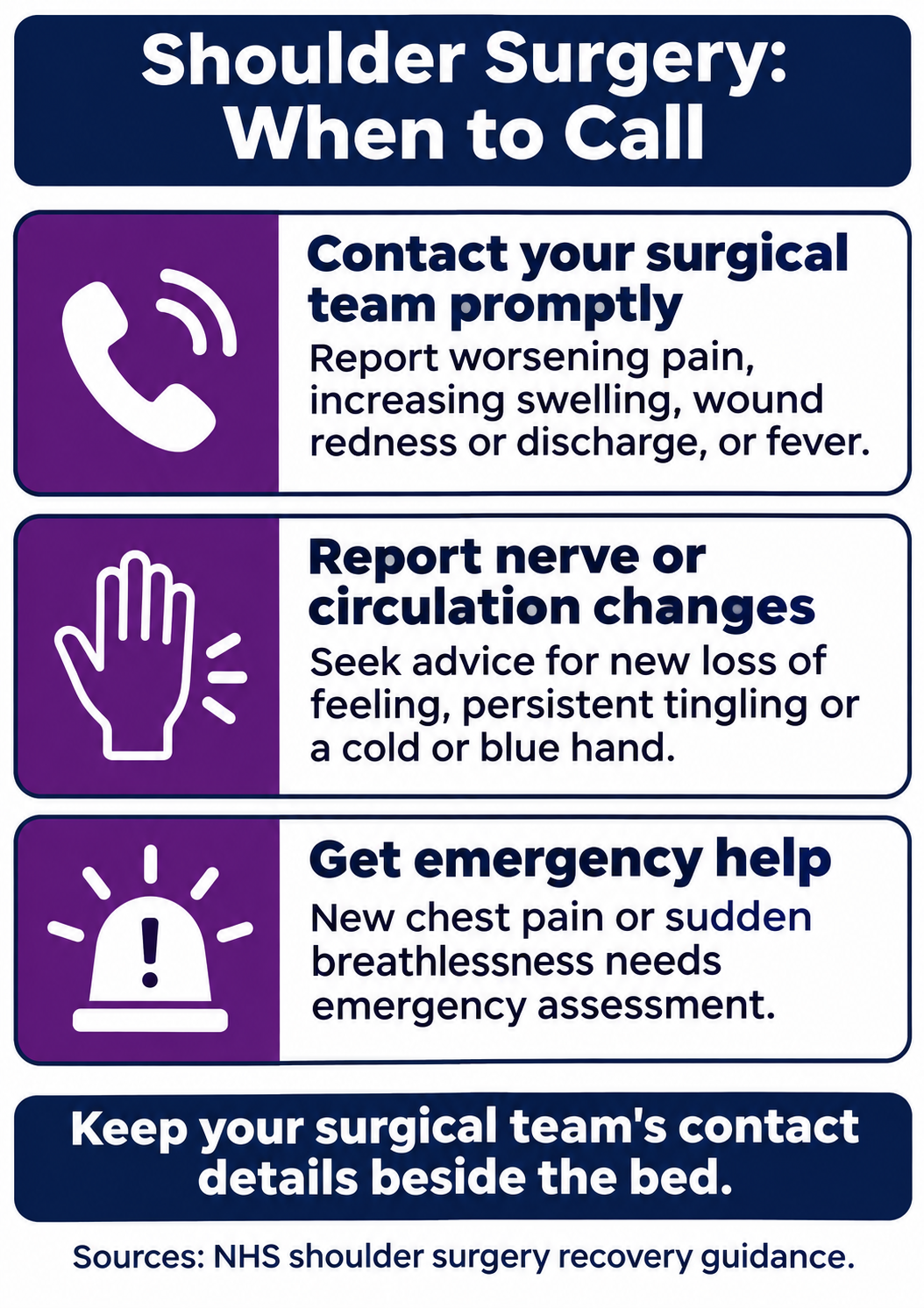
Some nighttime discomfort is expected. Other symptoms are not, and they should be reported promptly.
- New or worsening pain that does not settle with your prescribed medication.
- Swelling, redness, or warmth around the incision.
- Fever or feeling generally unwell.
- Numbness, tingling, or weakness in the hand or fingers that is new.
- Any feeling that the shoulder gave way or that something changed suddenly.
These are general red flags, not a complete list. Your surgical team’s after-hours instructions are the right place to check specific concerns. The American Academy of Orthopaedic Surgeons patient information library also offers reliable general information on shoulder surgery recovery, though it does not replace your own surgeon’s advice.
Working With Your Physical Therapist on Sleep Positioning
A physical therapist can look at your actual bed setup, your sling, and your shoulder mobility and give you a positioning plan that fits your body. This is often more useful than a generic list of tips.
Bring a photo of your bed and pillows to your first post-op visit, or describe them clearly. Small details, such as a very soft mattress or a high pillow, change what will work for you. Your therapist can also advise on how to transition from back sleeping to side sleeping as your surgeon’s restrictions lift, and how to pace daytime activity so you are tired enough to sleep at night.
If you want to understand the rehabilitation side of recovery in more detail, the American Physical Therapy Association provides general information about what physical therapy involves. Your individual program, however, should come from your own therapist and surgeon.
Conclusion
Side sleeping after shoulder surgery is usually possible, but the safe side is the one opposite your operated shoulder, and only once your surgeon allows it. Build a pillow setup that supports the operated arm in front of you, keep a pillow behind your back to prevent rolling, and treat back sleeping as a reliable backup in the early weeks. If pain, swelling, or new symptoms appear at night, contact your surgical team rather than waiting it out.
Frequently Asked Questions
Can I sleep on my side the night after shoulder surgery?
In most cases, no. The first night is usually spent on your back with the operated arm supported, often in a sling, as directed by your surgeon. Follow your discharge instructions exactly, and call your surgical team if you are unsure which position is allowed.
Can I sleep on the operated side if it feels comfortable?
Comfort is not a reliable guide in early recovery. Lying on the operated side can compress and twist the repair even if it does not hurt much at the time. Wait for explicit clearance from your surgeon before trying it.
How long do I need to sleep on my back after a rotator cuff repair?
This varies by surgeon and by the size and type of tear. Many protocols ask for back sleeping or sling use at night for several weeks, but the exact timeline should come from your own surgical team. Ask before surgery so you can prepare your bed.
What is the best pillow for side sleeping after shoulder surgery?
A medium-firm pillow in front of your chest to support the operated forearm, plus a pillow between your knees and one behind your back, works well for most people. A body pillow can replace several of these. Very soft pillows tend to let the arm drift down.
Can I use a recliner instead of a bed?
Some patients find a recliner easier for the first week or two because it limits rolling and keeps the upper body slightly elevated. Check with your surgeon whether reclined sleeping fits your protocol. If you use one, make sure your neck and operated arm are both well supported.
Is it normal to wake up several times a night after shoulder surgery?
Yes, broken sleep is common in the first week or two. Pain, the sling, and unfamiliar sleeping positions all contribute. If sleep does not improve or pain is poorly controlled, speak with your surgical team.
Can I roll onto my operated side while asleep?
It can happen, especially in the early weeks. Placing a pillow behind your back creates a physical barrier that reduces the chance. If you wake on the operated side with new pain or swelling, contact your surgeon.
Does the type of shoulder surgery change sleep rules?
Yes. Rotator cuff repairs, shoulder replacements, and arthroscopic procedures often have different restrictions and timelines. Always follow the protocol for your specific procedure rather than general advice from others.
Can I take sleeping medication after shoulder surgery?
Only with your surgeon’s or pharmacist’s approval. Some sleep aids and sedatives can interact with pain medication or increase fall risk. Ask before taking anything new, including over-the-counter products.
When should I call my surgeon about sleep-related problems?
Call if you have new or worsening pain, swelling, redness, fever, numbness or tingling in the hand, or a sudden change in how the shoulder feels. These are general warning signs, and your surgical team’s after-hours instructions should guide you on where to call.