The elbow joint presents an ideal anatomical region for ultrasound examination due to the relatively superficial location of most clinically relevant structures. This elbow ultrasound imaging modality provides excellent visualization of tendons, ligaments, nerves, and joint spaces, making it an invaluable tool for diagnosing elbow pathology.
The Elbow Ultrasound examination is performed systematically from four distinct approaches: anterior, medial, lateral, and posterior views, each optimized to visualize specific anatomical structures.
Key structures examined during elbow ultrasonography include the distal biceps tendon, brachialis tendon, common extensor and flexor tendons, lateral and medial collateral ligaments, triceps tendon, and the median, ulnar, and radial nerves.
Elbow Ultrasound examination
Anterior View Examination
The anterior examination begins with the patient’s forearm in full supination. The ultrasound transducer is positioned in the transverse axis just proximal to the elbow joint, allowing clear visualization of the distal biceps brachii tendon and surrounding structures.
Anatomical Landmarks and Normal Appearance
In the transverse view, the cortex of the distal humerus appears as a hyperechoic curved line at the bottom of the image. The brachialis muscle is visualized inferiorly, while the biceps brachii appears superior to it. Normal muscle tissue demonstrates a characteristic hypoechoic appearance with hyperechoic fibro-adipose separations creating a feathery pattern throughout the muscle belly.
See Also: Elbow Anatomy

Biceps Tendon Visualization
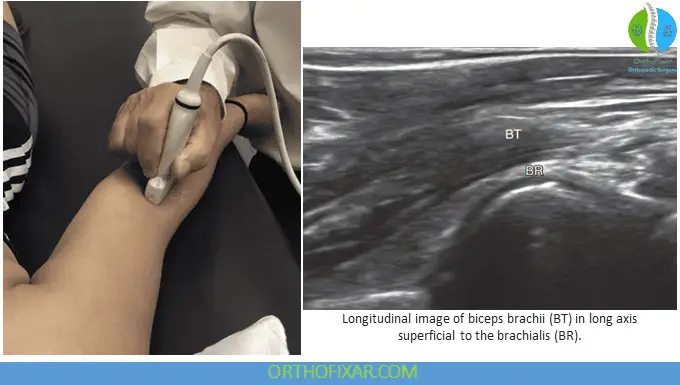
To examine the biceps tendon in its longitudinal axis, the transducer is rotated 90 degrees. The normal biceps tendon appears as a long, fibrillar structure with uniform thickness and characteristic parallel hyperechoic lines representing the tendon fibers. This fibrillar pattern is crucial for distinguishing normal from pathological tendon tissue.
Alternative Lateral Approach
When anterior visualization proves challenging, an alternative lateral approach can be employed. The probe is positioned longitudinally over the lateral arm with the forearm supinated and elbow flexed to 90 degrees. In this position, the transducer lies in the short axis across the proximal radius, revealing the curved echogenic structure of the radial head. Dynamic examination during forearm pronation and supination allows observation of the biceps tendon movement and radial head rotation.
Brachialis Tendon Assessment
The brachialis tendon lies deep to the biceps brachii tendon and is best visualized with the transducer placed in the long axis along the anterior brachium. The coronoid and radial fossae may appear as concavities in the distal humerus, with the brachialis muscle overlying these anatomical depressions.
See Also: Elbow X-Rays Views
Lateral View Examination
Common Extensor Tendon
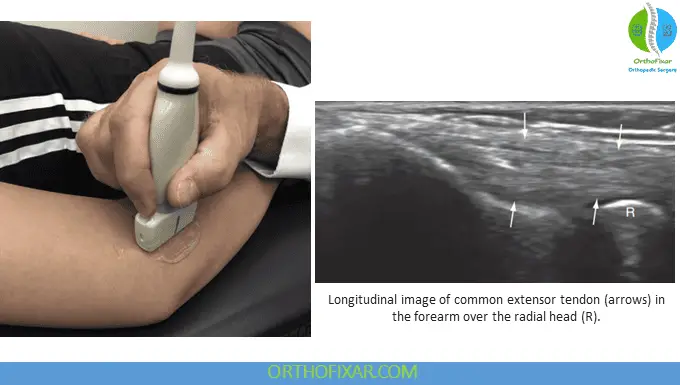
The lateral elbow ultrasound examination focuses primarily on the common extensor tendon, visualized with the transducer positioned in the long axis relative to the radius. Key bony landmarks include the hyperechoic radial head and capitellum. The common extensor tendon originates from the lateral epicondyle and displays the characteristic fibrillar hyperechoic appearance of normal tendon tissue.
Common Flexor Tendon
From the medial aspect of the elbow, the common flexor tendon is examined with the transducer placed in the long axis relative to the ulna. This tendon appears hyperechoic and fibrillar near its origin at the medial epicondyle, gradually transitioning to a hypoechoic appearance as it becomes more muscular distally.
Lateral Collateral Ligament Complex
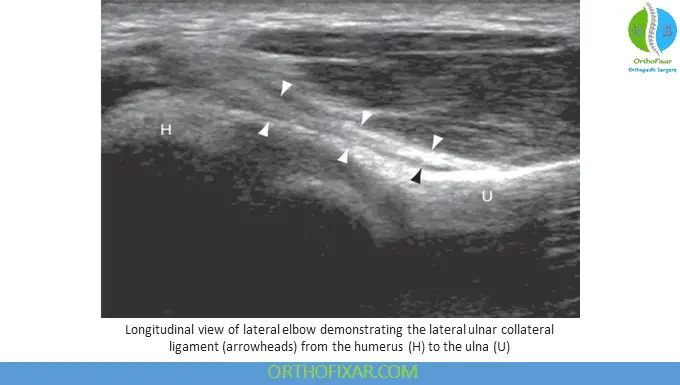
The lateral collateral ligament presents a diagnostic challenge due to its similarity in appearance to the common extensor tendon. Differentiation requires following these structures distally, where the deeper radial collateral ligament attaches to the annular ligament immediately over the radial head, while the common extensor tendon becomes increasingly muscular superficially. The lateral ulnar collateral ligament (LUCL) can be visualized by angling the transducer posteriorly from the distal humerus to the ulna, appearing as a hyperechoic, fibrillary structure.
Radial Nerve Identification
The radial nerve is located laterally between the brachialis and brachioradialis muscles. In short-axis view, it appears as hypoechoic fascicles surrounded by a hyperechoic epineurium. The nerve can be traced proximally as it traverses the intermuscular fascia and follows the humeral shaft. Longitudinal examination is achieved by rotating the transducer 90 degrees, allowing visualization of the nerve’s branching pattern as it divides into deep and superficial branches.
Medial View Examination
The medial elbow ultrasound examination requires the elbow in near-full extension or slight flexion with the forearm supinated. The transducer is initially placed in the long axis with respect to the forearm.
Anatomical Structures
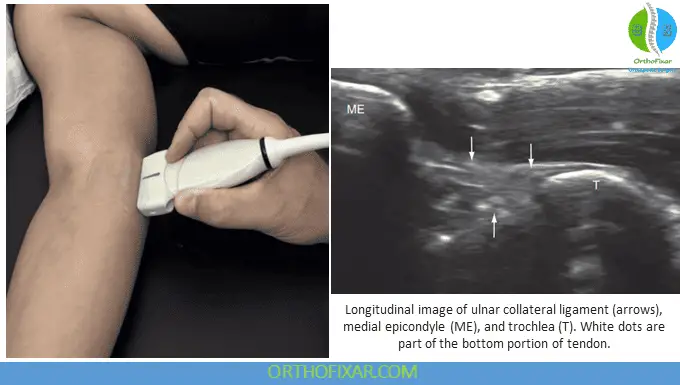
The bony contours of the medial epicondyle and proximal ulna serve as primary landmarks. Between these prominences lie the common flexor tendon superficially and the ulnar collateral ligament in a deeper plane. The common flexor tendon maintains its hyperechoic, fibrillar appearance proximally before transitioning to hypoechoic muscle tissue distally.
Ulnar Collateral Ligament Assessment
The ulnar collateral ligament appears hyperechoic and fibrillar when properly visualized. Critical attention must be paid to maintaining perpendicular orientation to avoid anisotropy artifacts that can make the ligament appear less uniform or pathological. Ligament thickness varies among individuals and has been documented to increase in professional baseball players correlating with years of experience, representing adaptive changes to repetitive stress.
Posterior View Examination
Triceps Tendon and Olecranon Bursa
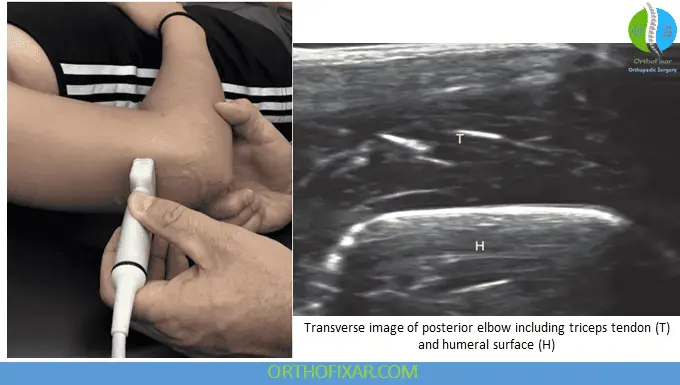
The posterior elbow ultrasound examination visualizes the triceps tendon, anconeus muscle, and ulnar nerve. With the elbow flexed to 90 degrees and the arm resting on a table, the transducer is placed in short axis and moved from the olecranon process to the myotendinous junction. Careful probe manipulation may reveal the distinct medial, lateral, and deep components of the triceps tendon complex.
Triceps Tendon Characteristics
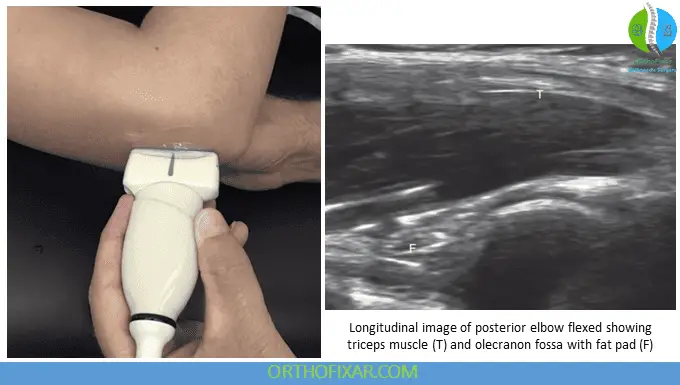
The triceps tendon demonstrates a fibrillar pattern similar to other tendons. Longitudinal examination, achieved by rotating the transducer 90 degrees, reveals the tendon as a linear structure with internal striations thought to represent fat between tendon fibers. Following the tendon distally shows its insertion over the olecranon and relationship to the olecranon fossa.
Joint Effusion Detection
Elbow effusion can be detected by flexing the joint to 45 degrees, which displaces fluid posteriorly into the olecranon recess. Gentle probe pressure can detect even minimal amounts of intra-articular fluid, making this technique highly sensitive for identifying joint pathology.
Anconeus Epitrochlearis Muscle
In select individuals, the anconeus epitrochlearis muscle may be visualized as an accessory muscle between the posterior medial epicondyle and the medial olecranon. This structure appears as a small, isolated ovoid mass forming the floor of the condylar groove, superficial to the ulnar nerve.
Ulnar Nerve Examination
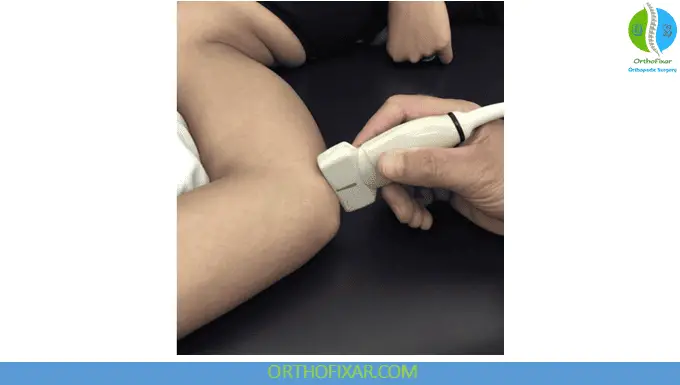
The ulnar nerve is located at the medial aspect of the elbow and is best visualized with the transducer in short axis over the posterior medial elbow, spanning the olecranon and medial epicondyle. The nerve appears as a hypoechoic structure within a hyperechoic nerve sheath. Dynamic examination during elbow flexion and extension allows assessment of normal nerve translation versus pathological subluxation over the medial epicondyle.
Clinical Applications and Diagnostic Considerations
Elbow ultrasonography provides valuable diagnostic information for numerous pathological conditions including tendinopathies, ligament injuries, nerve entrapments, and joint effusions. The technique offers several advantages including real-time imaging, dynamic assessment capabilities, lack of ionizing radiation, and cost-effectiveness compared to other imaging modalities.
Understanding normal anatomical variants and maintaining proper scanning techniques are essential for accurate interpretation. Common pitfalls include anisotropy artifacts, inadequate penetration in muscular patients, and confusion between similar-appearing structures such as tendons and ligaments.
The systematic approach outlined in this guide ensures comprehensive elbow ultrasound examination while maintaining efficiency in clinical practice. Correlation with clinical findings and patient symptoms remains paramount for optimal diagnostic accuracy and treatment planning.
References & More
- Martinoli C, Bianchi S, Giovagnorio F, Pugliese F. Ultrasound of the elbow. Skeletal Radiol. 2001 Nov;30(11):605-14. doi: 10.1007/s002560100410. Epub 2001 Aug 30. PMID: 11810151. PubMed
- Deniel A, Causeret A, Moser T, et al. Entrapment and traumatic neuropathies of the elbow and hand: an imaging approach. Diagn Interv Imaging. 2015;96(12):1261–1278. PubMed
- Atanda A, Buckley PS, Hammoud S, et al. Early anatomic changes of the ulnar collateral ligament identified by stress ultrasound of the elbow in young professional baseball pitchers. Am J Sports Med. 2015;43(12):2943–2949. PubMed
- Tagliafico A, Gandolfo N, Michaud J, et al. Ultrasound demonstration of distal triceps tendon tears. Eur J Radiol. 2012;81(6):1207–1210.
- Tagliafico AS, Bignotti B, Martinoli C, Elbow US. Anatomy, variants, and scanning technique. Radiology. 2015;275(3):636–650.
- Orthopedic Physical Assessment by David J. Magee, 7th Edition.