Introduction to Veins Anatomy
Veins are an essential component of the cardiovascular system, responsible for returning deoxygenated blood back to the heart. Unlike arteries, veins operate under low pressure and are uniquely adapted to store and transport large volumes of blood. In fact, veins can contain up to two-thirds of the body’s circulating blood volume, making them critical in blood volume regulation and venous return.
Understanding veins anatomy is particularly important in clinical practice, as venous disorders such as varicose veins, deep vein thrombosis (DVT), and chronic venous insufficiency are common—especially in the lower limbs.
Structural Characteristics of Veins
Thin Walls and High Distensibility
Unlike arteries, veins have:
- Thin walls
- Large lumens
- High distensibility
These features allow veins to accommodate significant changes in blood volume with minimal increases in pressure.
Layers of the Vein Wall
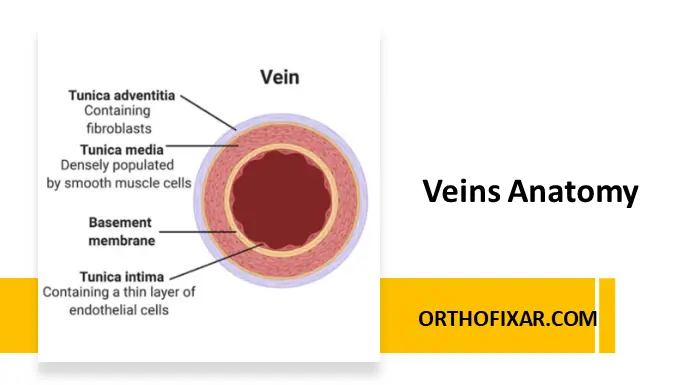
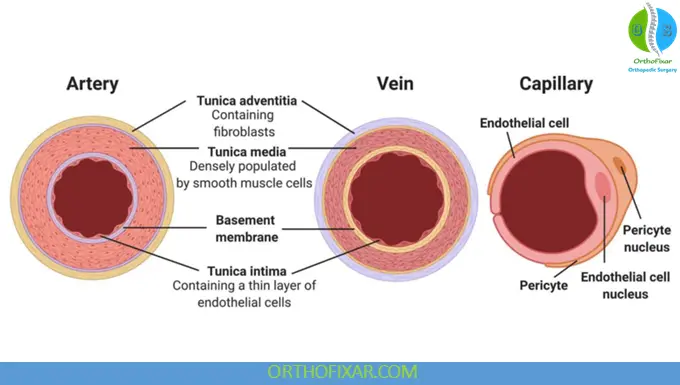
Veins consist of three histological layers:
1. Tunica Intima
- Lined by non-thrombogenic endothelium
- Contains unidirectional venous valves that protrude into the lumen
- These valves prevent retrograde blood flow and promote venous return toward the heart
2. Tunica Media
- Thinner than arterial media
- Contains circumferential rings of smooth muscle and elastic tissue
- Allows changes in vein caliber in response to minor changes in venous pressure
3. Tunica Adventitia
- The thickest layer in veins
- Provides structural support and anchoring to surrounding tissues
See Also: Arteries Anatomy
Venules and Venous Plexuses
The smallest veins, known as venules, drain blood from capillary beds. These venules interconnect to form venous plexuses, which play an important role in regional circulation.
Common examples include:
- Prostatic venous plexus
- Rectal venous plexus
These plexuses provide alternate pathways for blood flow and are clinically relevant in conditions such as portal hypertension.
Major Venous Pathways to the Heart
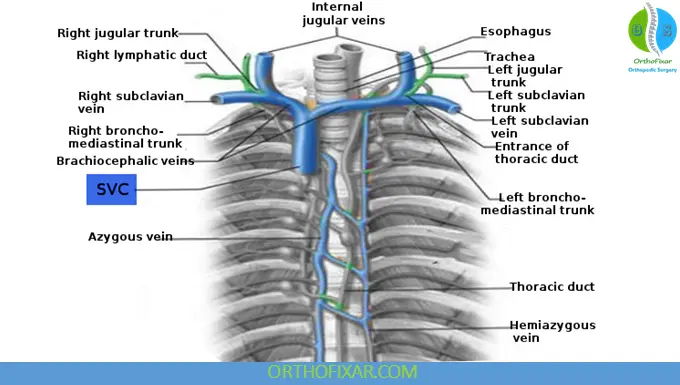
Superior Vena Cava System
Veins from the:
- Upper limbs
- Head and neck
- Upper trunk
Drain into the superior vena cava (SVC), which empties directly into the right atrium of the heart.
Inferior Vena Cava System
Veins from the:
- Lower limbs
- Pelvis
- Abdominal organs
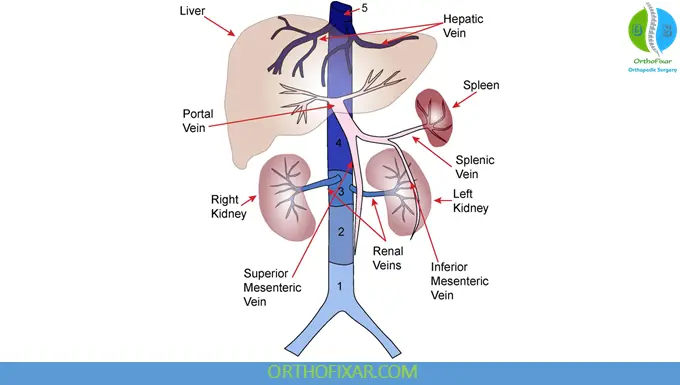
Drain into the inferior vena cava (IVC), with one important exception—the portal circulation.
Portal Venous System and the Liver
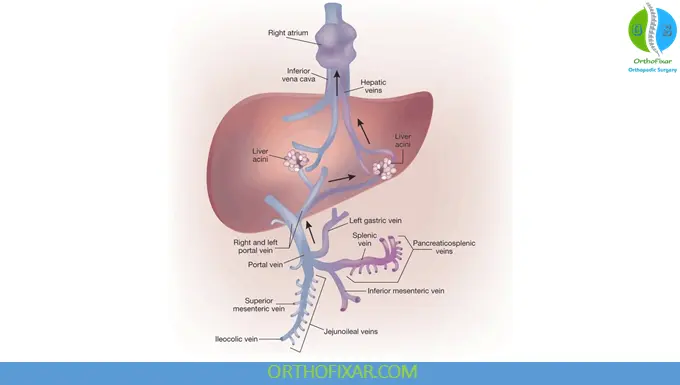
The portal vein is formed by the union of:
- Superior mesenteric vein
- Splenic vein
It supplies approximately 75% of the liver’s blood flow, rich in nutrients absorbed from the gastrointestinal tract. This flow is supplemented by oxygenated blood from the hepatic artery.
Blood passes through the hepatic sinusoids and then drains via three major hepatic veins into the inferior vena cava.
Veins of the Lower Limbs: Clinical Significance
Due to their weaker wall structure and exposure to gravity, leg veins are particularly vulnerable to:
- Irregular dilatation (varicose veins)
- Compression
- Venous ulcers
- Tumor invasion
For this reason, lower limb venous anatomy warrants special clinical attention.
Deep and Superficial Venous System of the Legs
Deep Venous System
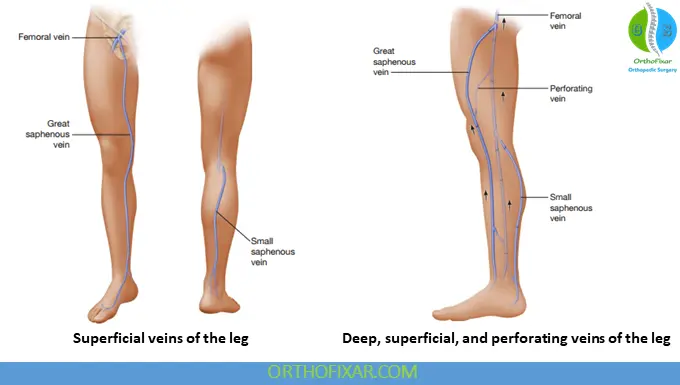
- Carries approximately 90% of venous return from the lower extremities
- Located deep within the muscles
- Well supported by surrounding tissues
- Includes veins accompanying major arteries (e.g., femoral, popliteal veins)
Superficial Venous System
Located within the subcutaneous tissue and has relatively poor structural support.
Key superficial veins include:
Great Saphenous Vein
- Originates on the dorsum of the foot
- Passes anterior to the medial malleolus
- Ascends along the medial leg and thigh
- Joins the femoral vein below the inguinal ligament
Small Saphenous Vein
- Begins on the lateral side of the foot
- Ascends along the posterior calf
- Drains into the popliteal vein in the popliteal fossa
Perforating and Anastomotic Veins
- Anastomotic veins connect the great and small saphenous veins and may become visible when dilated
- Perforating (bridging) veins connect the superficial venous system to the deep venous system
When functioning normally, these veins allow blood to flow from superficial to deep veins only.
Venous Valves and the Calf Muscle Pump
Role of Venous Valves
- One-way valves in deep, superficial, and perforating veins
- Prevent venous reflux and pooling
- Reduce venous stasis
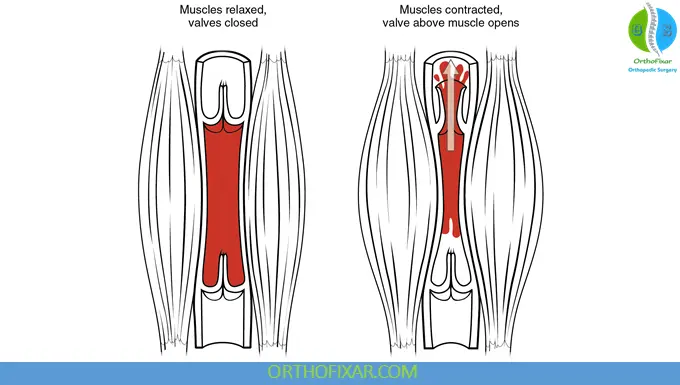
Calf Muscle Pump
- Contraction of calf muscles during walking compresses deep veins
- Acts as a peripheral heart, propelling blood upward against gravity
- Essential for efficient venous return from the lower limbs
Clinical Relevance of Veins Anatomy
A solid understanding of veins anatomy is crucial for:
- Diagnosing venous insufficiency
- Preventing deep vein thrombosis
- Managing varicose veins
- Interpreting vascular imaging
- Performing safe venipuncture and cannulation
Conclusion
Veins are highly specialized vessels designed for low-pressure blood return and volume storage. Their unique anatomy—thin walls, valves, venous plexuses, and reliance on muscle pumps—makes them both efficient and vulnerable. Mastery of veins anatomy is essential for healthcare professionals involved in cardiovascular, surgical, and rehabilitative care.
References & More
- Tucker WD, Arora Y, Mahajan K. Anatomy, Blood Vessels. [Updated 2023 Aug 8]. In: StatPearls [Internet]. Treasure Island (FL): StatPearls Publishing; 2025 Jan-. Available from: Pubmed
- Bickley, L. S., Szilagyi, P. G., Hoffman, R. M., & Soriano, R. P. (2021). Bates’ guide to physical examination and history taking, 12e.
- Current Progress in Vascular Engineering and Its Clinical Applications – Scientific Figure on ResearchGate. Available from: Researchgate
- Flushing Out Antibodies to Make AAV Gene Therapy Available to More Patients – Scientific Figure on ResearchGate. Available from: Researchgate
- White HJ, Soos MP. Anatomy, Thorax, Superior Vena Cava. [Updated 2023 Sep 4]. In: StatPearls [Internet]. Treasure Island (FL): StatPearls Publishing; 2025 Jan-. [Figure, Superior vena cava Image courtesy O.Chaigasame] Available from: Pubmed
[…] Superficial veins […]