Understanding Anatomical terminology is the foundation of medical education, clinical practice, radiology, surgery, physiotherapy, and orthopaedics. Standardized anatomical language allows healthcare professionals worldwide to communicate accurately without confusion.
Common everyday descriptions such as “front,” “back,” “upper,” “lower,” “bow legs,” or “knock knees” are familiar but lack precision. For this reason, medicine uses universally accepted anatomy terminology to describe body positions, movements, planes, and relationships.
This guide explains the essential concepts of anatomy medical terminology, including anatomical position, body planes, directional terms, and joint movements.
What Is Anatomical Terminology?
Anatomical terminology refers to the standardized language used to describe the structure, position, orientation, and movement of the human body.
These terms are essential in:
- Anatomy education
- Clinical examination
- Orthopaedic assessment
- Radiology interpretation
- Surgical procedures
- Medical documentation
Without standard terminology, medical communication would become inaccurate and potentially dangerous.
Anatomical Position
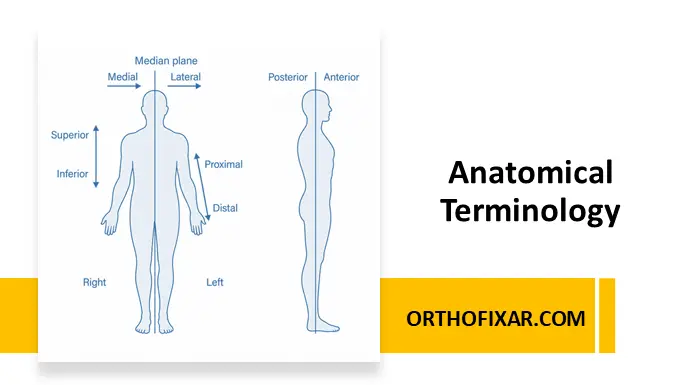
The reference point for all anatomical descriptions is the anatomical position.
Definition of Anatomical Position
The body is considered to be:
- Standing erect
- Facing forward
- Legs together
- Knees pointing forward
- Arms by the sides
- Palms facing forward
This standard position ensures consistency when describing body parts and movements.
Importance of Anatomical Position
All directional terms, body planes, and movements are described relative to this position, regardless of the patient’s actual posture.
Principal Planes of the Body
The body is divided into specific planes that help describe anatomy and movement.
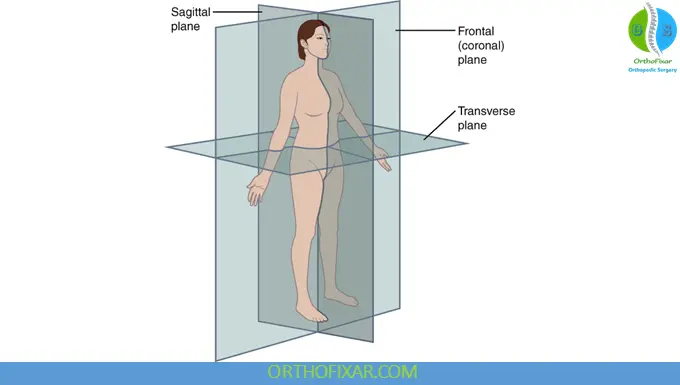
Sagittal Plane
The sagittal plane divides the body into right and left portions.
Types of Sagittal Planes
- Median (midsagittal) plane: divides the body into equal right and left halves
- Parasagittal planes: parallel to the median plane
Clinical Importance
The sagittal plane is important for describing:
- Flexion and extension movements
- MRI and CT scan orientation
- Orthopaedic deformities
Coronal Plane
The coronal plane (also called the frontal plane) divides the body into anterior and posterior sections.
Characteristics
- Vertical orientation
- Perpendicular to the sagittal plane
- Corresponds to a frontal view of the body
Clinical Applications
Coronal planes are used in:
- Shoulder and hip movement analysis
- Radiographic imaging
- Surgical anatomy
Transverse Plane
The transverse plane divides the body into upper and lower sections.
Features
- Horizontal orientation
- Also called the axial plane
Clinical Importance
Used frequently in:
- CT imaging
- Cross-sectional anatomy
- Rotational movement analysis
See Also: Anatomical Planes of the Body: Transverse, Coronal & Sagittal Planes
Directional Terms in Anatomy
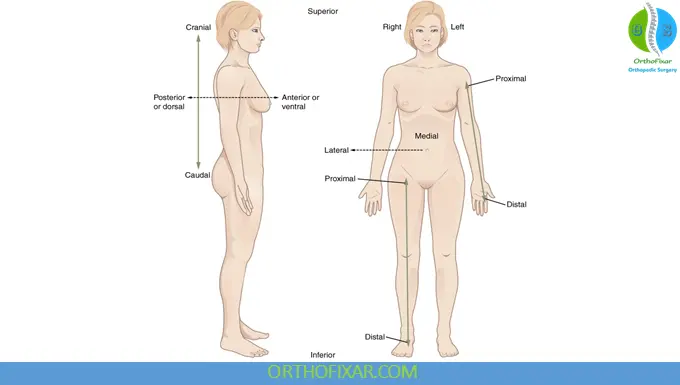
Anterior and Posterior
Anterior
Refers to the front of the body.
Posterior
Refers to the back of the body.
Alternative Terms
- Ventral = anterior
- Dorsal = posterior
Special Note About the Foot
The top surface of the foot is called the dorsum, while the bottom surface is the plantar surface.
Medial and Lateral
Medial
Closer to the midline of the body.
Lateral
Further away from the midline.
Examples
- The thumb is lateral to the little finger.
- The inner thigh is medial.
- The outer thigh is lateral.
Proximal and Distal
These terms are commonly used in the limbs.
Proximal
Closer to the trunk or point of origin.
Distal
Further from the trunk or point of origin.
Example
- The elbow is proximal to the wrist.
- The fingers are distal to the elbow.
Axial and Rotational Alignment
Axial Alignment
Axial alignment describes the longitudinal arrangement of bones or limb segments.
Valgus Alignment
The distal segment angles away from the midline.
Examples:
- Physiologic knee valgus
- “Knock knees”
Varus Alignment
The distal segment angles toward the midline.
Examples:
- Bow legs
- Genu varum
Rotational Alignment
Rotational alignment refers to twisting around a longitudinal axis.
Normal Example
- Patellae face forward
- Feet slightly externally rotated
Significant asymmetry may indicate pathology.
Joint Movements in Anatomical Terminology
Flexion and Extension
These movements occur primarily in the sagittal plane.
Flexion
Bending movement that decreases the angle between bones.
Examples:
- Bending the elbow
- Flexing the knee
Extension
Straightening movement that increases the angle between bones.
Examples:
- Straightening the elbow
- Straightening the knee
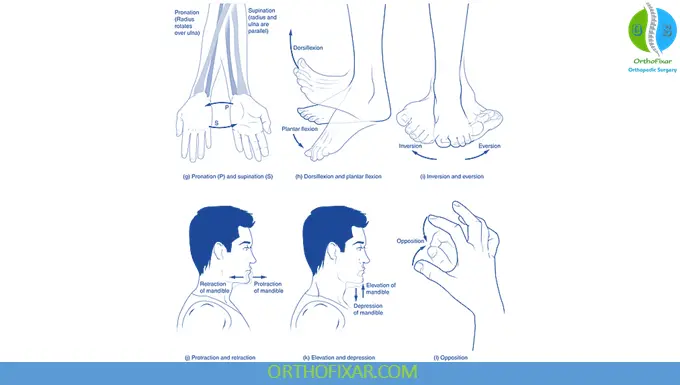
Plantar flexion and Dorsiflexion
These terms specifically describe ankle movements.
Plantarflexion
Pointing the foot downward.
Dorsiflexion
Drawing the foot upward.
Abduction and Adduction
These movements occur in the coronal plane.
Abduction
Movement away from the midline.
Adduction
Movement toward the midline.
Examples
- Raising the arm sideways = abduction
- Returning the arm to the body = adduction
Special Rule for Fingers and Toes
Movements are described relative to the midline of the hand or foot rather than the body.
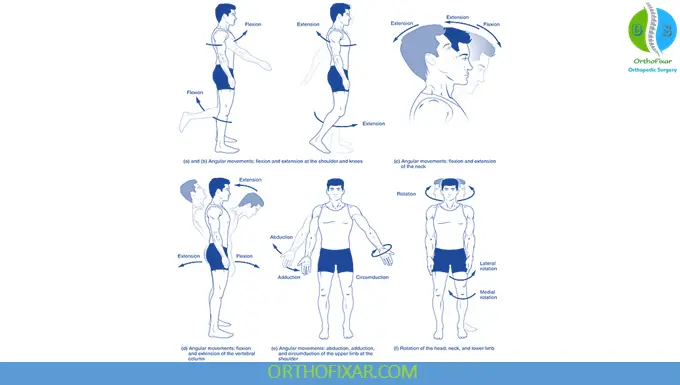
Medial and Lateral Rotation
Medial Rotation
Turning toward the midline.
Lateral Rotation
Turning away from the midline.
These movements occur around a longitudinal axis.
Pronation and Supination
These rotational movements are primarily used for the forearm and foot.
Pronation
- Forearm: Palm turns downward.
- Foot: Associated with flattening and eversion.
Supination
- Forearm: Palm turns upward.
- Foot: Associated with inversion and arch elevation.
Circumduction
Circumduction is a circular movement that combines:
- Flexion
- Extension
- Abduction
- Adduction
It occurs mainly in ball-and-socket joints such as:
- Shoulder joint
- Hip joint
Specialized Anatomical Movements
Some movements are unique to specific body regions.
Examples
- Opposition of the thumb
- Inversion of the foot
- Eversion of the foot
- Lateral flexion of the spine
- Spinal rotation
These are discussed in greater detail in regional anatomy.
Clinical Importance of Anatomical Terminology
Understanding Anatomical terminology is essential because it:
- Improves communication between healthcare professionals
- Prevents medical errors
- Standardizes radiology reports
- Assists surgical planning
- Enhances anatomy education
- Facilitates accurate physical examination
In orthopaedics, precise terminology is especially critical when describing:
- Fractures
- Deformities
- Limb alignment
- Joint movements
- Surgical approaches
Commonly Used Anatomical Terms Table
| Term | Meaning |
|---|---|
| Anterior | Front |
| Posterior | Back |
| Medial | Toward midline |
| Lateral | Away from midline |
| Proximal | Nearer to trunk |
| Distal | Farther from trunk |
| Flexion | Bending |
| Extension | Straightening |
| Abduction | Away from midline |
| Adduction | Toward midline |
| Supination | Palm upward |
| Pronation | Palm downward |
| Valgus | Distal part angled outward |
| Varus | Distal part angled inward |
Conclusion
Mastering anatomy terminology is essential for every medical student and healthcare professional. Standardized anatomical language provides precision when describing body structures, movements, alignments, and relationships.
A clear understanding of body planes, directional terms, and joint movements forms the basis for advanced study in anatomy, orthopaedics, radiology, surgery, and rehabilitation medicine.
Whether interpreting imaging studies, documenting physical examinations, or communicating with colleagues, accurate anatomy medical terminology remains indispensable in modern medicine.
References & More
- Purves D, Augustine GJ, Fitzpatrick D, et al., editors. Neuroscience. 2nd edition. Sunderland (MA): Sinauer Associates; 2001. Some Anatomical Terminology. Available from: Pubmed
- Anatomical terminology – Wikipedia
- Millers Review of Orthopaedics -7th Edition Book.