
The Adductor Hallucis muscle is a critical component of the foot’s muscular architecture, contributing to the complex movements and stability of the foot.
Overview
- Muscle Name: Adductor Hallucis
- Compartment: Central compartment of the sole
- Layer: Third layer of plantar muscles
- Primary Function: Adduction of the great toe (hallux)
Adductor Hallucis Muscle Anatomy
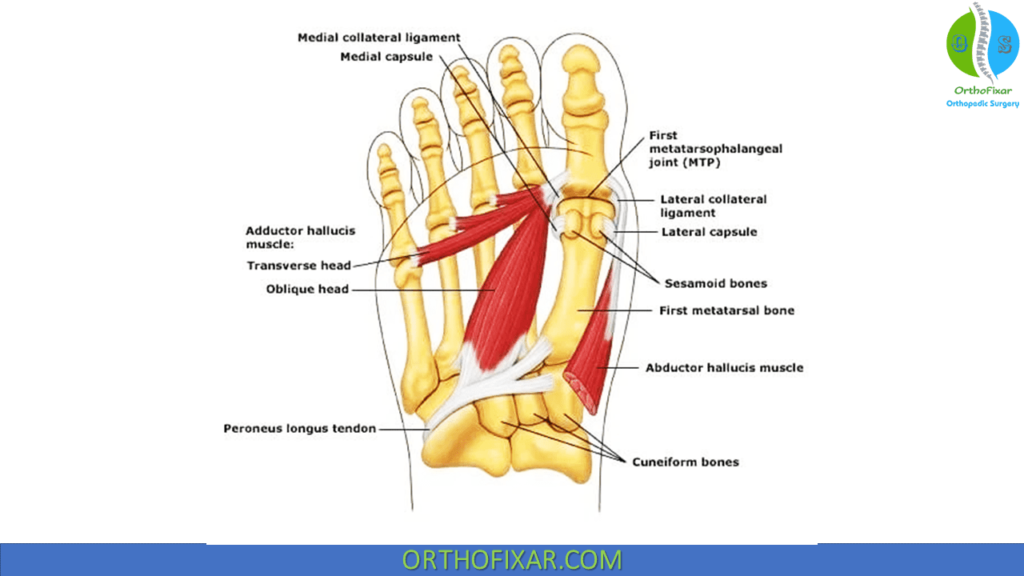
The adductor hallucis has two distinct heads, each with separate origins but a common insertion:
1. Oblique Head
- Origin:
- Bases of the 2nd–4th metatarsals
- Sheath of the fibularis (peroneus) longus tendon
- Fiber Direction: Oblique (posterolateral → anteromedial)
2. Transverse Head
- Origin:
- Plantar ligaments of metatarsophalangeal (MTP) joints (2nd–5th)
- Deep transverse metatarsal ligaments
- Fiber Direction: Horizontal (lateral → medial)
Insertion (Both Heads)
- Lateral side of the base of the proximal phalanx of the great toe
- Lateral sesamoid bone of the first MTP joint
See Also: Foot Anatomy
Innervation
- Nerve: Deep branch of the lateral plantar nerve
- Root Value: S2–S3
This distinguishes it from many other intrinsic foot muscles, which may be innervated by the medial plantar nerve.
Blood Supply
- Primarily from branches of the lateral plantar artery
- Contribution from the plantar arterial arch
Function
Primary Actions
- Adduction of the great toe toward the second toe
- Stabilization of the 1st MTP joint
Secondary Roles
- Supports the transverse arch of the foot
- Assists in maintaining forefoot integrity during push-off phase of gait
- Works synergistically with:
- Flexor hallucis brevis muscle and
- Interossei muscles
| Origin | Oblique Head: Bases of the 2nd, 3rd, and 4th metatarsal bones and sheath of the peroneus longus tendon. Transverse Head: Capsules of the metatarsophalangeal joints and deep transverse metatarsal ligament. |
| Insertion | Lateral side of the base of the proximal phalanx of the big toe, with some fibers attaching to the medial sesamoid bone. |
| Innervation | Lateral plantar nerve (S1, S2). |
| Blood Supply | Arterial supply primarily from branches of the plantar metatarsal arteries, which are branches of the posterior tibial artery. |
| Action | Adduction and flexion of the big toe; stabilization of the transverse arch of the foot during locomotion. |
Clinical Significance
1. Hallux Valgus (Bunion Deformity)
- Imbalance between the adductor hallucis and abductor hallucis contributes to lateral deviation of the great toe
- The adductor hallucis may exacerbate deformity by pulling the hallux laterally
2. Transverse Arch Collapse
- Weakness or dysfunction can contribute to forefoot splaying and pain
3. Surgical Considerations
- The tendon is sometimes released in bunion correction surgery to restore alignment
Diagnostic Approaches
When assessing conditions related to the Adductor Hallucis muscle, healthcare professionals employ a variety of diagnostic tools. Physical examination, focusing on tenderness, swelling, and range of motion, is fundamental. Imaging modalities, including ultrasound and MRI, are invaluable in visualizing the muscle’s structure, detecting abnormalities, and guiding treatment plans.
Treatment Strategies
Treatment of Adductor Hallucis muscle related disorders encompasses a range of conservative to surgical interventions, depending on the severity and underlying cause. Conservative measures include physical therapy, orthotics, and modifications in footwear to alleviate stress on the muscle. In cases where conservative management fails to provide relief, surgical options may be considered to correct anatomical deformities or release tension in the muscle.
References & More
- Clinically Oriented Anatomy – 8th Edition
- Owens S, Thordarson DB. The adductor hallucis revisited. Foot Ankle Int. 2001 Mar;22(3):186-91. doi: 10.1177/107110070102200303. PMID: 11310858. Pubmed
- Arakawa T, Tokita K, Miki A, Terashima T. Anatomical study of human adductor hallucis muscle with respect to its origin and insertion. Ann Anat. 2003 Dec;185(6):585-92. doi: 10.1016/S0940-9602(03)80133-4. PMID: 14704005. Pubmed

Closed.