The Barlow test is a neonatal physical examination maneuver used to detect Developmental Dysplasia of the Hip (DDH). It assesses whether an infant’s hip is unstable and can be dislocated posteriorly from the acetabulum. This test is routinely performed during newborn and early infant examinations, especially within the first few months of life when hip instability is most clinically detectable (infants up to 6 months of age).
The Barlow test is commonly performed together with the Ortolani test, as both maneuvers complement each other in evaluating hip stability.
Anatomy Behind the Test
In infants with developmental dysplasia, the acetabulum is often shallow and does not adequately cover the femoral head. The hip capsule and surrounding ligaments may also be lax.
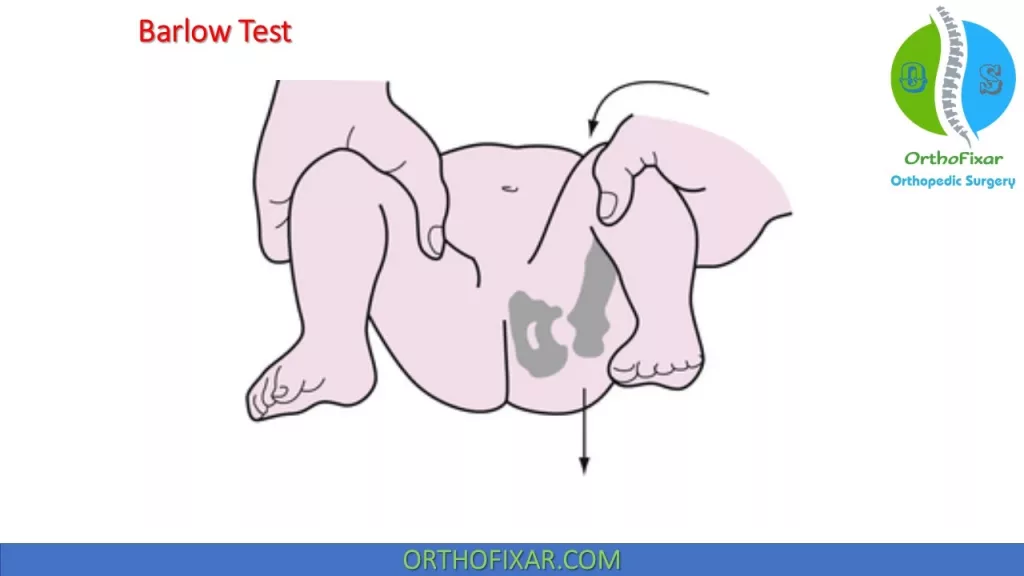
The Barlow maneuver applies posterior-directed pressure to determine whether the femoral head can be displaced from the acetabulum.
How do you perform the Barlow Test?
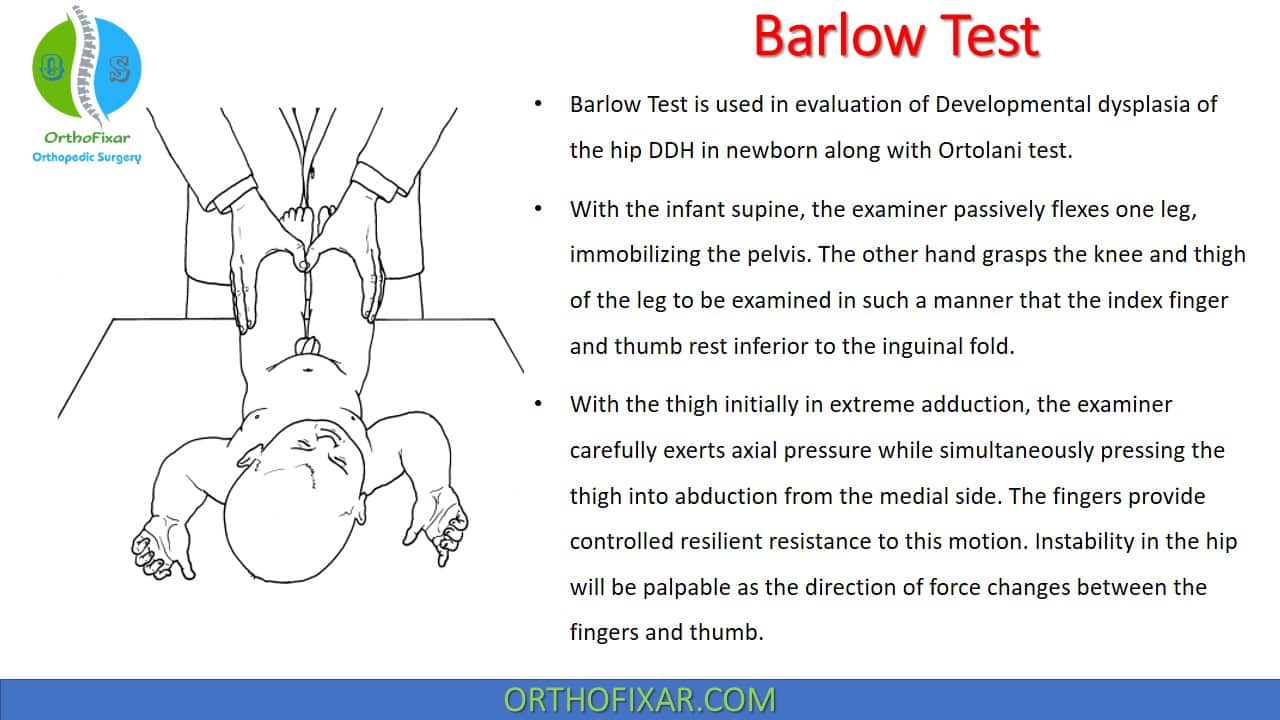
With the infant supine, the examiner passively flexes one leg, immobilizing the pelvis. The other hand grasps the knee and thigh of the leg to be examined in such a manner that the index finger and thumb rest inferior to the inguinal fold.
With the thigh initially in extreme adduction, the examiner carefully exerts axial pressure while simultaneously pressing the thigh into abduction from the medial side. The fingers provide controlled resilient resistance to this motion. Instability in the hip will be palpable as the direction of force changes between the fingers and thumb.
See Also: Ortolani Test
What does a positive Barlow Test mean?
If the hip is dislocatable — that is, if the hip can be popped out of socket with this maneuver — the Barlow Test is considered positive.
The Ortolani maneuver is then used, to confirm the positive finding (i.e., that the hip actually dislocated).
Sensitivity & Specificity
- Sensitivity: 66 %
- Specificity: 95 %
Barlow and Ortolani Test
The examiner attempts to reduce the dislocation or subluxation using the Ortolani and Barlow maneuvers.
- With the newborn supine, the clinician places the tips of the long and index fingers over the greater trochanter, with the thumb along the medial thigh. The infant’s leg is positioned in neutral rotation with 90 degrees of hip flexion and is gently abducted while lifting the leg anteriorly. With abduction one can feel a clunk, as the femoral head slides over the posterior rim of the acetabulum and into the socket. This is the clunk originally described by Ortolani, and is called the sign of entry, as the hip relocates with this maneuver.
- Maintaining the same position, the leg is then gently adducted, while gentle pressure is directed posteriorly on the knee, and a palpable clunk is noted as the femoral head slides over the posterior rim of the acetabulum and out of the socket. This clunk was originally described by Barlow, and is called the sign of exit, as the hip dislocates with this maneuver.
Both Barlow and Ortolani tests are designed to detect motion between the femoral head and the acetabulum.
The reproducibility of these tests is dependent on ligamentous or capsular laxity, which usually disappears by the age of 10–12 weeks.
Barlow Test vs Ortolani Test
| Feature | Barlow Test | Ortolani Test |
|---|---|---|
| Purpose | Detect dislocatable hip | Detect reducible dislocated hip |
| Movement | Adduction + posterior pressure | Abduction + anterior lifting |
| Indicates | Instability | Reduction of dislocation |
Both tests should always be performed together for comprehensive neonatal hip evaluation.

Reference
- Barlow TG: Early diagnosis and treatment of congenital dislocation of the hip. J Bone Joint Surg Br 44:292–301, 1962. PMID: 14080075. Pubmed
- Aronsson DD, Goldberg MJ, Kling TF, et al: Developmental dysplasia of the hip. Pediatrics 94:201–208, 1994. Pubmed
- Clinical Tests for the Musculoskeletal System 3rd Edition.
- Dutton’s Orthopaedic Examination, Evaluation, And Intervention 3rd Edition.