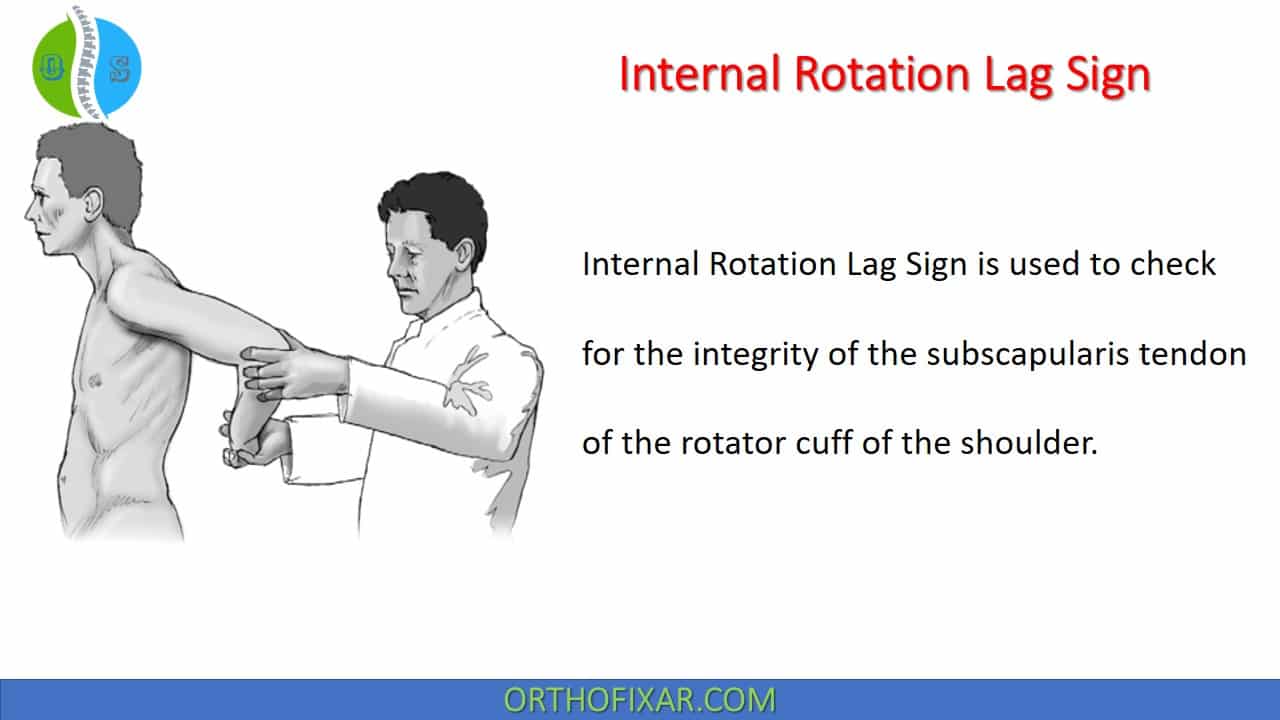
Internal Rotation Lag Sign is used to check for the integrity of the subscapularis tendon of the rotator cuff of the shoulder.
How do you perform Internal Rotation Lag Sign?
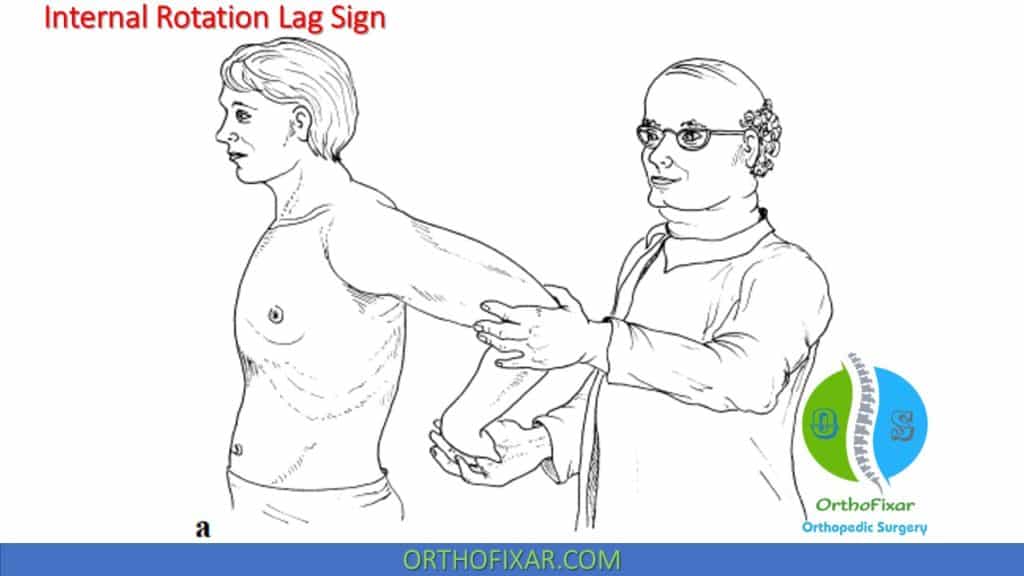
- The patient is sitting or standing with his or her back to the examiner.
- The affected arm is held by the examiner in almost maximal internal rotation.
- The elbow is flexed to 90 degrees, and the shoulder is held at 20 degrees of elevation and 20 degrees of extension.
- The dorsum of the hand is passively lifted away from the lumbar region until almost full internal rotation is reached.
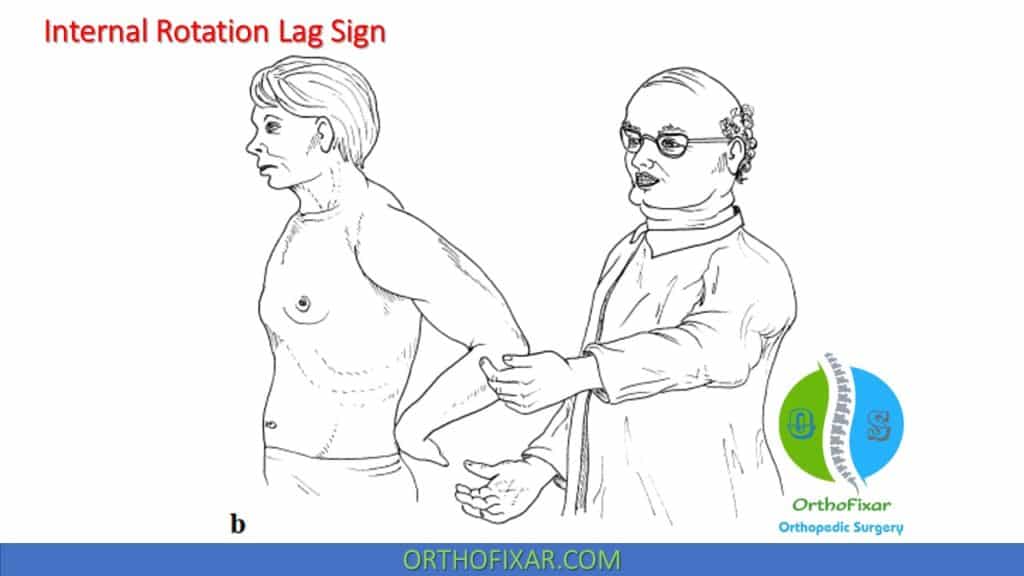
- The patient is asked to maintain this position actively as the examiner releases the wrist while maintaining support at the elbow.
See Also: Neer Test
What does a positive Internal Rotation Lag Sign mean?
If there is a tear of the subscapularis tendon, the patient is unable to actively hold the submaximally internally rotated position. The arm recoils against the back.
Sensitivity & Specificity
A study by Hertel et al.1 reported high sensitivity and specificity with this test:
- Sensitivity: 97 %
- Specificity: 96 %
Another study by Caroline A Miller 2 found that the specificities of the drop sign and internal rotation lag sign were 77% and 84%, respectively, and a sensitivity of 73% and 100%, respectively.
Diagnostic Utility of Internal rotation lag sign for Identifying Subscapularis Tears:
| Population | Reference Standard | Sens | Spec | +LR | -LR |
|---|---|---|---|---|---|
| 37 patients with shoulder pain | Subscapularis tear diagnosed via ultrasound | 1.0 | .84 | 6.2 (1.9, 12.0) | .00 (.00, 2.50) |
| 55 patients suffering from subacromial and/or glenohumeral impingement syndrome scheduled for an arthroscopic procedure | Subscapularis tear diagnosed via arthroscopic visualization | .71 | .60 | 1.8 | .48 |
| 312 patients scheduled to undergo arthroscopic shoulder surgery | Subscapularis tear diagnosed via arthroscopic visualization | .20 | .97 | 6.7 | .83 |
Related Anatomy
Subscapularis Muscle
- Subscapularis Muscle originates from Ventral scapula.
- It inserts on Humerus (lesser tuberosity).
- Its action include Internally rotates the arm and provided anterior stability to the shoulder joint.
- It innervates from upper and lower subscapular nerves.

Reference
- Hertel R, Ballmer FT, Lombert SM, et al: Lag signs in the diagnosis of rotator cuff rupture. J Elbow Shoulder Surg Am 5:307–313, 1996. PMID: 8872929.
- Caroline A Miller, Gail A Forrester, Jeremy S Lewis: The validity of the lag signs in diagnosing full-thickness tears of the rotator cuff: a preliminary investigation. Arch Phys Med Rehabil. 2008 Jun. PMID: 18503815.
- Miller CA, Forrester GA, Lewis JS. The validity of the lag signs in diagnosing full-thickness tears of the rotator cuff: a preliminary investigation. Arch Phys Med Rehabil. 2008 Jun;89(6):1162-8. doi: 10.1016/j.apmr.2007.10.046. PMID: 18503815.
- Bartsch M, Greiner S, Haas NP, Scheibel M. Diagnostic values of clinical tests for subscapularis lesions. Knee Surg Sports Traumatol Arthrosc. 2010 Dec;18(12):1712-7. doi: 10.1007/s00167-010-1109-1. Epub 2010 Apr 8. PMID: 20376624.
- Yoon JP, Chung SW, Kim SH, Oh JH. Diagnostic value of four clinical tests for the evaluation of subscapularis integrity. J Shoulder Elbow Surg. 2013 Sep;22(9):1186-92. doi: 10.1016/j.jse.2012.12.002. Epub 2013 Feb 20. PMID: 23434234.
- Clinical Tests for the Musculoskeletal System 3rd Edition.
- Dutton’s Orthopaedic Examination, Evaluation, And Intervention 3rd Edition.
- Netter’s Orthopaedic Clinical Examination An Evidence-Based Approach 3rd Edition Book.