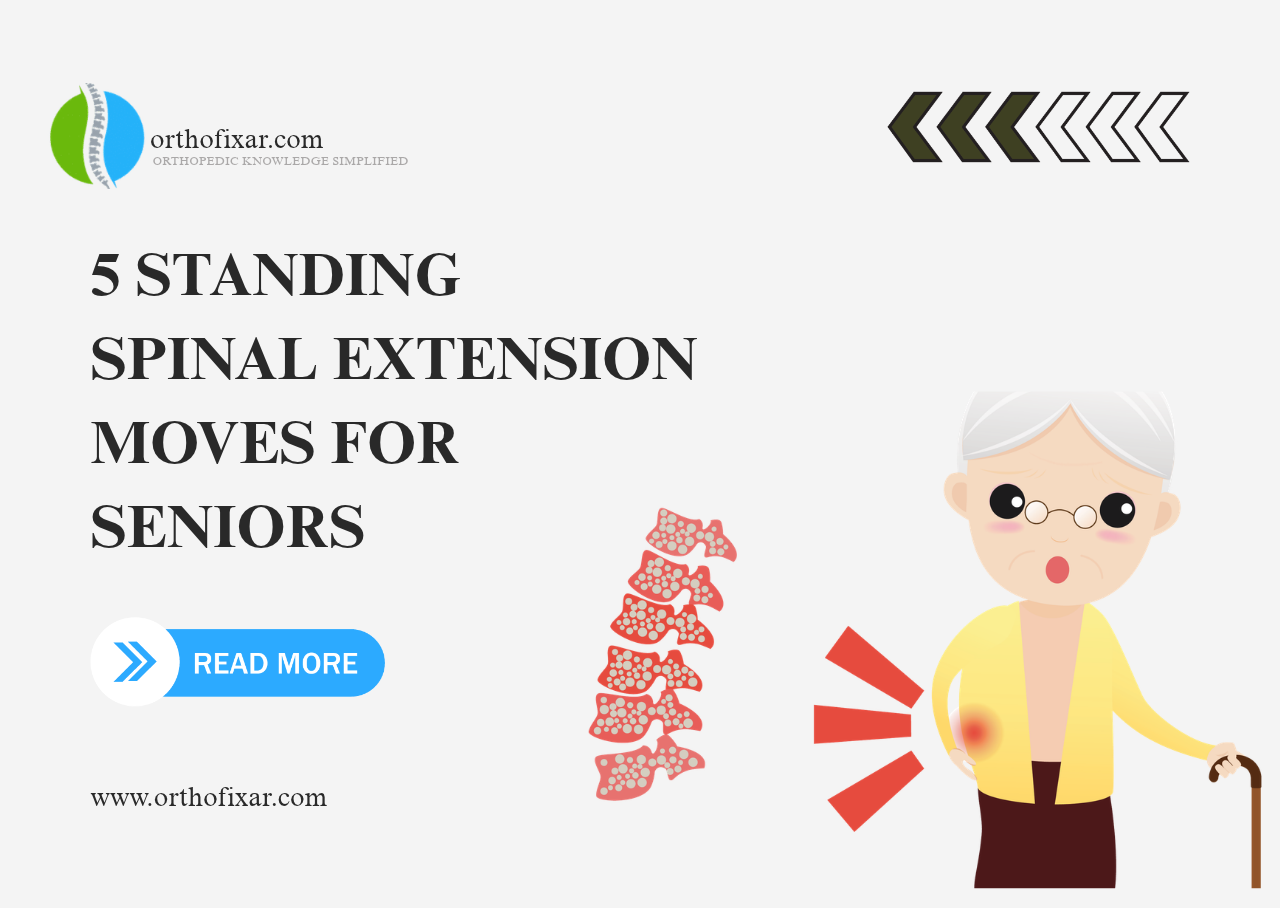
You can extend your spine while standing, and for many older adults it is one of the safest and most functional ways to do it. Standing spinal extension moves counteract the rounded-forward posture that develops from sitting, driving, and screen time, and they train the same motion you use when you reach for a high shelf or look up. This guide covers five practical standing extension exercises commonly used in older-adult rehabilitation, along with how to progress them, what to watch for, and how to build them into a daily routine. Each move can be performed with a chair or countertop nearby for support.
Why Standing Spinal Extension Matters for Older Adults
Spinal extension means bending gently backward, straightening the upper back, and opening the front of the hips and chest. It is the natural opposite of the flexed, shoulders-forward position that dominates most sitting and driving. When extension becomes limited, reaching overhead, looking up, and walking with an upright stride all become harder.
Standing versions of these moves offer practical advantages for seniors. They require no floor transfers, they can be done in a kitchen or hallway, and they mirror real-life tasks. They also let you keep a hand on a stable surface, which many older adults find reassuring.
- Posture: counters the rounded upper back that builds up from prolonged sitting.
- Accessibility: no getting down to the floor and back up.
- Function: trains reaching overhead, looking up, and standing taller while walking.
- Confidence: a countertop or chair back provides support if balance is a concern.
- Bone and joint health: gentle, controlled extension helps maintain spinal mobility over time.
Before You Start: Safety Checks and Setup
Spinal extension is not right for everyone, and a few quick checks help you start safely. If you have osteoporosis with prior vertebral fractures, a diagnosed spinal condition, recent back surgery, or pain that worsens with backward bending, check with your physician or physical therapist before doing these moves.
Set up a clear, non-slip space with a sturdy countertop, wall, or chair back within arm’s reach. Wear supportive shoes or go barefoot on a non-slip floor. Move slowly, and stop any movement that causes sharp pain, dizziness, or numbness.
- Stand with feet hip-width apart and weight evenly distributed.
- Keep a stable support within reach if balance is uncertain.
- Move into extension slowly and hold briefly rather than bouncing.
- Breathe normally; avoid holding your breath.
- Stop if you feel sharp pain, tingling, or lightheadedness.
Extension should feel like a gentle opening and lengthening, never a sharp pinch. If it feels like a pinch, reduce the range and try again.
The 5 Standing Spinal Extension Moves
These five moves progress from the simplest standing extension to more active versions. Start with the first one or two and add the others as they feel comfortable. Aim for a slow, controlled pace rather than a large range.
1. Standing Backward Bend (Hands on Hips)
This is the foundational move. Place your hands on your lower ribs or hips, keep your knees slightly soft, and gently lean backward from the waist. Reach only as far as feels comfortable, hold for a breath or two, then return to upright.
- Do 5 to 8 slow repetitions.
- Keep the movement small at first.
- Use a countertop for support if needed.
2. Standing Overhead Reach and Open
From an upright stance, reach both arms overhead and gently lengthen through the spine, allowing a slight backward opening. This combines extension with the shoulder mobility used for reaching high shelves. Return your arms and spine to neutral slowly.
- Reach up rather than forcing your back to arch.
- Keep ribs from flaring excessively.
- Do 5 to 10 repetitions.
3. Wall-Assisted Chest and Spine Opener
Stand facing a wall at arm’s length and place both hands on it at shoulder height. Step one foot back and gently press your hips forward while keeping your hands on the wall, creating a supported extension through the upper back. Hold for a few seconds, then ease back.
- Keep the neck relaxed and gaze forward.
- Press hips forward only as far as comfortable.
- Hold 5 to 10 seconds, repeat 3 to 5 times.
4. Chair-Supported Standing Extension
Stand behind a sturdy chair and rest your hands lightly on the chair back. Gently lean backward, letting the chair provide balance support. This version suits people who feel unsteady leaning back without a handhold.
- Keep hands light on the chair back.
- Return to upright under control.
- Do 6 to 10 repetitions.
5. Standing Extension with Side Bend
Combine a gentle backward bend with a slight sideways reach of one arm overhead. This adds lateral mobility, which supports reaching and twisting tasks. Alternate sides and keep the movement smooth.
- Reach one arm up and over as you extend slightly.
- Alternate sides evenly.
- Do 5 repetitions per side.
Comparison Table: The Five Moves at a Glance
| Move | Main Focus | Support Needed | Suggested Reps |
|---|---|---|---|
| Standing backward bend | Basic spinal extension | Optional countertop | 5–8 |
| Overhead reach and open | Extension + shoulder reach | None | 5–10 |
| Wall-assisted opener | Upper back + chest | Wall | 3–5 holds |
| Chair-supported extension | Supported extension | Chair back | 6–10 |
| Extension with side bend | Extension + lateral mobility | Optional | 5 per side |
How to Progress Safely Over Time
Progress by increasing range, hold time, or repetitions—one at a time, not all at once. If a move feels easy and pain-free for a week or two, add a few more repetitions or a slightly longer hold. If you feel stiffness or soreness afterward, ease back.
Consistency matters more than intensity. A short daily practice of a few minutes usually serves older adults better than occasional longer sessions. Many people find it helpful to do one or two moves after each period of prolonged sitting.
- Add repetitions before adding range.
- Increase hold time gradually.
- Stop if pain increases during or after.
- Keep the movements slow and controlled.
- Reassess comfort each week.
Common Mistakes to Avoid
The most frequent error is forcing a large backward bend too quickly. Extension should build gradually, and a small, controlled range often delivers the same benefit with less risk. Another common mistake is holding the breath, which raises tension and reduces control.
Letting the head drop back forcefully is also unwise, especially for people with neck sensitivity. Keep the gaze forward or slightly up rather than craning the neck. Bouncing into the end of range is another habit worth avoiding.
- Forcing a large range too fast.
- Holding your breath.
- Dropping the head backward.
- Bouncing at the end of range.
- Ignoring pain signals.
When to Seek Professional Guidance
If pain persists, worsens, or is accompanied by numbness, weakness, or balance changes, see a healthcare professional. A physical therapist can assess your movement and tailor extension exercises to your specific needs. Organizations such as the American Physical Therapy Association provide resources on finding a physical therapist.
People with osteoporosis should discuss extension exercises with their clinician, since the safe range and approach can vary. For general information on bone health, the National Institute of Arthritis and Musculoskeletal and Skin Diseases osteoporosis page is a reliable starting point.
Fitting These Moves Into Your Day
Short, frequent sessions tend to work best. Try a couple of moves after breakfast, again after lunch, and once in the evening if you have been sitting. Tying them to existing routines makes them easier to remember.
- After each long sit or drive.
- Before and after a walk.
- During screen breaks.
- While waiting for the kettle to boil.
- As a gentle morning wake-up.
Conclusion
Standing spinal extension moves are a practical, low-equipment way for older adults to maintain spinal mobility and counter forward posture. Start with the backward bend or chair-supported version, add the others as comfort allows, and progress slowly. Keep a support nearby, move without pain, and check with a clinician if you have a spinal condition or osteoporosis. A few minutes of consistent practice can support the reaching, looking up, and upright walking that daily life depends on.
Frequently Asked Questions
Are standing spinal extension moves safe for seniors?
For most older adults, gentle standing extension is safe when performed with control and support nearby. People with osteoporosis, prior vertebral fractures, recent back surgery, or a diagnosed spinal condition should check with their physician or physical therapist first, because the safe range can vary.
How often should I do these exercises?
Short sessions done most days tend to work well. A few minutes once or twice daily, or after long periods of sitting, is a reasonable starting point. Increase frequency or duration gradually based on how your back responds.
What if leaning backward causes pain?
Stop the movement and reduce your range or try a supported version such as the chair-supported extension. If pain persists, sharpens, or comes with numbness or weakness, consult a healthcare professional before continuing.
Can I do these moves if I have osteoporosis?
Extension exercises can be appropriate, but the safe range and approach depend on your individual bone health and fracture history. Discuss the specific moves with your clinician or physical therapist, who can tailor them to you.
Do I need equipment?
No special equipment is required. A sturdy countertop, wall, or chair back is enough for support. Supportive shoes and a non-slip floor help with safety.
How long should I hold each stretch?
A brief hold of a few seconds is usually enough for the dynamic moves. For supported holds like the wall-assisted opener, 5 to 10 seconds works well. Breathe normally and avoid forcing the range.
Can these exercises improve posture?
Regular extension practice can help counter rounded-forward posture and support a more upright stance. Posture is influenced by many factors, so combining these moves with general activity and strength work tends to be most effective.
Should I do these before or after walking?
Either can work. Some people prefer a gentle set before walking to loosen up, while others use them afterward to counter any stiffness. Choose what fits your routine and feels comfortable.
What should I do if I feel dizzy?
Stop, sit down if needed, and rest. Dizziness during extension can relate to blood pressure changes or inner-ear sensitivity. If it recurs, speak with your healthcare provider before continuing.
Can I combine these moves with other exercises?
Yes. Standing extension pairs well with gentle strengthening and balance work. A physical therapist can help you sequence exercises safely based on your goals and health history.