Kneeling after a knee replacement is possible for many people, but it is rarely comfortable at first and should never be rushed. The implant itself is strong enough to tolerate kneeling in most cases; the bigger challenges are scar sensitivity, reduced bend in the new joint, and the confidence needed to get down and back up safely. This guide explains what usually determines whether kneeling is realistic, how to practise it in stages, and which warning signs mean you should stop and speak to your surgical or physiotherapy team.
Why Kneeling Feels Different After a Knee Replacement
A total knee replacement removes the worn joint surfaces and replaces them with metal and plastic components. These components do not have the same soft cushioning as natural cartilage, so direct pressure on the front of the knee often feels odd, numb, or uncomfortable even when healing is complete. Understanding why the sensation differs from a natural knee helps set realistic expectations and reduces anxiety about what is normal.
The skin and scar over the kneecap also become sensitive after surgery. Many patients describe reduced sensation or a tight feeling around the scar for months, and some notice it permanently. This is a normal variation and not automatically a sign that something has gone wrong. The nerves that supply the front of the knee are small and are often stretched or divided during surgery, which is why numbness and altered sensation are so common.
Range of movement matters just as much as implant strength. Kneeling deeply requires the knee to bend well past a right angle, and patients who finish rehabilitation with a stiffer knee may find kneeling physically difficult regardless of how strong the implant is. A knee that cannot bend far enough will not allow the shin to rest comfortably on the ground, which places extra strain on the hip and lower back.
Finally, confidence plays a role that is easy to overlook. After surgery, many people become cautious about putting weight through the new joint, and that caution can make the mechanics of kneeling feel awkward. Rebuilding trust in the knee is part of the process, and it usually comes from repeated, controlled practice rather than from willpower alone.
When Can You Start Kneeling?
There is no single universal timeline, because recovery speed, surgical technique, implant type, and rehabilitation progress all vary. Most surgeons and physiotherapists prefer patients to wait until the wound is fully healed, swelling has settled, and the knee has a reasonable range of movement before attempting kneeling. Some patients feel ready within a few months, while others take considerably longer, and both patterns can be normal.
A practical starting point is to ask your own surgical team at a follow-up appointment. They know your operation, your bone quality, and your rehabilitation progress, and they can tell you whether there are any specific restrictions in your case. General guidance is useful for planning, but personalised advice is what keeps you safe.
- Wait until the surgical wound is completely closed and dry with no discharge.
- Do not kneel while the knee is still noticeably swollen or warm.
- Get clearance from your surgeon or physiotherapist before trying floor-level kneeling.
- Start on a soft surface rather than a hard floor.
- Never kneel on a knee that is painful at rest or feels unstable.
How to Kneel Safely: A Step-by-Step Approach
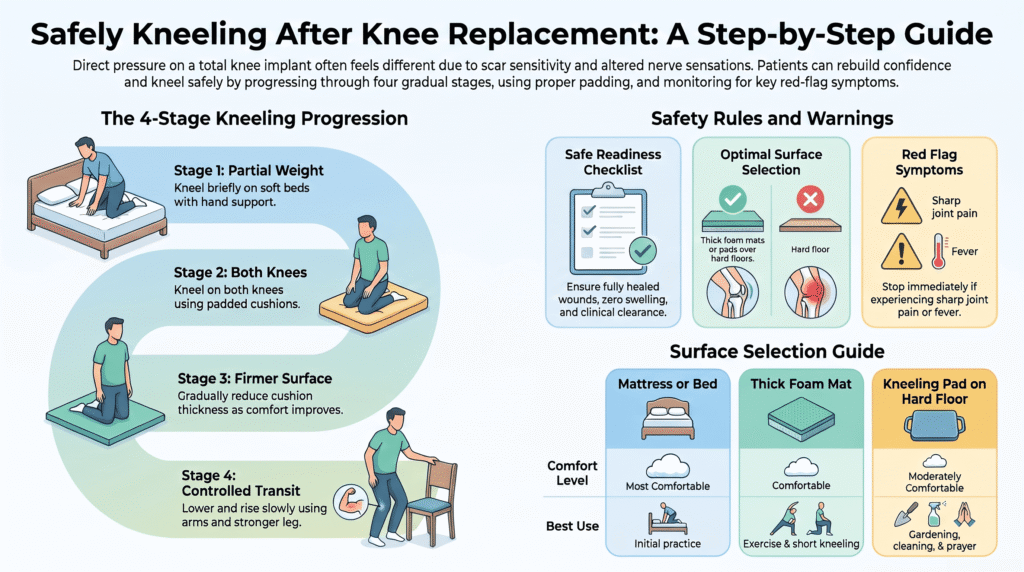
Kneeling is a skill best rebuilt gradually, in the same way you would rebuild strength after surgery. The sequence below moves from low-pressure positions to full kneeling, and you can pause at any stage for as long as you need. There is no prize for speed, and repeating an earlier stage is always acceptable if a later one feels uncertain.
Stage 1: Partial Weight Through the Knee
Begin by kneeling on a soft surface such as a mattress, a thick cushion, or a padded mat. Place a pillow under the knee for extra cushioning and keep your hands on a stable support like a chair or the edge of a bed. The aim is to introduce gentle pressure without committing your full body weight to the operated knee.
- Kneel on the operated knee only briefly, for a few seconds at first.
- Keep most of your weight through your hands and the other leg.
- Stop if you feel sharp pain, not just pressure or numbness.
- Repeat a few times a day rather than for long periods.
Stage 2: Kneeling on Both Knees
Once single-knee kneeling feels manageable, try kneeling on both knees on a padded surface with your hands resting on a chair seat. This position spreads the load and lets you control how much weight goes through the operated knee. It also mimics many everyday tasks more closely than single-knee kneeling does.
- Keep the surface soft and the kneeling time short.
- Use a cushion or knee pad under the operated knee.
- Rise slowly, using your hands and the other leg for support.
- Avoid twisting your body while kneeling.
Stage 3: Kneeling on a Firmer Surface
When padded kneeling feels comfortable and predictable, you can gradually reduce the thickness of the cushion. Hard floors will always feel different from soft surfaces, and some patients choose to use a knee pad permanently for gardening, cleaning, or religious practice. There is no requirement to progress to bare floors if a pad makes the activity comfortable and sustainable.
Stage 4: Getting Down and Up Safely
Getting to the floor and back up is often harder than the kneeling itself. Use a stable chair or a firm surface to hold on to, and consider practising the movement with a physiotherapist present the first time. The descent and the rise both rely on arm strength, balance, and control, so they deserve as much attention as the kneeling position.
- Lower yourself using your arms and the stronger leg first.
- Keep your movements slow and controlled rather than dropping down.
- Rise by pushing through your hands and the stronger leg.
- Avoid kneeling on a wet or slippery floor.
Practical Tips for Comfortable Kneeling
Small adjustments make a large difference to how kneeling feels. Most patients find that pressure and numbness are the main issues, rather than pain deep inside the joint. Addressing those surface sensations is often the key to making kneeling tolerable.
- Use a dedicated kneeling pad or a folded blanket.
- Kneel on carpet, grass, or a mat rather than tiles or concrete.
- Keep kneeling sessions short and take breaks.
- Avoid kneeling immediately after exercise when the knee is warm and swollen.
- Wear trousers or long clothing to reduce friction on the scar.
- Shift your weight slightly rather than staying completely still.
- Do not kneel on a knee that has recently been injected or irritated.
- Warm up gently before kneeling, especially in cold weather when joints feel stiffer.
Comparing Kneeling Surfaces and What to Expect
The table below summarises how different surfaces typically feel after a knee replacement. These are general patterns rather than rules, and your own experience may differ. Use it as a starting point for choosing where to practise.
| Surface | Typical Comfort Level | Best Use | Practical Notes |
|---|---|---|---|
| Mattress or bed | Most comfortable | First attempts and practice | Very soft, so it does not mimic real kneeling |
| Thick foam mat | Comfortable | Exercise and short kneeling | Good balance of cushioning and stability |
| Carpet | Moderately comfortable | Household tasks | Thin carpet offers little cushioning |
| Kneeling pad on hard floor | Moderately comfortable | Gardening, cleaning, prayer | Portable and easy to reposition |
| Bare hard floor | Uncomfortable for most | Rarely recommended | Pressure and numbness are common |
| Grass or soft ground | Variable | Outdoor activity | Check for uneven ground and hidden objects |
Kneeling and Bone Health: Why Osteomalacia Matters
Osteomalacia is a condition in which the bones soften because of a problem with bone mineralisation, most often linked to vitamin D deficiency. Softened bone behaves differently from healthy bone, and that has direct implications for anyone recovering from joint replacement surgery. The bone around an implant must carry load effectively, and when mineralisation is impaired, that load-bearing capacity can be reduced.
People with osteomalacia may experience bone pain, muscle weakness, and a higher risk of fractures. These symptoms can affect balance, walking, and the ability to kneel or rise from the floor safely, so they deserve attention alongside the knee replacement itself. Muscle weakness in particular can make the controlled descent and rise involved in kneeling more difficult and less predictable.
If you have been diagnosed with osteomalacia, or you have unexplained bone pain and muscle weakness, discuss it with your doctor before starting kneeling practice. Your treatment team can advise on appropriate assessment and treatment, and reliable background information is available from the NHS overview of osteomalacia and the NIAMS guide to osteomalacia.
- Bone pain and muscle weakness can make kneeling and rising less stable.
- Vitamin D status is relevant to bone health and should be checked if deficiency is suspected.
- Softened bone may change how much load is safe through the knee.
- Discuss any new bone pain with your doctor rather than assuming it is post-surgical.
- Follow your treatment plan before pushing into demanding kneeling positions.
Exercises That Support Safe Kneeling
Kneeling depends on knee bend, thigh strength, and balance. A physiotherapist can tailor exercises to your stage of recovery, and the following are common examples used in rehabilitation. Consistency matters more than intensity, and progress is usually measured over weeks rather than days.
- Seated knee bends to improve range of movement.
- Straight-leg raises to strengthen the thigh muscle.
- Sit-to-stand practice from a chair to build control.
- Step-ups onto a low step for leg strength.
- Single-leg balance practice near a stable support.
- Gentle stretching for the calf and hamstring.
Do not add new exercises without checking with your rehabilitation team, particularly if you have other health conditions affecting your bones or balance. Exercises that suit one patient may be inappropriate for another, and a physiotherapist can adjust the programme to your needs.
When Kneeling Is Not Recommended
Some patients are advised against kneeling, at least for a period. This is usually because of wound healing problems, persistent swelling, very limited knee bend, or other medical conditions that affect safety. In these situations, alternative approaches such as seated tasks, long-handled tools, or a low stool can often achieve the same goal.
- An unhealed or infected wound.
- Significant ongoing swelling or warmth around the knee.
- Very restricted knee bend that makes kneeling unsafe.
- Instability or giving way of the knee.
- Severe bone pain linked to an underlying condition such as osteomalacia.
- Advice from your surgeon that kneeling should be avoided.
If any of these apply, ask your surgical team what is safe for you rather than relying on general guidance. Restrictions are often temporary, and knowing the reason behind them makes it easier to follow them.
Warning Signs to Stop and Seek Advice
Some discomfort is expected, but certain symptoms should prompt a call to your doctor or physiotherapist. Seek urgent medical advice if you develop a hot, swollen knee with fever, or if the knee suddenly gives way. These can be signs of infection or implant problems that need prompt assessment.
- Sharp pain inside the joint rather than surface pressure.
- New swelling that does not settle with rest.
- Redness, warmth, or discharge from the scar.
- Fever or feeling generally unwell.
- Sudden instability or difficulty bearing weight.
- Numbness that does not resolve after changing position.
Conclusion
Kneeling after a knee replacement is realistic for many patients, but it depends on wound healing, knee bend, scar sensitivity, and your overall bone health. Build up gradually on soft surfaces, use padding, and get clearance from your surgical or physiotherapy team before attempting floor-level kneeling. If you have a condition such as osteomalacia, discuss it with your doctor first, because softened bones change what is safe. With patience and a staged approach, most people can find a kneeling method that works for their daily needs, whether that involves a padded mat, a modified position, or a combination of both.
Frequently Asked Questions
Can you kneel after a knee replacement?
Many people can kneel after a knee replacement, but comfort varies widely. The implant is generally strong enough, while scar sensitivity and limited knee bend are the more common barriers. Always check with your surgeon or physiotherapist before starting.
How long after knee replacement can I kneel?
There is no fixed timeline. Most clinicians advise waiting until the wound is fully healed and swelling has settled, and many patients begin practising kneeling several months after surgery. Your own team can give you a specific guide based on your recovery.
Is kneeling bad for a knee replacement?
Kneeling is not automatically harmful to the implant, but it can be uncomfortable and should not be forced. Kneeling on an unhealed wound, an unstable knee, or softened bone is not advisable. Follow your clinical advice.
Why does my knee feel numb when I kneel?
Numbness around the front of the knee is common after surgery because small nerves near the scar are affected. It often improves over time but can persist. If numbness is new, spreading, or accompanied by weakness, mention it to your doctor.
What should I kneel on after knee replacement?
A thick foam mat, a kneeling pad, or a folded blanket is usually the most comfortable option. Soft surfaces reduce direct pressure on the scar and kneecap. Hard floors are best avoided or used only with padding.
Can I kneel for religious prayer after knee replacement?
Many patients return to kneeling for prayer, but it may require adjustments such as a padded mat, a stool, or a modified position. Speak to your surgical team if prayer involves prolonged or deep kneeling, and ask whether a chair-based alternative is acceptable for your circumstances.
Does osteomalacia affect kneeling after knee replacement?
Osteomalacia softens the bones and can cause bone pain and muscle weakness, which may make kneeling and rising less safe. If you have this condition, discuss kneeling with your doctor and follow your treatment plan before attempting demanding positions.
What if kneeling causes sharp pain?
Sharp pain inside the joint is different from surface pressure or numbness and is a signal to stop. Rest the knee and contact your surgical or physiotherapy team if the pain continues or is accompanied by swelling.
Can I damage my knee replacement by kneeling?
Kneeling on a healed knee replacement is unlikely to damage the implant in ordinary use, but forcing kneeling through pain or instability is not sensible. If you have concerns about implant safety in your specific case, ask your surgeon.
Do I need physiotherapy before kneeling?
Physiotherapy helps improve knee bend, strength, and balance, all of which support safe kneeling. A physiotherapist can also teach you how to get down and up from the floor safely. Ask for guidance if you are unsure how to begin.