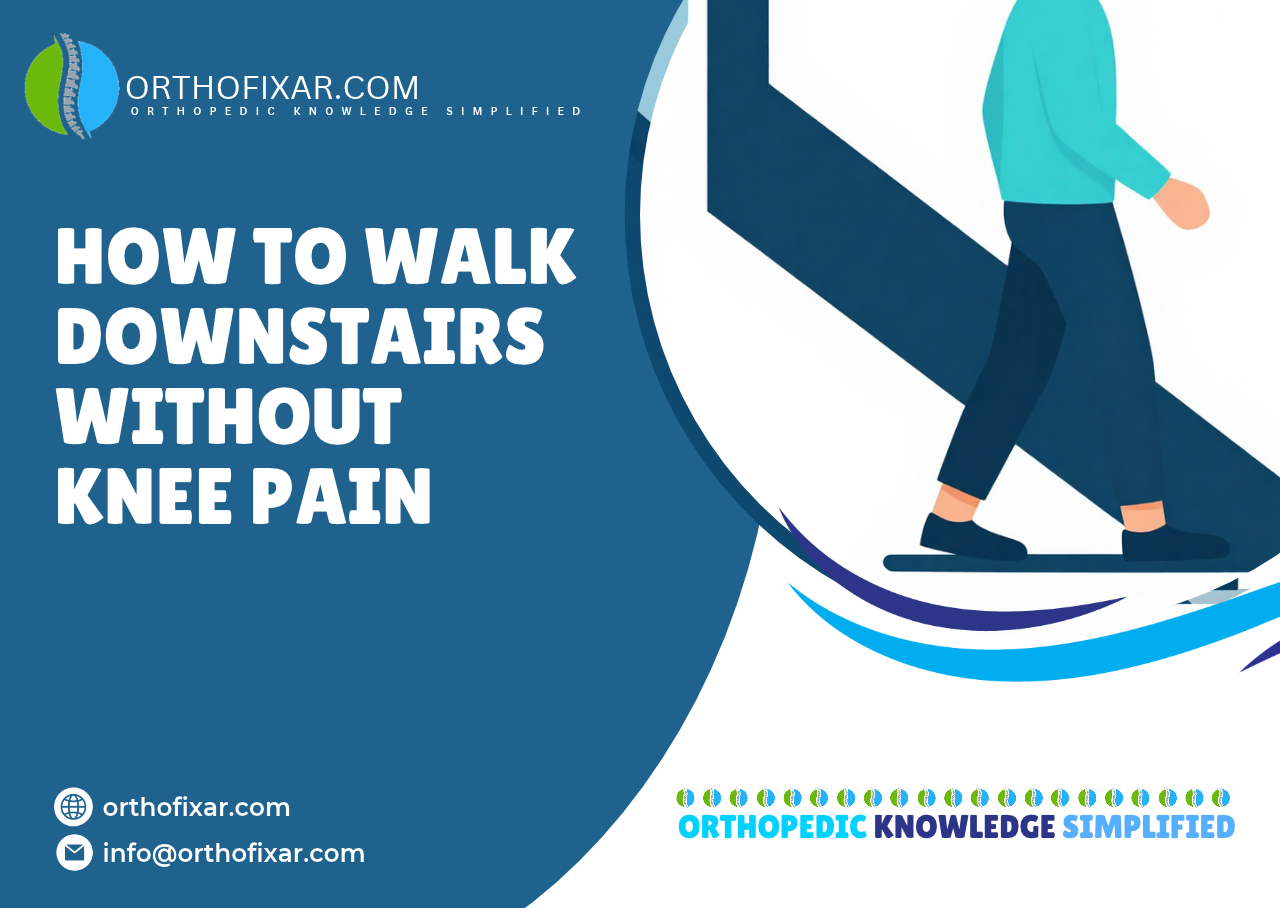
Walking downstairs with knee pain is a common complaint in clinical practice, and it rarely signals permanent joint damage. The descent phase loads the front of the knee—the patellofemoral joint—and the quadriceps far more than walking on flat ground, which is why pain often appears on the way down but not the way up. This article explains why that happens and outlines five practical strategies that change how the joint is loaded, so you can descend with more control and less discomfort.
Why Walking Downstairs Hurts More Than Walking Up
Descending stairs is an eccentric task. Your quadriceps must lengthen while still producing force to lower your body weight against gravity, and that combination creates high compressive load through the kneecap and patellar tendon.
On flat ground, the knee bends only slightly. During a descent, it can flex well past 60 degrees while your body weight is driven through one leg at a time—a very different mechanical demand.
This is why many people with patellofemoral pain, mild knee osteoarthritis, or a recovering meniscus injury report the same pattern: going up is fine, going down is brutal. The tissue is being asked to control load, not just lift it.
- Eccentric quadriceps load is higher on descent than on ascent.
- Patellofemoral joint compression increases as the knee bends deeper.
- Single-leg control is tested with every step down.
- Pain often reflects load tolerance rather than structural damage.
Fix 1: Take Smaller Steps and Slow the Descent
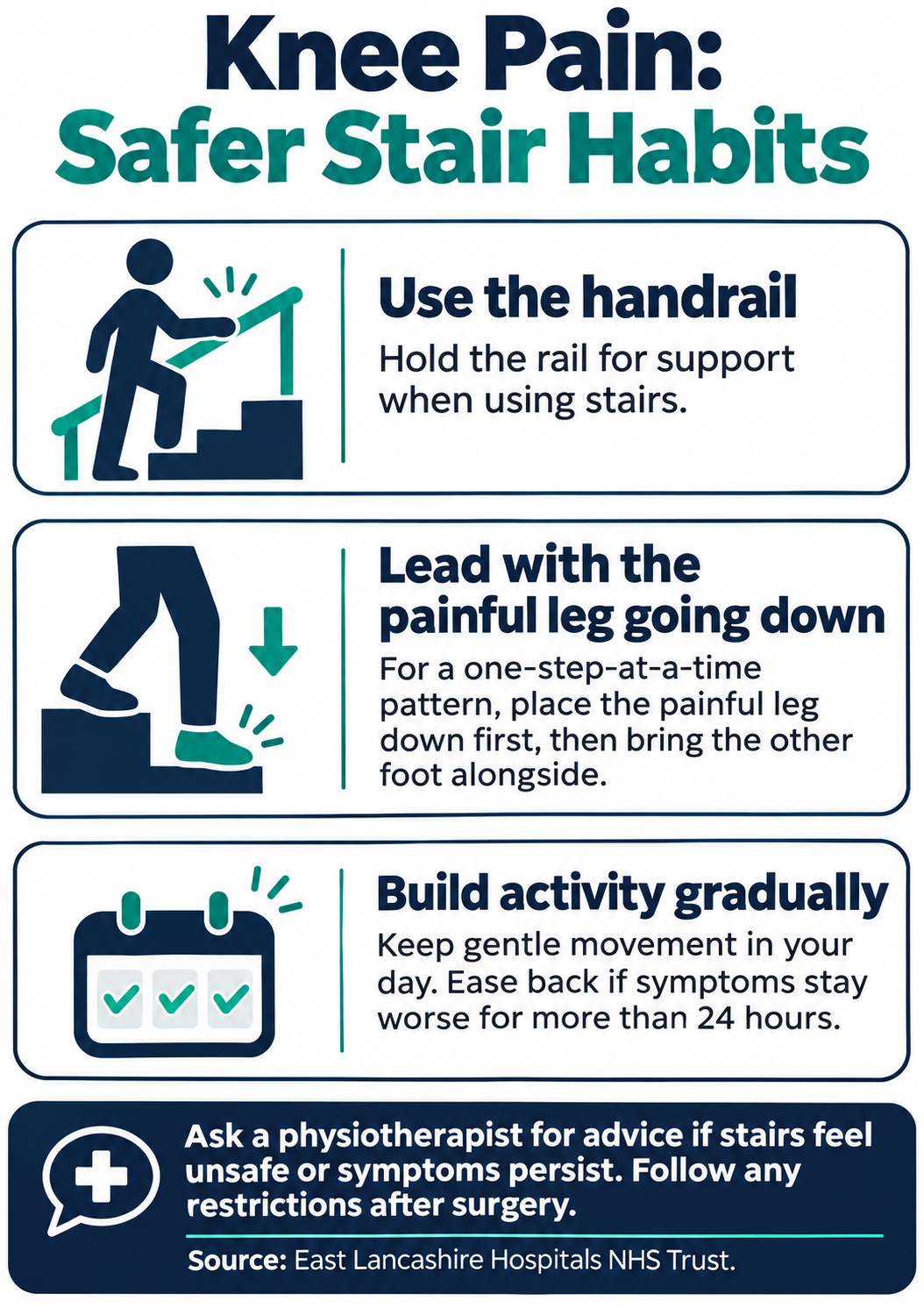
Step length changes knee load more than most people realize. A long stride down forces a deeper, faster knee bend and a harder landing on the front leg.
Shorter steps keep the knee over the foot and reduce peak force through the patellofemoral joint. It feels slower, but it is genuinely easier on the tissue.
Try this on a short flight of stairs: descend at roughly half your usual speed and notice where the load lands. Most people feel the difference immediately in the front of the knee.
- Shorten your step so the front foot lands closer to the body.
- Lower yourself with control rather than dropping into the step.
- Pause briefly at the bottom before the next step.
- Use a handrail for support while you retrain the pattern.
Fix 2: Use Your Hips, Not Just Your Knees
Many people descend by hinging almost entirely at the knee, which concentrates load at the front of the joint. Involving the hip changes the picture.
A slight forward lean from the hips, with the buttocks pushed back, lets the glutes and hamstrings share the work. The knee still bends, but it is no longer doing all the braking.
Teaching a hip hinge on the stairs is often the single change that makes descending tolerable for someone who has been avoiding stairs for weeks.
- Lean slightly forward from the hips, keeping the chest tall.
- Push the hips back as the front knee bends.
- Keep the knee tracking over the middle toes rather than collapsing inward.
- Let the back leg trail rather than stiffening it.
Fix 3: Strengthen the Muscles That Control the Descent
Load tolerance is built, not found. If the quadriceps, glutes, and calf complex cannot handle eccentric demand, the stairs will keep hurting regardless of technique.
Begin with controlled, pain-tolerable strengthening rather than rest. Complete rest rarely solves a load-tolerance problem and often makes the first return to stairs harder.
Useful starting points include:
- Slow sit-to-stand from a chair, lowering for three to four seconds.
- Step-downs from a low step, controlling knee alignment.
- Wall sits held for short, comfortable intervals.
- Calf raises performed slowly through full range.
- Bridges and hip hinges to build glute and hamstring contribution.
A general guide is to work at a level where discomfort stays mild and settles within a day. Sharp pain, swelling, or pain that lingers into the next day means the dose was too high.
Fix 4: Address Stiffness Before You Hit the Stairs
Morning stiffness or stiffness after prolonged sitting makes the first descent of the day feel worse. A cold, stiff joint does not absorb load as comfortably.
A few minutes of gentle movement before descending can change the experience. This is not a cure, but it is a practical warm-up.
- Ten to fifteen slow knee bends while seated.
- Ankle pumps to wake up the calf and circulation.
- A short walk on flat ground before the stairs.
- Gentle quadriceps and hamstring stretches if they feel tight.
Fix 5: Adjust the Environment and Your Footwear
Sometimes the simplest fix is the one people overlook. Stair geometry, handrails, lighting, and shoes all influence how safely and comfortably you descend.
Deep, steep steps load the knee more than shallow ones. If your home stairs are steep, using the handrail and taking one step at a time is a reasonable short-term strategy while strength improves.
- Wear supportive shoes with a stable sole rather than loose slippers.
- Use the handrail consistently, especially on unfamiliar stairs.
- Ensure good lighting so you can see each step.
- Take one step at a time if a full alternating pattern is painful.
- Consider a temporary rail or grab bar if your stairs lack one.
Comparing the Five Fixes at a Glance
| Fix | What It Targets | Best For | Effort to Start |
|---|---|---|---|
| Smaller, slower steps | Reduces peak knee load | Immediate symptom relief | Very low |
| Hip hinge technique | Redistributes load to hips | Front-of-knee pain | Low |
| Strengthening | Builds load tolerance | Long-term improvement | Moderate |
| Warm-up and mobility | Reduces stiffness | Morning or post-sitting pain | Very low |
| Environment and footwear | Improves safety and control | Home and unfamiliar stairs | Low |
When to See a Physical Therapist or Doctor
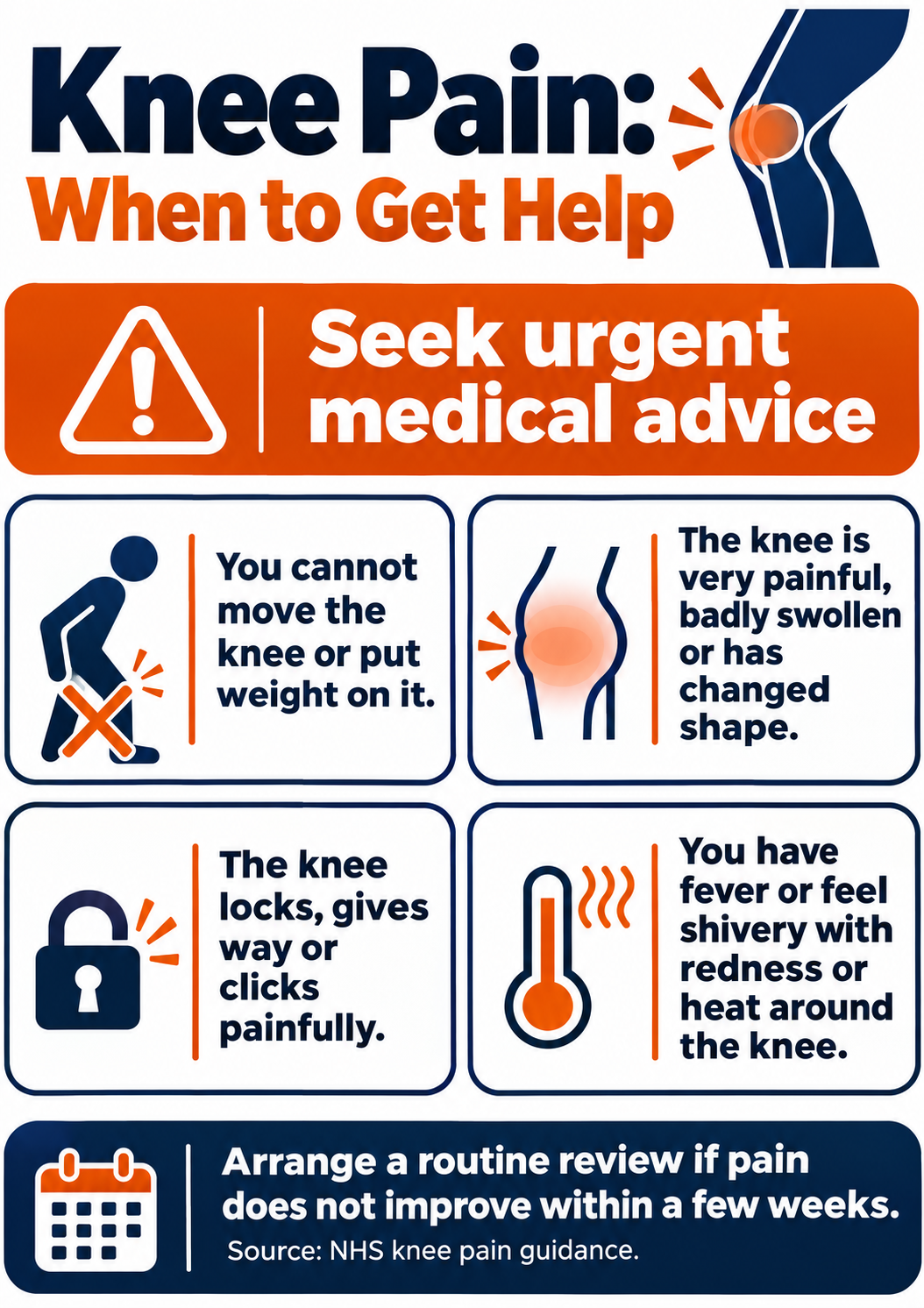
Most mechanical knee pain on stairs responds to the strategies above over several weeks. Some signs warrant a professional assessment rather than self-management.
Seek evaluation if you notice:
- Knee locking, catching, or giving way unexpectedly.
- Significant swelling that appears after activity.
- Pain that steadily worsens despite sensible loading.
- Inability to bear weight or a recent injury with a pop.
- Night pain or pain that does not relate to activity.
If you are unsure whether your symptoms are mechanical or something more, a licensed physical therapist can assess your movement and give you a specific plan. In many regions you can find a clinician through the official directory of the American Physical Therapy Association or the equivalent national professional body where you live.
Building a Practical Daily Routine
Consistency matters more than intensity. A short, daily routine built around your actual stairs tends to outperform occasional long sessions.
- Warm up for two minutes before descending.
- Practice two or three controlled descents with a handrail.
- Complete one strengthening block, such as slow sit-to-stands.
- Track how the knee feels the next morning as your guide.
If you have access to a physiotherapist, ask them to watch you descend a flight and give feedback on step length and hip position. That single observation often reveals the pattern driving the pain.
Conclusion
Walking downstairs with knee pain usually reflects how the joint is loaded, not a sign that the knee is failing. Smaller and slower steps, a hip-driven technique, targeted strengthening, a brief warm-up, and sensible footwear or handrail use cover most of the practical ground. Build tolerance gradually and let next-day symptoms guide the dose. If pain persists, worsens, or comes with swelling or instability, get assessed by a qualified clinician.
Frequently Asked Questions
Is it okay to keep walking downstairs if it hurts?
Mild discomfort that settles within a day is generally acceptable and helps build tolerance. Sharp pain, swelling, or pain that lingers into the next day suggests the load is too high, so reduce step depth, use the handrail, or shorten the session.
Why does my knee hurt going down stairs but not up?
Descending requires the quadriceps to lengthen under load while the body lowers, which increases compression at the front of the knee. Going up uses a different, concentric contraction pattern that many people tolerate better.
Should I rest completely until the pain goes away?
Complete rest rarely solves a load-tolerance problem and can make returning to stairs harder. Controlled, pain-tolerable activity and strengthening are usually more effective than prolonged avoidance.
Can knee pain on stairs be arthritis?
It can be, but pain on stairs is not specific to arthritis. Patellofemoral pain, tendon irritation, and general deconditioning can all produce the same symptom, which is why an assessment helps clarify the cause.
How long does it take to improve?
Many people notice some change within a few weeks of consistent technique and strengthening work, though timelines vary with the cause, your baseline strength, and how consistently you load the knee.
Should I use the handrail?
Yes, using the handrail is a sensible way to reduce load and improve safety while you rebuild strength. It is a training aid, not a sign of weakness, and you can gradually rely on it less as control improves.
Are knee sleeves or braces helpful on stairs?
Some people find a sleeve or brace provides reassurance or mild support, but it does not replace strengthening. Discuss whether a brace suits your specific issue with a clinician rather than using one as a permanent substitute.
Which exercises help most for stair pain?
Slow, controlled quadriceps and glute strengthening tends to help most. Sit-to-stands, low step-downs, wall sits, and calf raises are practical starting points that mirror the demands of descending.
Does walking upstairs also need attention?
Ascent is usually better tolerated, but building general leg strength helps both directions. If ascent also becomes painful, mention it during your assessment, as it can change the exercise plan.
When should I see a doctor instead of a physical therapist?
See a doctor if you have significant swelling, locking, giving way, night pain, or an inability to bear weight. A physical therapist can guide rehabilitation for mechanical pain, but these red flags warrant medical review first.