Achilles tendinopathy is one of the most common overuse injuries affecting the lower leg, and it can interrupt your running routine, daily walks, or sport. The good news is that most cases improve with the right combination of exercise, load management, and patient-focused care. In this guide, you will learn what Achilles tendinopathy feels like, why it happens, which treatments actually help, and how to rebuild strength with safe, effective exercises.
What Is Achilles Tendinopathy?
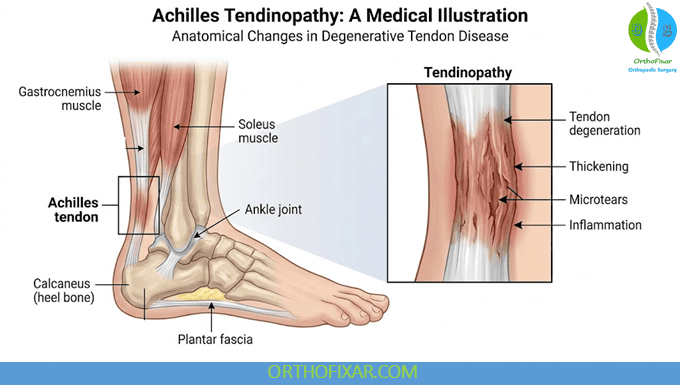
Achilles tendinopathy is a painful condition that affects the thick tendon running down the back of your lower leg. It develops when the tendon’s structure changes under repeated stress and can no longer handle the load you place on it.
Previously, doctors often called this “tendonitis,” but research shows it is not simply an inflammatory condition. Tendinopathy is better described as a failed healing response, where the tendon becomes thickened, disorganized, or irritated. This distinction matters because the treatment approach focuses on rebuilding strength rather than just resting and taking anti-inflammatories.
Common Symptoms of Achilles Tendinopathy
Symptoms usually develop gradually and vary from person to person. Many people first notice discomfort after activity, then pain starts to appear earlier in the day.
- Morning stiffness and pain in the back of the heel that eases after walking a few steps
- Pain or aching after running, jumping, or long walks
- Tenderness when pressing on the tendon, especially a few centimeters above the heel
- Swelling or a thickened appearance around the tendon
- A creaking or grating sensation when moving the ankle, known as crepitus
- Pain when standing on tiptoes or during the push-off phase of walking
If you have pain in both legs, it is still worth treating each side separately. Some people notice more severe symptoms on one side for reasons that are not always clear.
What Causes Achilles Tendinopathy?
The tendon is strong but not invincible. It needs time to adapt to new demands, and problems happen when the load increases faster than the tendon can recover.
- Suddenly increasing running mileage, speed, or hill work
- Starting a new sport or returning to training after a long break
- Wearing shoes with minimal cushioning or very stiff heel counters
- Having tight calf muscles or reduced ankle range of motion
- Overpronation or other gait mechanics that increase strain on the tendon
- Being overweight or having metabolic conditions that affect tendon health
Age is another factor. The tendon naturally becomes less elastic and more prone to injury as we get older, which is why Achilles tendinopathy is common in both recreational athletes and less active adults.
How Is Achilles Tendinopathy Diagnosed?
A physical therapist or sports medicine doctor can usually diagnose Achilles tendinopathy with a clinical examination. They will ask about your training history, check for tenderness, assess ankle strength, and perform simple tests like single-leg calf raises.
Imaging is not always needed. However, an ultrasound or MRI may be used if the diagnosis is uncertain, if symptoms are severe, or if you are not improving after several weeks of conservative care. These scans help rule out partial tears, bursitis, or other conditions that mimic tendinopathy.
Conservative Treatment Options
Treatment has shifted away from extended rest and passive therapies. The most effective approach involves active rehabilitation, and many options can be done at home or under the guidance of a physical therapist.
| Treatment | Purpose | Example |
|---|---|---|
| Load management | Reduce pain and allow the tendon to recover | Temporarily decreasing running distance or frequency |
| Calf strengthening | Increase tendon capacity and resilience | Heavy slow resistance exercises with a weighted backpack |
| Eccentric training | Improve the tendon’s ability to absorb force | Slowly lowering the heel off a step with a straight or bent knee |
| Isometric exercises | Provide short-term pain relief | Holding a calf raise position on a step for 30 to 45 seconds |
| Shockwave therapy | Stimulate healing in stubborn cases | Focused extracorporeal shockwave sessions over several weeks |
| Manual therapy | Improve ankle mobility and reduce calf tightness | Gentle soft tissue massage or joint mobilization |
Nonsteroidal anti-inflammatory drugs may help with short-term pain, but they are not a primary treatment for tendinopathy. They do not address the underlying structural issue and should not be relied upon for long-term recovery.
“The tendon responds best to gradual, progressive loading rather than complete rest.”
Best Exercises for Achilles Tendinopathy
Exercise is the cornerstone of recovery. The goal is to gradually increase the tendon’s tolerance to load while keeping pain at a manageable level, usually below 3 or 4 out of 10.
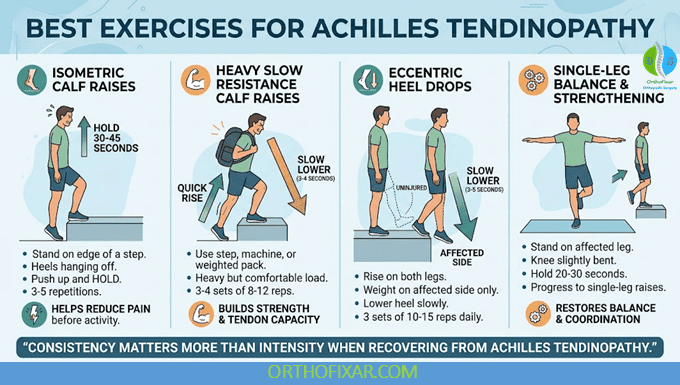
Isometric Calf Raises
Stand on the edge of a step with the balls of your feet on the step and your heels hanging off. Push up onto your toes, then hold that position for 30 to 45 seconds. Lower down slowly and repeat 3 to 5 times. This can help reduce pain before walking or running.
Heavy Slow Resistance Calf Raises
Use a leg press machine, a step, or a loaded backpack to perform calf raises with a heavy but comfortable weight. Lift up quickly and lower over 3 to 4 seconds. Aim for 3 to 4 sets of 8 to 12 repetitions, with a short rest between sets. This type of training builds strength and tendon capacity effectively.
Eccentric Heel Drops
Stand on a step with both feet on the edge. Rise up onto your toes using both legs, then lift your uninjured foot so all weight is on the affected side. Lower the heel slowly over 3 to 5 seconds until you feel a comfortable stretch in the calf. Use both legs to return to the starting position. Perform 3 sets of 10 to 15 repetitions once or twice daily.
Single-Leg Balance and Strengthening
Stand on the affected leg with your knee slightly bent and hold the position for 20 to 30 seconds. Progress to doing single-leg calf raises off a step as comfort allows. This exercise helps restore balance and coordination while loading the tendon in a functional position.
“Consistency matters more than intensity when recovering from Achilles tendinopathy.”
Your physical therapist may adjust these exercises based on your pain levels and strength. It is normal to feel mild discomfort during and after exercise, but persistent sharp pain or swelling that lasts for hours means the load is too high.
Recovery Timeline and Return to Activity
Recovery takes time, and the timeline varies depending on how long you have had symptoms and how well you respond to rehabilitation. Most people notice meaningful improvement within 6 to 12 weeks of consistent strengthening work, but full recovery can take longer.
Return to running or sport should be gradual. A common approach is to reduce volume and intensity, add walking or uphill intervals, and progress to running only when you can perform single-leg calf raises without a significant pain increase. A physical therapist can help you build a progressive plan based on your sport and training history.
You should also address contributing factors such as footwear, warm-up routines, and calf flexibility. Wearing shoes with adequate heel support and gradually increasing your training load will reduce the risk of a relapse.
When to Seek Medical Care
Most cases of Achilles tendinopathy can be managed without surgery, but some situations require medical attention. See a healthcare provider if you experience sudden severe pain, a popping sensation in the calf or heel, difficulty walking on your toes, or swelling that develops quickly after an injury.
Surgery is rarely the first option and is usually considered only after six months or more of structured rehabilitation. When other treatments have failed, procedures such as debridement or tendon repair may be discussed, but the evidence for surgery over injections remains mixed.
Conclusion
Achilles tendinopathy can be frustrating, but it is highly treatable with the right approach. Focus on gradual loading, consistent calf strengthening, and smart training modifications rather than complete rest. If you are unsure how to progress your rehabilitation, work with a physical therapist to build a tailored exercise plan and get back to the activities you enjoy.
Frequently Asked Questions
Is Achilles tendinopathy the same as Achilles tendonitis?
Not exactly. Tendonitis implies active inflammation, which is rarely the dominant feature in chronic cases. Tendinopathy is a broader term that covers tendon degeneration, thickening, and failed healing. The treatment is similar, but the terminology affects how doctors and patients understand the condition.
Can I still run with Achilles tendinopathy?
In many cases, yes, but you may need to reduce your mileage, avoid hill sprints, and insert extra rest days. Running through severe pain is not recommended. A good guideline is to keep pain under 3 or 4 out of 10 during and after running, and to stop if symptoms worsen significantly.
How long does Achilles tendinopathy take to heal?
Healing timelines vary. Some people see improvement within a few weeks, while others need several months of consistent exercise. Chronic cases, especially those lasting more than six months, may take longer to resolve and require a more structured rehabilitation program.
Do I need surgery for Achilles tendinopathy?
Surgery is the last resort and only considered after a long period of conservative treatment has failed. Most people recover with exercise-based rehabilitation, load management, and patience. Your doctor will only suggest surgery if you have persistent pain despite trying structured therapy for six months or more.
Should I stretch the Achilles tendon?
Gentle stretching may help improve ankle mobility and calf flexibility, but stretching alone will not cure tendinopathy. In fact, heavy stretching during a flare-up can increase irritation. Focus on strengthening exercises first, and stretch mildly and pain-free as part of your routine.
What shoes are best for Achilles tendinopathy?
Shoes with appropriate heel support and cushioning can reduce strain on the tendon. Some people find a slight heel lift helpful in the early stages because it shortens the tendon and reduces tension. Avoid completely flat or extremely flexible shoes until your symptoms improve.
Does ice help Achilles tendinopathy?
Ice can provide short-term pain relief, especially after activity, but it does not repair the tendon or speed up recovery. Use ice for 10 to 15 minutes after exercise if you feel sore, but do not rely on it as the sole treatment.
Can Achilles tendinopathy affect both heels?
Yes, it can occur bilaterally, especially when the cause is systemic, such as metabolic conditions or age-related tendon changes. Even if both sides are affected, treatment should include strengthening both legs and addressing any underlying risk factors.
When can I return to sport after Achilles tendinopathy?
You can return to sport when you can perform single-leg calf raises with minimal pain, when strength in the affected leg is close to the other side, and when running or jumping does not cause a significant flare-up. Progression should be gradual and guided by how your tendon responds.
What happens if I ignore Achilles tendinopathy?
Ignoring symptoms usually leads to worsening pain and a longer recovery. The tendon becomes less resilient over time, and simple activities like walking may eventually hurt. Early intervention with strengthening and load management gives you a much better chance of a full return to activity.