Infection control for medical students comes down to one simple idea: treat every patient interaction as a chance to prevent—not transmit—infection. Standard precautions are the baseline practices applied to all patients, and learning them early will protect both you and the people you care for. This guide gives you a practical breakdown of what standard precautions mean, how to apply them on the wards, and where students most often go wrong.
What Are Standard Precautions?
Standard precautions are the minimum infection prevention practices that apply to all patients, in all care settings, at all times. They are not based on a patient’s diagnosis or perceived risk—they assume that anyone’s blood, body fluids, and mucous membranes may contain infectious agents.
These practices are designed to protect both healthcare workers and patients from the spread of infections.
Core elements of standard precautions
- Hand hygiene performed before and after patient contact
- Use of personal protective equipment (PPE) when exposure is possible
- Respiratory hygiene and cough etiquette
- Safe injection practices, including never reusing needles
- Proper cleaning and disinfection of patient care equipment and surfaces
- Safe handling and disposal of contaminated materials and sharps
When you hear the phrase “standard precautions,” think of it as the safety net that catches you when you don’t yet know a patient’s infection status.
Key Components of Standard Precautions
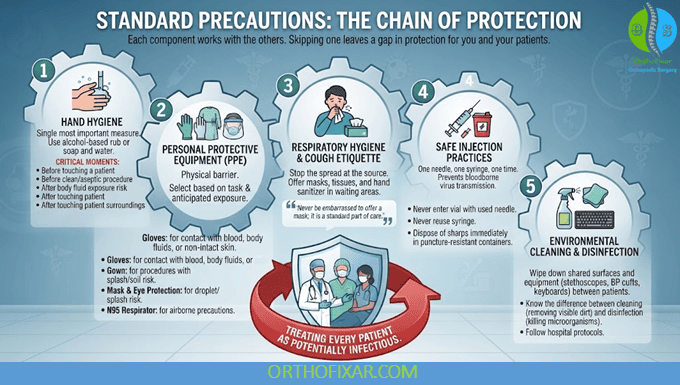
Each component of standard precautions works with the others. Skipping one piece leaves a gap in your protection and your patients’ safety.
Hand Hygiene
Hand hygiene remains the single most important measure in infection control for medical students. Use an alcohol-based hand rub for routine decontamination, and switch to soap and water when hands are visibly dirty or when caring for patients with spore-forming infections like Clostridioides difficile.
Perform hand hygiene at these critical moments:
- Before touching a patient
- Before clean or aseptic procedures
- After body fluid exposure risk
- After touching a patient
- After touching patient surroundings
“Treat every patient as if they may be infectious, because in many cases, you simply won’t know yet.”
Personal Protective Equipment (PPE)
PPE is your physical barrier against exposure. It includes gloves, gowns, surgical masks, respirators, goggles, and face shields. The key is selecting the right equipment based on the task and the type of exposure you anticipate.
- Gloves for contact with blood, body fluids, or non-intact skin
- Gown for procedures that may generate splashes or soil clothing
- Mask and eye protection for procedures that may generate droplets or splashes
- N95 respirator or higher when airborne precautions are required
Respiratory Hygiene and Cough Etiquette
Patients can spread infections before they even know they have one. Ask patients to cover their coughs and sneezes, offer masks when needed, and ensure that waiting areas have tissues and hand sanitizer available.
You should never be embarrassed to offer a mask to a coughing patient—it is a standard part of care, not an accusation.
Safe Injection Practices
One needle, one syringe, one time. This is the rule that prevents the transmission of bloodborne viruses like hepatitis B, hepatitis C, and HIV. Never enter a vial with a used needle, never reuse a syringe, and always dispose of sharps immediately in puncture-resistant containers.
Environmental Cleaning and Disinfection
Surfaces and patient care equipment often carry hidden contamination. Wipe down shared items like stethoscopes, blood pressure cuffs, and keyboards between patients. Know the difference between cleaning (removing visible dirt) and disinfection (killing or reducing microorganisms) and follow hospital protocols.
A Practical Example: Donning and Doffing PPE
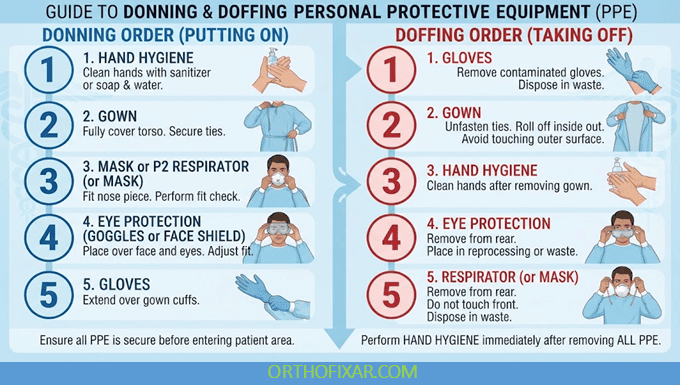
Imagine you are asked to assess a patient with a new cough and fever. You will need a gown, gloves, a surgical mask, and eye protection.
Donning order:
- Perform hand hygiene
- Put on the gown, tying it at the back
- Apply the surgical mask
- Apply eye protection
- Put on gloves, pulling them over the gown cuffs
Doffing order:
- Remove gloves first, using glove-to-glove and skin-to-skin technique
- Remove goggles or face shield by the headband only
- Untie and remove the gown, rolling it away from your body
- Remove the mask by the ear loops or ties, avoiding the front
- Perform hand hygiene immediately after
Go slowly the first few times. Practicing this sequence before you need it in an emergency is the best way to build muscle memory.
Common Pitfalls Medical Students Should Avoid
Even with good intentions, students often make small errors that increase risk. Watch out for these common ones:
- Relying on gloves instead of performing hand hygiene
- Touching your face, phone, or stethoscope before washing hands
- Doffing PPE in the wrong order and contaminating yourself
- Reusing the same mask or gloves between patients
- Leaving sharps on trays or beds instead of disposing them immediately
- Using hand sanitizer on visibly soiled hands
- Wearing a gown or mask into hallways where it is not needed
Most exposures happen during removal of PPE, not while wearing it. Treat doffing as a deliberate, careful process.
Standard Precautions vs. Transmission-Based Precautions
Standard precautions apply to every patient. Transmission-based precautions are added when a patient is known or suspected to have a highly transmissible organism. These include contact, droplet, and airborne precautions.
Think of it this way: standard precautions are the default; transmission-based precautions are the upgrade for specific infections.
| Type | When Used | Typical PPE | Example |
|---|---|---|---|
| Standard precautions | All patients, all encounters | Based on task; gloves, gown, mask as needed | Blood draw, wound dressing, physical exam |
| Contact precautions | Known or suspected organism spread by direct or indirect contact | Gown and gloves | MRSA colonization, norovirus gastroenteritis |
| Droplet precautions | Large respiratory droplets | Surgical mask, eye protection if splashes likely | Influenza, pertussis, meningococcal disease |
| Airborne precautions | Small airborne particles that remain suspended | N95 respirator or PAPR, gown, gloves | Tuberculosis, measles, varicella |
Always check the patient’s precautions signage before entering the room, and ask when in doubt.
Why Standard Precautions Matter for Medical Students
As a medical student, you are not just learning medicine—you are becoming part of the safety culture. Consistent use of standard precautions protects you from occupational exposure, reduces the risk of transmitting infections to vulnerable patients, and sets the tone for how you will practice for decades.
You also play a visible role. When patients see you wash your hands and put on gloves correctly, they feel safer and more confident in their care.
“Your hands can be the safest tool of healing or the fastest vehicle for infection—the choice is made at every patient contact.”
Infection control for medical students is not an isolated rotation topic. It follows you into clinical placements, clerkships, residency, and beyond. Building these habits now makes them automatic later.
Putting It All Together: A Ward-Day Checklist
Before you enter a clinical shift, run through this quick mental checklist:
- Do I have alcohol-based hand rub and the right PPE available?
- Is my stethoscope clean, and my fingernails short and free of polish?
- Am I comfortable with the donning and doffing sequence?
- Do I know the difference between standard and transmission-based precautions?
- Will I stop or ask for help if I am unsure about an exposure risk?
If you answered yes to all of these, you are ready to learn, observe, and care with confidence.
Conclusion
Standard precautions are the non-negotiable foundation of safe clinical care. They are simple in theory, but they demand consistency, attention, and humility in practice. For medical students, mastering infection control early means fewer exposures, safer patients, and a stronger start to your clinical training.
Make these practices automatic, and they will serve you for your entire career.
Frequently Asked Questions
What is the difference between standard precautions and transmission-based precautions?
Standard precautions apply to all patients, while transmission-based precautions are added for patients with known or suspected highly transmissible infections. Transmission-based precautions are always used in addition to standard precautions, not as a replacement.
When should medical students wear gloves?
Wear gloves whenever there is potential contact with blood, body fluids, mucous membranes, non-intact skin, or contaminated surfaces. Change gloves between tasks on the same patient, and remove them promptly after the task. Gloves do not replace hand hygiene.
Do I need to perform hand hygiene even if I wore gloves?
Yes. Gloves can have tiny defects, and contamination can occur during removal. Always clean your hands after removing gloves. Hand hygiene before donning gloves is also recommended.
Can I use the same mask for multiple patients?
No. A surgical mask should be removed and discarded after each patient interaction, or earlier if it becomes moist, damaged, or visibly soiled. Reusing masks increases the risk of self-contamination and cross-transmission.
What should I do if I get a needlestick injury?
Immediately wash the site with soap and water, report the exposure to your supervisor and occupational health department, and follow the hospital’s exposure protocol. Do not wait. Rapid reporting improves outcomes and access to post-exposure prophylaxis if needed.
Are standard precautions only for patients with confirmed infections?
No. They apply to every patient, regardless of diagnosis. Many infections are spread by patients who are asymptomatic, or by those whose diagnosis is not yet known. Following standard precautions consistently protects everyone.
When should I use soap and water instead of alcohol-based hand rub?
Use soap and water when hands are visibly dirty or greasy, after using the bathroom, and when caring for patients with spore-forming infections such as Clostridioides difficile or norovirus. Alcohol-based rubs are effective in most other situations.
How should I clean my stethoscope?
Clean the entire stethoscope—including the diaphragm, tubing, and earpieces—with an alcohol-based wipe or hospital-approved disinfectant between patients, especially if it has contacted the patient’s skin or environmental surfaces.
Do standard precautions apply outside hospital settings?
Yes. The same principles apply in outpatient clinics, emergency departments, ambulances, and even in community or home care settings. Infection control is about behavior, not location.
What should I do if PPE supplies are limited?
If PPE availability is limited during a shortage, follow your institution’s policies, which may include extended use or reuse of certain items under strict protocols. Never compromise patient safety without reporting the issue to supervisors or infection control teams.