Performing intravenous cannulation is a core skill for any healthcare student, but it requires more than just a steady hand. This guide covers the essential steps for preparation, the correct insertion technique, and the most common complications you need to recognize and manage during IV cannulation.
Understanding IV Cannulation Preparation
Proper preparation is the key to a successful first attempt. Rushing this phase often leads to failed cannulation or patient discomfort.
Patient Assessment and Vein Selection
Begin by assessing the patient’s medical history and checking for any contraindications, such as an infected site or a history of mastectomy on that side. Look for veins that are straight, soft, and have a good bounce.
- Start with the distal veins of the hand or forearm to preserve proximal sites for future access.
- Avoid areas with valves, bifurcations, or over joints, as these are prone to complications.
- Use a tourniquet to make veins more prominent, but do not leave it on for more than two minutes.
Equipment Checklist
Gather everything before you approach the patient. Having to search for supplies mid-procedure increases anxiety and infection risk.
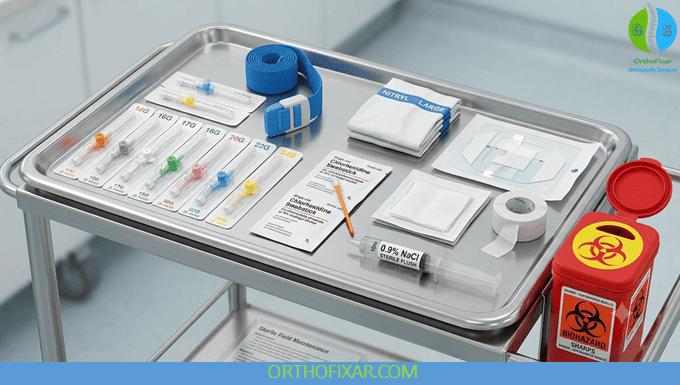
- Appropriate gauge cannula (14G to 24G) based on the therapy required.
- Tourniquet, gloves, and antiseptic swabs (2% chlorhexidine in 70% alcohol).
- Dressing, tape, and a flush solution (0.9% sodium chloride).
- Sharps container within arm’s reach.
Hand Hygiene and Aseptic Technique
Infection prevention starts before you touch the patient. Perform hand hygiene using soap and water or an alcohol-based rub. Apply clean gloves and maintain asepsis throughout the procedure.
“The moment you break aseptic technique, you risk introducing pathogens directly into the bloodstream. Always treat the insertion site as a sterile field.” — Clinical Skills Manual
Step-by-Step IV Cannulation Technique
Once you are prepared, follow these steps carefully. Consistent technique reduces trauma to the vein and improves patient comfort.
Applying the Tourniquet and Dilating the Vein
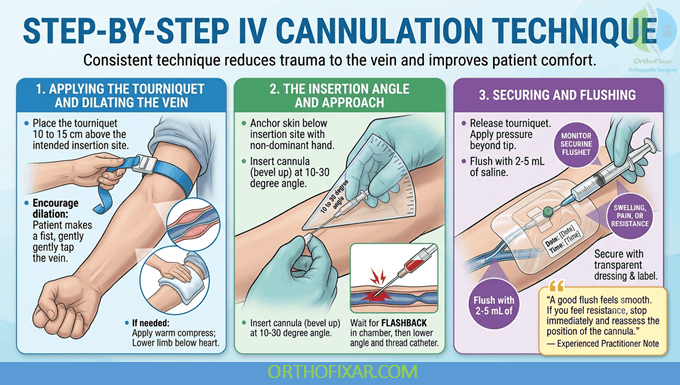
Place the tourniquet 10 to 15 cm above the intended insertion site. Ask the patient to make a fist or gently tap the vein to encourage dilation. Do not slap the vein, as this can cause spasm.
- If the vein is still flat, apply a warm compress for a few minutes.
- Lower the limb slightly below the heart to increase venous filling.
The Insertion Angle and Approach
Anchor the skin below the insertion site with your non-dominant hand to prevent the vein from rolling. Insert the cannula at a 10 to 30 degree angle with the bevel facing up.
- Advance the needle slowly until you see a flashback of blood in the chamber.
- Lower the angle of the cannula and advance it slightly further to ensure the tip is fully inside the vein.
- Thread the catheter off the needle while stabilizing the hub.
Securing and Flushing
Once the cannula is in place, release the tourniquet. Apply firm pressure over the vein just beyond the cannula tip to prevent bleeding. Attach the flush syringe and slowly inject 2 to 5 mL of saline.
- Check for signs of infiltration: swelling, pain, or resistance to flush.
- Secure the cannula with a transparent dressing so you can monitor the site.
- Label the dressing with the date and time of insertion.
“A good flush feels smooth. If you feel resistance, stop immediately and reassess the position of the cannula.” — Experienced Practitioner Note
Common Complications of IV Cannulation
Even with excellent technique, complications can occur. Knowing how to identify and respond to them is a core part of your training.
Infiltration and Extravasation
Infiltration happens when fluid leaks into surrounding tissue. Extravasation is the leakage of a vesicant drug that can cause tissue damage. Both present with swelling, cool skin, and pain at the site.
- Stop the infusion immediately if you suspect extravasation.
- Elevate the limb and apply a warm or cold compress as dictated by the specific drug.
- Document the event and notify the supervising clinician.
Phlebitis
Phlebitis is inflammation of the vein wall. It can be mechanical, chemical, or infectious. Signs include redness, warmth, a palpable cord, and pain along the vein.
- Remove the cannula at the first sign of phlebitis.
- Apply a warm compress to the area.
- Consider culturing the cannula tip if infection is suspected.
Hematoma Formation
A hematoma occurs when blood leaks into the tissue around the vein, usually from a missed attempt or failure to apply adequate pressure after removal. It causes bruising and swelling.
- Apply firm pressure to the site for at least two minutes.
- Elevate the limb and apply a cold pack to reduce swelling.
- Do not attempt a new cannulation on the same vein or nearby area.
Air Embolism
Though rare, an air embolism is a life-threatening complication. It can happen if air enters the system through an open hub or a disconnected line. Symptoms include sudden dyspnea, chest pain, and hypotension.
- Clamp the line immediately and place the patient in the left lateral Trendelenburg position.
- Administer oxygen and call for emergency assistance.
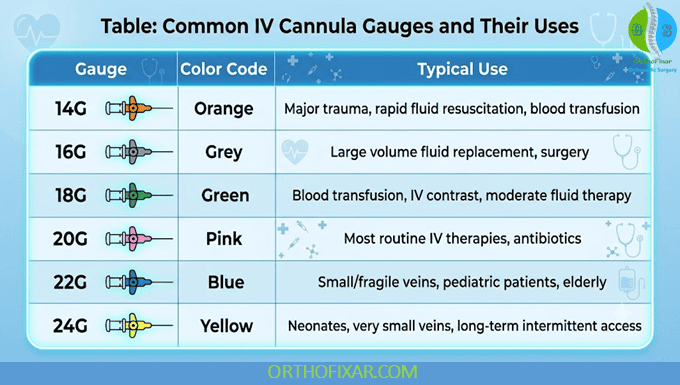
Table: Common IV Cannula Gauges and Their Uses
| Gauge | Color Code | Typical Use |
|---|---|---|
| 14G | Orange | Major trauma, rapid fluid resuscitation, blood transfusion |
| 16G | Grey | Large volume fluid replacement, surgery |
| 18G | Green | Blood transfusion, IV contrast, moderate fluid therapy |
| 20G | Pink | Most routine IV therapies, antibiotics |
| 22G | Blue | Small/fragile veins, pediatric patients, elderly |
| 24G | Yellow | Neonates, very small veins, long-term intermittent access |
Conclusion
Mastering IV cannulation is about combining knowledge with deliberate practice. Focus on your preparation, respect aseptic technique, and stay alert for signs of complications. With time, this skill becomes second nature, allowing you to provide safe and effective care for your patients.
Frequently Asked Questions (FAQ)
What is the most common cause of failed IV cannulation?
The most common cause is poor vein selection, such as choosing a vein that is too small, fragile, or located over a joint. Dehydration and patient movement also contribute significantly to failure rates.
How do I know if the cannula is in the vein correctly?
You will see a flashback of blood in the cannula chamber, and the catheter should thread smoothly off the needle. A successful flush will show no swelling, and the patient will not report pain.
Can I use a cannula that has been dropped on the floor?
No. Any sterile device that touches a non-sterile surface must be discarded. Use a new cannula from a sterile pack to prevent infection.
What should I do if the vein rolls during insertion?
Anchor the skin firmly with your thumb or index finger about 2 cm below the insertion site. This stretches the skin and holds the vein in place. You can also try applying more tension with the non-dominant hand.
Is it normal for the site to bleed after removal?
Some oozing is normal. Apply firm pressure with a dry gauze pad for at least two minutes, or longer for patients on anticoagulants, until bleeding stops completely.
How often should I change an IV cannula?
Routine replacement is generally recommended every 72 to 96 hours, or sooner if signs of phlebitis, infiltration, or infection appear. Always follow your facility’s specific policy.
What is the difference between infiltration and extravasation?
Infiltration is the leakage of a non-vesicant fluid into tissue, causing swelling and discomfort. Extravasation is the leakage of a vesicant drug, which can cause blistering, tissue necrosis, and severe injury.
Why does the patient feel a burning sensation during flush?
A burning sensation may indicate that the cannula is not fully in the vein, or that the flush is being delivered too fast. Check for swelling and stop if pain persists. It can also be a sign of chemical phlebitis from certain medications.
Can I use the same vein for a second attempt?
You should avoid the same vein if the first attempt caused a hematoma or significant trauma. Choose a different vein, preferably on the opposite arm or a more proximal site.
When should I call for help during IV cannulation?
Call for help if you have made two unsuccessful attempts, the patient has difficult veins, or you suspect a complication like extravasation or an allergic reaction. It is always better to ask for assistance than to cause harm.