SOAP notes are one of the most important documentation skills you will learn as a medical student. This structured format helps you record patient encounters clearly, organize your clinical reasoning, and communicate effectively with your healthcare team. In this guide, you will learn the SOAP note format, see a full clinical example, and get practical tips to write better notes during your rotations.
What Are SOAP Notes?
SOAP stands for Subjective, Objective, Assessment, and Plan. It is a framework used by medical professionals to document patient encounters in a consistent, logical way. The format is widely used across hospitals, clinics, and outpatient settings.
- It organizes information into four clear sections.
- It helps you connect patient history and physical findings with your diagnosis and treatment plan.
- It strengthens your clinical reasoning because each section flows into the next.
- It is expected during medical school rotations and residency applications.
“If you didn’t write it down, it didn’t happen.” This common documentation mantra reminds students that accurate records protect both patients and clinicians.
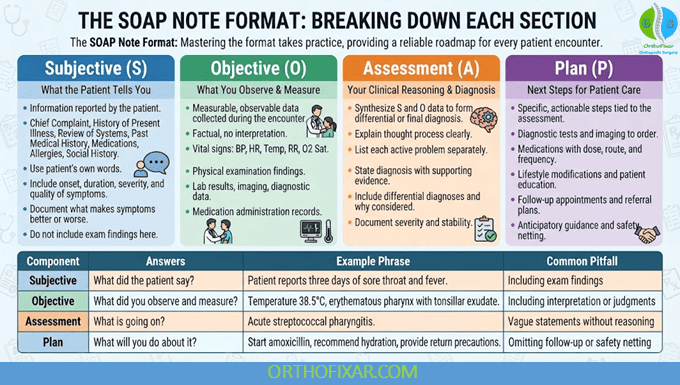
The SOAP Note Format: Breaking Down Each Section
Each component of the SOAP note has a specific purpose. Mastering the format takes practice, but the structure gives you a reliable roadmap for every patient encounter.
Subjective (S)
The subjective section contains information reported by the patient. This includes the chief complaint, history of present illness, review of systems, past medical history, medications, allergies, and social history.
- Use the patient’s own words when possible.
- Include onset, duration, severity, and quality of symptoms.
- Document what makes symptoms better or worse.
- Do not include your exam findings here.
Objective (O)
The objective section includes measurable, observable data that you collect during the encounter. This section is factual and should not include your interpretation.
- Vital signs: blood pressure, heart rate, temperature, respiratory rate, oxygen saturation.
- Physical examination findings.
- Laboratory results, imaging findings, and other diagnostic data.
- Medication administration records when relevant.
Assessment (A)
The assessment is your clinical reasoning. Here you synthesize the subjective and objective data to form a differential diagnosis or a final diagnosis. You should explain your thought process clearly.
- List each active problem separately.
- State the diagnosis with supporting evidence.
- Include differential diagnoses and why they are considered.
- Document the severity and stability of each condition.
Plan (P)
The plan outlines the next steps for diagnosis, treatment, and patient care. It should be specific, actionable, and tied to the assessment.
- Diagnostic tests and imaging to order.
- Medications with dose, route, and frequency.
- Lifestyle modifications and patient education.
- Follow-up appointments and referral plans.
- Anticipatory guidance and safety netting.
| Component | Answers | Example Phrase | Common Pitfall |
|---|---|---|---|
| Subjective | What did the patient say? | “Patient reports three days of sore throat and fever.” | Including exam findings |
| Objective | What did you observe and measure? | “Temperature 38.5°C, erythematous pharynx with tonsillar exudate.” | Including interpretation or judgments |
| Assessment | What is going on? | “Acute streptococcal pharyngitis.” | Vague statements without reasoning |
| Plan | What will you do about it? | “Start amoxicillin, recommend hydration, provide return precautions.” | Omitting follow-up or safety netting |
Complete SOAP Note Example for Medical Students
The best way to understand the SOAP note format is to see a complete clinical example. Review this sample and notice how each section connects to the next.
Chief Complaint: “I have had chest pain for the past two days.”
Subjective: The patient is a 52-year-old male with a history of hypertension and type 2 diabetes who reports substernal chest pressure that started two days ago. He describes the pain as a heavy sensation, 6 out of 10 in severity, non-radiating. The pain worsened when he walked up stairs this morning. It does not change with deep breathing or position. He reports associated shortness of breath and mild nausea. He denies diaphoresis, palpitations, or syncope. He takes metformin and lisinopril but admits missing doses this week.
Objective: Vital signs are stable. Blood pressure is 148/92 mmHg, heart rate is 94 beats per minute, respiratory rate is 18 breaths per minute, temperature is 36.9°C, and oxygen saturation is 97% on room air. Cardiovascular exam shows a regular rate and rhythm without murmurs or rubs. Lungs are clear to auscultation bilaterally. No lower extremity edema or calf tenderness. Electrocardiogram shows sinus rhythm with ST depression in leads V4 to V6. Initial troponin is mildly elevated at 0.06 ng/mL.
Assessment: The clinical presentation is concerning for unstable angina or non-ST-elevation myocardial infarction. The patient has multiple risk factors including diabetes, hypertension, and nonadherence to medication. The ST depression and elevated troponin support an acute coronary syndrome. Differential diagnoses include gastroesophageal reflux disease and musculoskeletal chest pain, but the exertional nature and ECG changes make cardiac ischemia more likely.
Plan: Admit the patient to the cardiology service for further workup. Start aspirin 325 mg orally immediately, continue lisinopril, hold metformin while in the hospital. Obtain serial troponin measurements every six hours. Order a chest X-ray and an echocardiogram. Start supplementary oxygen if saturation drops below 92%. Consult cardiology for possible cardiac catheterization. Educate the patient on medication adherence and cardiac warning signs.
“A well-written SOAP note tells a story: what happened, what it means, and how you will respond.” Keep this simple sentence in mind during every write-up.
Prescription Writing and Medication Plans in SOAP Notes
When you document medications in the plan section, precision is critical. Medical students often lose points for vague or incomplete medication orders.
- Always include the generic drug name, dose, route, and frequency.
- Write out the indication when possible, such as “for hypertension” or “for pain.”
- Check allergies before prescribing.
- Include a duration or stop date when appropriate.
- Review drug interactions with the patient’s current medication list.
Common SOAP Note Mistakes to Avoid
Many medical students make similar errors when they first start writing SOAP notes. Being aware of these pitfalls will help you improve quickly.
- Mixing subjective and objective information: keep patient-reported symptoms and your exam findings separate.
- Writing an assessment that simply repeats the problem list without analysis.
- Creating a plan that is too vague, such as “continue current care.”
- Forgetting to document patient education and follow-up.
- Using ambiguous abbreviations that could be misinterpreted.
- Copying forward old notes without updating the current status.
- Including irrelevant details that do not contribute to the clinical picture.
Tips for Writing SOAP Notes Efficiently
During clinical rotations, you will have limited time to document. These tips will help you write faster without sacrificing quality.
- Develop a personal template in your electronic medical record or note-taking app.
- Write the subjective section immediately after speaking with the patient while details are fresh.
- Use bullet points within each section to keep your note scannable.
- Focus on the most relevant findings and avoid dumping every lab value into the note.
- Practice writing one full SOAP note per patient even if you are not required to do so.
- Ask your resident or attending for feedback on your notes during rotation.
Conclusion
SOAP notes are a fundamental skill that will follow you throughout your medical career. Once you master the format, you will find it easier to organize your thoughts, defend your clinical decisions, and communicate with other healthcare providers. Practice writing SOAP notes for every patient you encounter, and ask for feedback. The more you write, the more natural the process becomes.
Frequently Asked Questions
What does SOAP stand for?
SOAP stands for Subjective, Objective, Assessment, and Plan. These four sections guide the structure of a patient encounter note from history to treatment plan.
How long should a SOAP note be?
A SOAP note should be comprehensive but concise. In most clinical settings, a good SOAP note fits on one to two pages. Focus on relevant details and skip unnecessary repetition.
Do SOAP notes differ by specialty?
Yes. The basic format stays the same, but the content shifts based on the specialty. For example, psychiatric notes focus more on mental status exam and safety assessment, while surgical notes emphasize wound findings and postoperative progress.
What is the difference between Subjective and Objective?
Subjective information comes directly from the patient, including symptoms, history, and concerns. Objective information is measurable data you collect through examination, vitals, and diagnostic tests.
How do I write a good Assessment?
A good assessment connects the dots between subjective and objective data. State the diagnosis or differential, explain the reasoning, and comment on severity or stability. Avoid simply listing problems without analysis.
What should I include in the Plan?
The plan should cover diagnostics, treatment, patient education, and follow-up. Be specific about medications, tests, procedures, and referrals. Always include return precautions when appropriate.
Can I use abbreviations in SOAP notes?
You can use standard medical abbreviations, but avoid unclear or institution-specific shortcuts. If there is any risk of misinterpretation, write the full term. Check your hospital’s approved abbreviation list.
How do I document a patient with multiple problems?
List each active problem separately in the assessment with its own supporting evidence and plan. This keeps the note organized and helps other providers quickly identify what is being addressed.
Are there templates for SOAP notes in medical school?
Yes, many medical schools and electronic health records provide templates. You can also create your own template based on your rotation needs. Just make sure the template includes all four core sections and is approved by your preceptor.
When are SOAP notes assessed on clinical rotations?
SOAP notes are typically evaluated during every core clinical rotation. Preceptors assess your notes for clarity, completeness, and clinical reasoning. Strong documentation skills can improve your rotation grades and later your residency readiness.