Medical students often sacrifice sleep to study more, but this habit backfires. Sleep is not a passive break—it actively strengthens memory and helps you recall complex information. Without enough quality sleep, the hours you spend with your textbooks may be largely wasted. Understanding the science behind sleep and memory in medical school can transform how you prepare for exams, retain clinical knowledge, and manage your hectic schedule.
Why Sleep Is Essential for Learning and Recall
When you learn something new, your brain creates neural pathways that need time to stabilize. This process, called consolidation, happens most efficiently during sleep. During deep sleep (slow-wave sleep) and REM sleep, the brain replays and reorganizes newly acquired information, moving it from short-term storage (the hippocampus) to long-term storage (the cortex). Without these phases, much of what you study never fully sticks.
- Deep sleep strengthens factual and procedural memories.
- REM sleep helps you integrate new concepts with existing knowledge.
- Skipping sleep disrupts synaptic pruning, causing mental clutter.
- Even a single night of poor sleep reduces your ability to recall what you studied the day before.
How Sleep Deprivation Harms Medical Students
Medical school is notorious for sleep loss. Cramming for exams, overnight shifts, and high stress levels all contribute to chronic sleep deprivation. But the effects go beyond fatigue. Sleep deprivation impairs attention, logical reasoning, and emotional regulation—skills that are critical for both studying and patient care.
- Reduced hippocampal activity lowers the capacity to encode new information.
- Increased cortisol levels disrupt memory consolidation during the night.
- Decision-making becomes slower and more error-prone.
- Long-term sleep loss can lead to burnout and decreased academic performance.
“Sleep is the single most effective thing you can do to reset your brain and body for learning. Medical students who prioritize sleep consistently outperform those who don’t, even with fewer total study hours.”
The Science of Memory Consolidation During Sleep
To understand why sleep and memory in medical school are so tightly linked, it helps to look at what happens in the brain overnight. During non-REM sleep, brain waves slow down and become synchronized. This allows the hippocampus and cortex to “talk” to each other, transferring newly learned material into long-term storage. During REM sleep, the brain rehearses emotional and procedural memories, helping you apply what you know in novel situations.
- Non-REM sleep (especially stage N3) consolidates facts, lists, and definitions.
- REM sleep integrates complex problem-solving and clinical reasoning.
- Spindle activity during sleep is directly linked to higher test scores.
- Research shows that sleeping after learning improves recall by 20–40% compared to staying awake.
Practical Strategies to Improve Learning Through Sleep
You can actively use sleep to boost your study results. Instead of pulling all-nighters, design your schedule around sleep cycles and use naps strategically.
- Study before bed: Review difficult material 30–60 minutes before sleep to maximize consolidation.
- Get 7–9 hours per night: Aim for consistent sleep duration, not just on weekends.
- Take power naps: A 20–30 minute nap after a study session can improve recall.
- Wake up and review: Briefly go over key points in the morning to reinforce them.
- Avoid screens before bed: Blue light delays melatonin and disrupts sleep quality.
- Keep a consistent sleep-wake schedule: Even on weekends, regularity strengthens circadian rhythms.
Time‑Restricted Studying and Sleep
Many medical students believe they need to study for hours without breaks. In reality, shorter, focused sessions followed by sleep are more effective. Try the “80/20” rule: study intensely for 50 minutes, then take a 10-minute break, and end your day with a review before sleep.
Using Naps to Boost Memory
If you have a gap between classes or during clinical rotations, a nap can refresh your mind and help lock in new information. Keep naps under 30 minutes to avoid sleep inertia. If you have more time, a 90-minute nap (one full sleep cycle) can be even more beneficial.
How Sleep Affects Different Types of Medical Knowledge
Medical school involves learning a wide range of material: anatomy, physiology, pharmacology, clinical reasoning, and procedural skills. Each type benefits from sleep in slightly different ways.
| Type of Knowledge | Example | How Sleep Helps |
|---|---|---|
| Factual recall | Names of bones, drug mechanisms | Deep sleep helps store facts in the cortex |
| Procedural skills | Suturing, intubation | REM sleep refines motor sequences |
| Clinical reasoning | Differential diagnosis | REM sleep integrates patterns from different cases |
| Problem-solving | Interpreting lab results | Sleep helps form new connections between concepts |
This table shows that you cannot rely on one study method alone. Pairing active recall and spaced repetition with adequate sleep is a winning combination.
Overcoming Common Sleep Obstacles in Medical School
Despite knowing the benefits, many medical students struggle to get enough sleep. Shifts, exams, and social pressure can make sleep feel like a luxury. However, you can overcome these obstacles with targeted strategies.
- Plan sleep around your schedule: Treat sleep as a non-negotiable appointment in your calendar.
- Use light exposure wisely: Get bright light in the morning to set your internal clock.
- Limit caffeine after 2 PM: Caffeine has a long half-life and can disrupt sleep even hours later.
- Wind down before bed: Read a book, listen to calm music, or practice mindfulness.
- If you can’t sleep, get up: Lying awake builds anxiety; do something relaxing in dim light until you feel sleepy.
“I used to believe that sacrificing sleep was the only way to keep up with the curriculum. Once I started sleeping seven hours a night, my test scores went up and I felt less stressed. Sleep isn’t a waste of time—it’s an investment.”
Creating an Optimal Study‑Sleep Routine
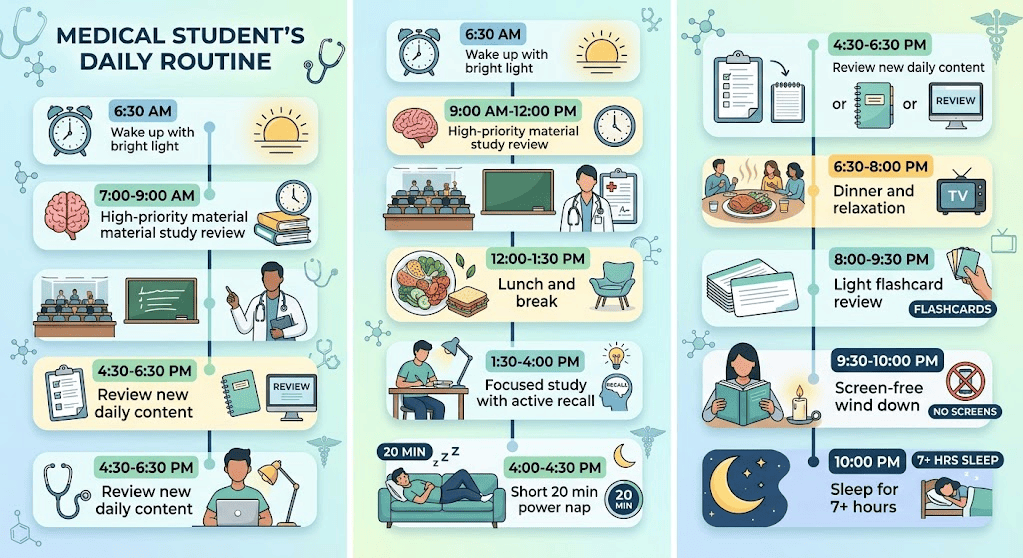
Your daily routine can make or break your sleep and memory in medical school. Consistency is key. Design a schedule that allows for at least 7 hours of sleep, plus short naps if needed. Below is a sample routine for a typical study day:
- 6:30 AM: Wake up, get bright light exposure.
- 7:00–9:00 AM: Study high‑priority material (review what you learned yesterday).
- 9:00 AM–12:00 PM: Classes or clinical rotations.
- 12:00–1:30 PM: Lunch and break (avoid heavy meals that cause drowsiness).
- 1:30–4:00 PM: Focused study sessions with active recall.
- 4:00–4:30 PM: Short nap (20 min) if needed.
- 4:30–6:30 PM: Review new content from the day.
- 6:30–8:00 PM: Dinner and relaxation.
- 8:00–9:30 PM: Light review or flashcards (no new difficult topics).
- 9:30–10:00 PM: Wind down, no screens.
- 10:00 PM: Sleep.
Adjust times based on your personal schedule, but keep the structure: sleep at the same time every night, study heavy material at peak alertness, and use sleep as a tool to solidify memory.
Conclusion
Sleep is not an obstacle to studying—it is a partner in learning. Medical students who understand the relationship between sleep and memory in medical school can study smarter, not harder. By prioritizing sleep, using strategic naps, and aligning your study schedule with your sleep cycles, you can improve retention, reduce stress, and perform better on exams and in clinical practice. Start tonight: put your phone away, review one key concept, and let your brain do the work while you rest.
Frequently Asked Questions
How many hours of sleep do medical students need?
Most adults need 7 to 9 hours per night for optimal cognitive function. Medical students, who face high cognitive demands, should aim for at least 7 hours consistently. Less than 6 hours significantly impairs memory consolidation and focus.
Is it better to study late at night or early in the morning?
Early morning is often more effective because your brain is rested and cortisol levels help with alertness. Studying late at night can disrupt your sleep schedule and reduce the quality of subsequent sleep. However, the best time depends on your personal chronotype. If you are a night owl, try to finish studying by 11 PM and get a full night’s sleep.
Does napping improve memory for medical exams?
Yes. A short nap (20–30 minutes) can improve alertness and memory consolidation. A longer nap of 90 minutes allows a full sleep cycle and can be even more beneficial, but may cause grogginess if you don’t have enough time to wake up fully.
Can I catch up on sleep over the weekend?
Partial catch‑up is possible, but it does not fully reverse the cognitive deficits from chronic sleep loss during the week. Consistency throughout the week is much more effective than trying to compensate on weekends.
What should I do if I can’t fall asleep due to exam stress?
Practice relaxation techniques such as deep breathing, progressive muscle relaxation, or guided meditation. Avoid caffeine after 2 PM and limit screen use an hour before bed. If you lie awake for more than 20 minutes, get up and read something boring (on paper) in dim light until you feel sleepy.
Does sleep quality matter more than sleep quantity?
Both matter. Quality sleep (uninterrupted, enough deep and REM phases) is essential for memory consolidation. Quantity provides enough time for multiple cycles. Prioritize a cool, dark, quiet bedroom and a consistent sleep schedule to improve quality.
How does alcohol affect sleep and memory?
Alcohol disrupts sleep architecture—especially REM sleep. Even moderate drinking reduces the brain’s ability to consolidate memories. Medical students should avoid alcohol, especially on nights before exams or study sessions.
Can exercise improve sleep and memory for medical students?
Yes. Regular aerobic exercise (30 minutes most days) improves sleep quality and increases blood flow to the hippocampus, which aids memory. However, exercising too close to bedtime can be stimulating, so finish workouts at least 2 hours before sleep.
Should I wake up to review if I remember a forgotten fact during the night?
No. Waking up disrupts your sleep cycle and reduces overall consolidation. If you remember something important, mentally note it and trust that your brain will process it further. In the morning, write it down. Interrupting sleep for a quick review usually does more harm than good.
How can I tell if I’m getting enough deep sleep?
You can use a sleep tracker (wearable or app) that estimates sleep stages, but these are not perfectly accurate. More reliable signs: you wake up feeling refreshed, can concentrate without excessive effort, and remember what you studied the previous day. If you often wake up tired or struggle with recall, evaluate your sleep hygiene.