Studying microbiology can feel overwhelming because you must memorize countless pathogens, their mechanisms, and the drugs that fight them. The key is not just memorizing facts but building a framework that connects organisms, diseases, and treatments. This article gives you a practical, step-by-step system for how to study microbiology effectively, with real examples and study tools you can use immediately.
1. Build a foundation: Understand the main types of microorganisms
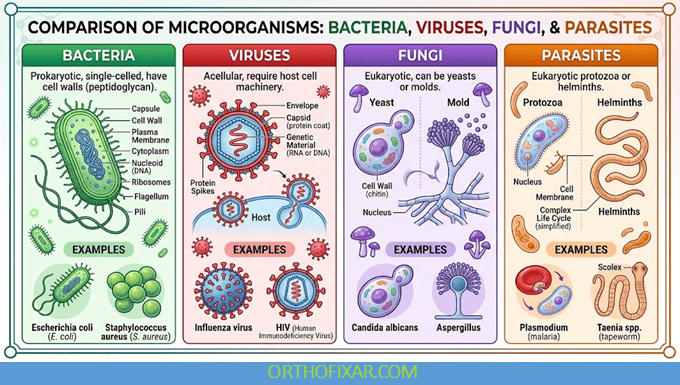
Before diving into specific diseases, you need a solid grasp of the four major groups: bacteria, viruses, fungi, and parasites. Each group has unique structural features, replication strategies, and vulnerabilities.
- Bacteria – prokaryotic, single-celled, have cell walls (peptidoglycan). Examples: E. coli, Staphylococcus aureus.
- Viruses – acellular, require host cell machinery. Examples: influenza virus, HIV.
- Fungi – eukaryotic, can be yeasts or molds. Examples: Candida albicans, Aspergillus.
- Parasites – eukaryotic protozoa or helminths. Examples: Plasmodium (malaria), Taenia (tapeworm).
Knowing these basics helps you predict how each type causes disease and which treatments work. For example, antibiotics target bacterial cell walls but have no effect on viruses.
2. Use a disease–pathogen–treatment matrix
Instead of studying each microbe in isolation, create a grid that links the organism, the disease it causes, key symptoms, and the first-line treatment. This is one of the most powerful how-to-study-microbiology techniques.
| Organism | Disease | Key features | First-line treatment |
|---|---|---|---|
| Mycobacterium tuberculosis | Tuberculosis | Acid-fast rod, airborne, granulomas | Rifampin + isoniazid (RIPE regimen) |
| Influenza A virus | Seasonal flu | Enveloped RNA virus, antigenic drift | Oseltamivir (neuraminidase inhibitor) |
| Candida albicans | Candidiasis (thrush / vaginitis) | Yeast with pseudohyphae, opportunistic | Fluconazole (azole antifungal) |
| Plasmodium falciparum | Malaria | Mosquito-borne, cyclical fevers | Artemisinin combination therapy (ACT) |
Use this table as a template. Fill it out as you study each module. The act of writing the connections cements them in your memory.
3. Master the immune response for each pathogen type
Understanding how the immune system reacts to different microbes will help you predict why certain diseases are chronic, why vaccines work, or why some treatments fail.
- Bacteria: Usually trigger neutrophils and complement. Extracellular bacteria (e.g., Streptococcus pyogenes) are cleared by opsonization. Intracellular bacteria (e.g., Mycobacterium) require Th1-mediated macrophage activation.
- Viruses: Trigger interferons and cytotoxic T cells. Enveloped viruses are neutralized by antibodies; non-enveloped viruses often require cellular immunity.
- Fungi: Neutrophils and macrophages are key. Candida induces Th17 responses. Immunocompromised patients are at highest risk.
- Parasites: Helminths stimulate Th2 and IgE; protozoa (like Plasmodium) involve Th1 and antibodies.
“Microbiology is not just about naming bugs—it’s about understanding the conversation between the pathogen and the host. The better you know the host’s side, the easier the pathogen side becomes.” – Study tip from a medical educator
4. Create concept maps for major diseases
Concept maps help you visualize relationships. For each important disease (e.g., tuberculosis, strep throat, influenza), draw a map that includes:
- Pathogen name and key features (Gram stain, shape, virulence factors)
- Transmission route (airborne, droplet, vector, etc.)
- Pathogenesis – how it damages tissue
- Clinical presentation
- Diagnostic tests (culture, PCR, serology)
- Treatment and resistance patterns
- Prevention (vaccine, hygiene, prophylaxis)
For instance, a map for Streptococcus pyogenes would connect it to pharyngitis, scarlet fever, rheumatic fever, and penicillin. Seeing the links prevents you from confusing similar organisms.
5. Use spaced repetition and active recall
Passive reading will not stick. You need to test yourself repeatedly. Tools like Anki or Quizlet are excellent for microbiology flashcards. Create cards that ask:
- “Which organism is an acid-fast rod that causes chronic cough and night sweats?” (Answer: M. tuberculosis)
- “What is the mechanism of action of vancomycin?” (Inhibits cell wall cross-linking in Gram-positive bacteria)
- “Name a viral infection treated with acyclovir.” (Herpes simplex virus)
Review these cards daily. The natural forgetting curve makes it essential to revisit each card after 1 day, 3 days, 1 week, and 1 month.
“I used to spend hours re-reading my microbiology textbook. Then I switched to active recall—just ten minutes a day of answering flashcard questions. My exam scores jumped from passing to top of the class.” – Second-year medical student
6. Focus on clinically relevant examples
Connecting microbiology to clinical cases makes the material more memorable. For each organism, think of a patient scenario.
- Example 1: A 70-year-old nursing home resident develops a productive cough, fever, and chest X-ray shows a cavity. Sputum smear is positive for acid-fast bacilli. You now know to think of M. tuberculosis, and the treatment regimen: rifampin, isoniazid, pyrazinamide, ethambutol (RIPE).
- Example 2: A child with a sore throat, fever, and a sandpaper-like rash. Rapid strep test positive. This is S. pyogenes. You recall it can cause rheumatic fever, so treatment with penicillin is essential.
- Example 3: An HIV-positive patient with white patches on the oral mucosa that scrape off. This is oral candidiasis from Candida albicans. Treatment: fluconazole. You also remember that antifungal resistance is rising, so culture and sensitivity may be needed.
These stories anchor the science to real medical decisions, which is the ultimate goal when you learn how to study microbiology.
7. Tackle antibiotic resistance with a mechanisms table
Antimicrobial resistance is a growing problem. For your studies, you must know the major resistance mechanisms for each drug class. Create a separate list or table:
- Beta-lactamases (e.g., ESBL) – break down penicillins and cephalosporins. Treat with carbapenems.
- Methicillin resistance in S. aureus (MRSA) – altered penicillin-binding protein (PBP2a). Treat with vancomycin or daptomycin.
- Vancomycin-resistant enterococci (VRE) – altered D-Ala-D-Ala target. Treat with linezolid or daptomycin.
- Efflux pumps – common in Pseudomonas aeruginosa and Gram-negative bacteria. Requires combination therapy.
- Target modification – macrolide resistance in Streptococcus pneumoniae by ribosomal methylation.
Linking resistance to treatment choices is essential for clinical practice and for exam questions that ask “What drug should you avoid given this resistance pattern?”
8. Use integrated study groups for discussion
Microbiology is a group-friendly subject. Meet with classmates and take turns explaining the mechanism of a specific pathogen or the rationale behind a treatment guideline. Use a whiteboard to draw diagrams of bacterial cell walls, viral replication cycles, or parasitic life cycles.
- Example group exercise: Each person picks one disease from a common body system (e.g., respiratory: pneumonia). The group compares bacterial pneumonia (e.g., S. pneumoniae) vs. viral (influenza) vs. fungal (Pneumocystis jirovecii). Discuss differences in epidemiology, symptoms, X-ray findings, and treatment.
- Another exercise: Create a “drug matching” game: write a list of pathogens on one side and antibiotics on the other, then correctly pair them.
Teaching someone else forces you to organize your knowledge. It is one of the most efficient how-to-study-microbiology strategies.
9. Practice with USMLE-style or exam-style questions
Once you have covered a topic, test yourself with multiple-choice questions. Focus on high-yield concepts: Gram stains, virulence factors, toxins, and drug mechanisms. Many resources have question banks with detailed explanations.
- Sample question: A patient with a dog bite develops cellulitis and a foul-smelling discharge. Gram stain shows Gram-negative rods. Which organism is most likely? (Answer: Pasteurella multocida – treat with amoxicillin-clavulanate.)
- Another sample: Traveler returning from West Africa with high fever, headache, and muscle pain. Blood smear shows ring forms inside red blood cells. What is the treatment? (Artemisinin-based combination therapy.)
After answering each question, review not just the correct answer but also why the other options are wrong. That deepens your differential thinking.
10. Stay updated on emerging pathogens and treatments
The field of microbiology evolves rapidly. For a 2026 perspective, pay attention to:
- New antimicrobial agents (e.g., novel beta-lactamase inhibitors such as cefepime-taniborbactam)
- Vaccine updates (mRNA technology expanding beyond COVID-19 to influenza, RSV, and even bacterial vaccines)
- Rising threats like Candida auris (multidrug-resistant fungus) and antimicrobial-resistant Neisseria gonorrhoeae
- Advances in diagnostic tools (PCR panels, metagenomic sequencing)
Incorporate these updates into your study matrix. For example, add a column for “resistance concerns” next to each pathogen.
Conclusion: Turn microbiology from memorization into understanding
Studying microbiology does not have to be a slog of rote memorization. By using a disease–pathogen–treatment matrix, active recall, concept mapping, and real clinical examples, you can build a lasting mental schema. Each microbe becomes part of a larger story: its structure determines how it attacks, and its vulnerabilities guide the treatment. Apply these methods consistently, and you will not only pass your exams but also feel confident applying microbiology in practice.
Frequently Asked Questions (FAQ)
1. What is the best way to start studying microbiology?
Start with the big picture: the four major microorganism groups and their basic characteristics. Then pick one or two common diseases per group and study the pathogen, the disease, and the treatment in a connected way. Use a table or concept map from the beginning.
2. How can I remember all the different bacteria and their diseases?
Create mnemonic associations and group bacteria by common features, such as Gram stain, shape, and oxygen requirements. For example, “GRAM positive cocci in clusters: Staph” – Staphylococcus. Then link each one to a classic disease (e.g., S. aureus → boils, toxic shock syndrome).
3. What is the most effective study technique for microbiology exams?
Active recall combined with spaced repetition. Write out questions from your notes, then try to answer without looking. Review them on a schedule (1 day, 3 days, 1 week). This method is proven to strengthen long-term memory.
4. Should I memorize the entire drug list or just key treatments?
Focus on first-line treatments for common and high-yield diseases. For each major pathogen, know one or two effective drugs and their mechanisms. You do not need to memorize every alternative drug unless your course specifically requires it.
5. How do I study viral infections differently from bacterial ones?
Viral infections require understanding viral replication cycles, host cell tropism, and immune evasion. Study the life cycle steps (attachment, entry, replication, assembly, release) because antivirals often target a specific step. For bacteria, focus on cell wall structure, toxins, and antibiotic targets.
6. What role does immunology play in studying microbiology?
Immunology is essential because it explains why certain people are more susceptible and how vaccines work. Learning the immune response to each pathogen type helps you predict disease severity and treatment outcomes. It also helps you understand why some infections become chronic.
7. Are there any recommended free resources for microbiology students?
Yes. Use online flashcard platforms like Anki (shared decks available), watch educational YouTube channels (e.g., Armando Hasudungan, SketchyMicro for visual mnemonics), and access free question banks like USMLE-Rx or practice tests from your institution. Many textbooks have companion websites with self-assessment quizzes.
8. How do I handle the vast number of parasites and fungi?
Focus on the most clinically important ones: for parasites, learn the life cycle of Plasmodium, Giardia, Entamoeba histolytica, and helminths like Taenia. For fungi, concentrate on Candida, Aspergillus, Cryptococcus, and dermatophytes. Use tables to compare them.
9. What is the best way to review microbiology before an exam?
Do a rapid-fire review using your disease–pathogen–treatment matrix. Go through each row and say the organism, the disease, and the treatment out loud. Then work through high-yield multiple-choice questions to simulate exam conditions.
10. How can I apply microbiology knowledge in real clinical settings?
When you see a patient, think of the most likely pathogen based on the site of infection (respiratory, urinary, skin), the patient’s immune status, and local resistance patterns. Use your knowledge to suggest appropriate cultures and empiric antibiotics. This is exactly how clinicians use microbiology every day.