Medical school demands more than intelligence—it requires a sustainable study schedule that protects your mental health while maximizing retention. This guide provides a complete weekly plan framework, evidence-based time-blocking strategies, and real-world examples to help you build a routine that works for your actual life, not just your exam dates.
Why Most Medical School Study Schedules Fail
The most common mistake first-year students make is over-planning. They create a schedule with eight hours of study per day, no breaks, and no flexibility. Within two weeks, burnout sets in.
A sustainable medical school study schedule must account for cognitive fatigue, social needs, and unexpected events. Your brain learns best when it has time to rest and consolidate information.
- Overpacked schedules leave no room for review or sleep.
- Ignoring your natural energy rhythms reduces study efficiency.
- Zero flexibility makes it impossible to adapt when a lecture runs late or a patient case takes longer.
- Neglecting exercise and social time accelerates burnout.
Understanding Your Weekly Time Budget
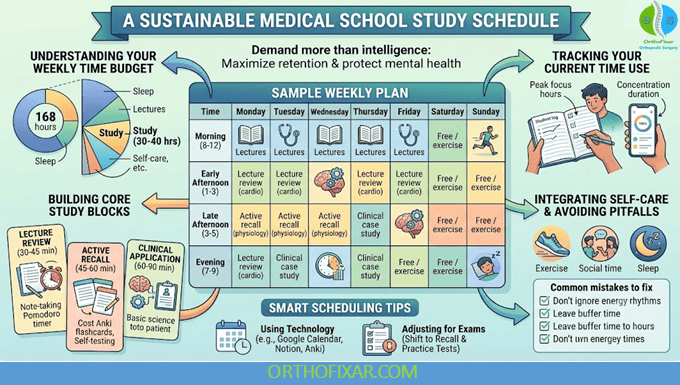
Before you build a schedule, calculate how many hours you actually have. A typical medical student has about 168 hours per week. Subtract sleep (56 hours for eight hours per night), lectures and labs (25–30 hours), meals (10 hours), commuting (5 hours), and basic self-care (7 hours).
This leaves you with roughly 50 to 60 hours for independent study, exercise, socializing, and errands. Aim for 30 to 40 hours of focused study per week. The rest is essential buffer time.
How to Track Your Current Time Use
Spend one week logging everything. Use a simple notebook or a free app. Note when you study, when you procrastinate, and when you feel most alert.
- Identify your peak focus hours (morning, afternoon, or evening).
- Notice how long you can concentrate before needing a break.
- See where you lose time to phone scrolling or indecision.
- Adjust your new schedule around these real patterns, not wishful thinking.
“You can’t manage what you don’t measure. A week of honest time tracking will tell you more about your study habits than any textbook on productivity.” — Dr. Mara Chen, medical education researcher
Building the Core Weekly Study Blocks
Divide your study time into three types of blocks: lecture review, active recall, and clinical application. Each serves a different purpose and uses different cognitive skills.
A sustainable medical school study schedule rotates these blocks to prevent monotony and deepen understanding.
Lecture Review Blocks (30–45 minutes each)
These blocks happen within 24 hours of each lecture. Review your notes, clarify confusing points, and create flashcards.
- Schedule these for the same day or the morning after.
- Use the Pomodoro method: 25 minutes of focused review, then a 5-minute break.
- Limit each block to one lecture topic to avoid overload.
- Example: After a physiology lecture on cardiac output, spend 30 minutes reviewing the key equations and drawing the pressure-volume loop.
Active Recall Blocks (45–60 minutes each)
Active recall is the most effective study method. These blocks involve testing yourself without notes.
- Use Anki or physical flashcards for spaced repetition.
- Write down everything you remember about a topic from memory.
- Work through practice questions from question banks.
- Example: For a pharmacology block, close your textbook and list all side effects of beta-blockers. Then check your accuracy.
Clinical Application Blocks (60–90 minutes each)
These blocks connect basic science to real patient cases. They prepare you for clinical rotations and step exams.
- Read a clinical case and identify the underlying pathophysiology.
- Draft differential diagnoses and treatment plans.
- Discuss cases with a study partner or group.
- Example: A case of chest pain requires you to apply anatomy, cardiology, and pharmacology knowledge simultaneously.
A Sample Weekly Medical School Study Schedule
This schedule assumes lectures from 8 AM to 12 PM, Monday through Friday. Adjust start times based on your school’s timetable.
| Day | Morning (8–12) | Early Afternoon (1–3) | Late Afternoon (3–5) | Evening (7–9) |
|---|---|---|---|---|
| Monday | Lectures | Lecture review (cardio) | Active recall (physiology) | Clinical case study |
| Tuesday | Lectures | Lecture review (renal) | Active recall (pharm) | Free / exercise |
| Wednesday | Lectures | Lecture review (respiratory) | Group active recall session | Anki card review |
| Thursday | Lectures | Lecture review (GI) | Practice questions (Step prep) | Free / social |
| Friday | Lectures | Catch-up or weak topic review | Clinical application block | Free / meal prep |
| Saturday | Review week’s weak spots | Full-length practice test (biweekly) | Free / hobbies | Free / rest |
| Sunday | Free / life admin | Light review (optional) | Plan next week’s schedule | Free / early bed |
“The best schedule is the one you actually follow. A perfect plan you abandon is worthless; an imperfect plan you maintain is gold.” — Dr. James Okonkwo, third-year medical resident
How to Adapt Your Schedule for Exam Periods
During exam blocks, your schedule must shift. Reduce new lecture review and increase active recall and practice tests.
- Two weeks before exams: Double active recall blocks, halve lecture review.
- One week before: Focus on high-yield topics and weak areas.
- Three days before: Simulate exam conditions with timed practice tests.
- Day before exam: Stop studying by 6 PM. Relax, eat well, sleep early.
Integrating Self-Care Without Guilt
A sustainable medical school study schedule includes time for exercise, sleep, and social connection. These are not optional extras—they are non-negotiable for cognitive performance.
- Schedule at least 30 minutes of physical activity five days per week.
- Protect your sleep: Go to bed and wake up at consistent times.
- Include two to three social activities per week (dinner with friends, club meetings, phone calls).
- Example: Block Saturday evening as “no study zone.” Use it for cooking, movies, or outdoor walks.
Common Scheduling Pitfalls and How to Fix Them
Even with a good plan, mistakes happen. Anticipate them so they don’t derail your whole week.
- Pitfall: Studying your favorite subjects first, then running out of time for harder ones.
Fix: Tackle the hardest topic during your peak energy hours. - Pitfall: Skipping breaks to “catch up.”
Fix: Short breaks improve focus. A five-minute walk resets your concentration. - Pitfall: Comparing your schedule to classmates’.
Fix: Everyone’s brain works differently. Trust your own tracking data. - Pitfall: Not leaving buffer time for emergencies.
Fix: Leave two to three unscheduled hours per week for illness, family needs, or extra review.
Using Technology to Support Your Plan
Digital tools can simplify scheduling, but they should not control your life. Choose one calendar app and one study app.
- Use Google Calendar or Notion for weekly planning.
- Set Anki to 20–30 new cards per day, and review old cards during commutes.
- Use a simple timer for Pomodoro sessions—do not overcomplicate.
- Avoid switching between multiple productivity apps; this wastes time.
Conclusion
Your medical school study schedule is a living document, not a prison sentence. It should evolve as you learn more about your own rhythms and as your coursework changes. Start with the framework above, track what actually works, and adjust weekly. The goal is not to study every possible hour—it is to study effectively enough to master the material while still living a life worth living. A sustainable schedule will carry you through preclinical years, clinical rotations, and beyond.
Frequently Asked Questions
How many hours should I study per day in medical school?
Most students need between 6 and 8 hours of focused study per day, including lecture time. This varies by your learning speed, the difficulty of your curriculum, and your personal efficiency. Quality matters more than quantity; two hours of active recall often beats four hours of passive reading.
Should I study every day of the week?
No. Taking at least one full day off per week is essential for long-term sustainability. Your brain consolidates learning during rest. A day without studying also prevents burnout and keeps you motivated.
What is the best time of day to study for medical students?
The best time is when you are most alert. For many students, this is in the morning after a good night’s sleep. However, some people focus better in the late evening. Track your energy levels for a week to discover your personal peak.
How do I handle falling behind on my schedule?
First, accept that falling behind happens to everyone. Do not try to cram two days of work into one. Instead, prioritize the most important topics, drop low-yield material temporarily, and adjust your schedule for the next week. Catch up gradually.
Is it better to study alone or in a group?
Both have advantages. Solitary study is best for deep focus and active recall. Group study is excellent for clinical case discussions, teaching each other, and staying accountable. Use a mix: solo for memorization, group for application.
How do I fit in exercise with a packed schedule?
Schedule exercise as a non-negotiable block, just like a lecture. Even 20–30 minutes of brisk walking, yoga, or bodyweight exercises improves blood flow to the brain and reduces stress. Treat it as part of your study plan, not as optional.
What should I do if I feel too tired to study?
Listen to your body. If you are genuinely exhausted, a 20-minute nap or a short walk may restore focus. If you are procrastinating due to boredom, switch to a different study method (e.g., from reading to practice questions). If fatigue is chronic, review your sleep and nutrition habits.
How do I plan for clinical rotations while in preclinical years?
During preclinical years, focus on building strong basic science foundations. Reserve one session per week for clinical application blocks—reviewing cases, learning physical exam skills, or shadowing. This eases the transition to clerkships.
Can I use the same schedule for Step 1 and Step 2 prep?
Yes, but you will need to adjust the balance. Step 1 prep requires heavier active recall of basic sciences. Step 2 prep demands more clinical reasoning and practice questions. Modify your weekly blocks accordingly during dedicated study periods.
How do I maintain motivation over months of studying?
Set small weekly goals and celebrate completing them. Connect your daily study to your long-term goal of becoming a competent physician. Switch study locations occasionally, work with a partner, and remind yourself why you started medical school. Motivation follows action, not the other way around.