Arterial blood gas interpretation is the skill of turning a small set of numbers into a clear clinical picture of a patient’s acid-base status, ventilation, and oxygenation. This guide gives you a repeatable step-by-step method, worked examples, a normal values table, and the common traps that cost students marks on exams and confidence at the bedside.
What an Arterial Blood Gas Actually Measures
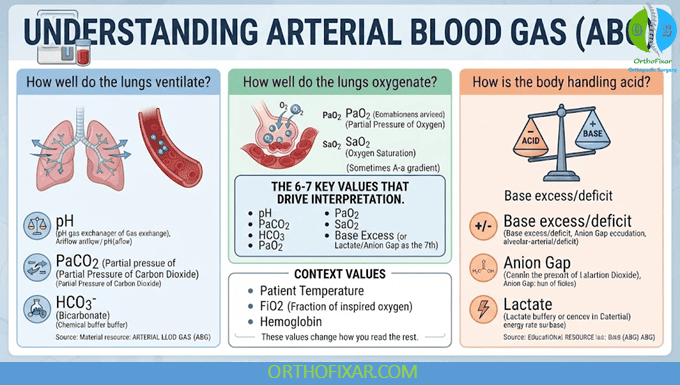
An arterial blood gas (ABG) is a sample of arterial blood analyzed for gas pressures, acidity, and related values. It answers three separate questions at once: how well the lungs ventilate, how well the lungs oxygenate, and how the body is handling acid.
You do not need to memorize every value on the printout. You need to master the six or seven that drive the whole interpretation.
- Acid-base status: pH, PaCO2, and bicarbonate (HCO3).
- Oxygenation: PaO2, SaO2, and sometimes the alveolar-arterial (A-a) gradient.
- Metabolic clues: base excess or base deficit, anion gap, and lactate.
- Context values: patient temperature, FiO2, and hemoglobin, which change how you read the rest.
The Core Variables You Read First
Before you run any step-by-step method, make sure you understand what each number is telling you. Skipping this stage is the most common reason students mislabel a gas.
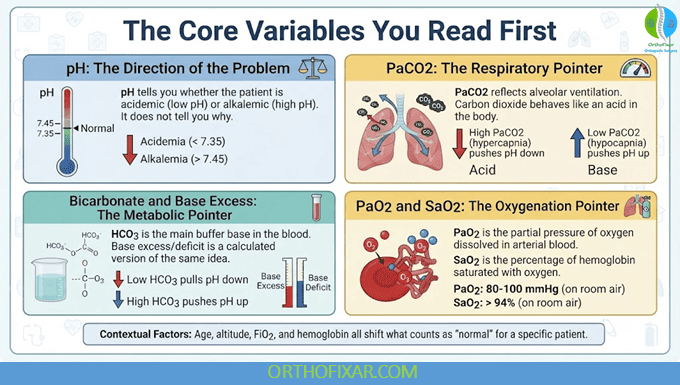
pH: The Direction of the Problem
- pH tells you whether the patient is acidemic (low pH) or alkalemic (high pH).
- It does not tell you why. A low pH can come from the lungs or from metabolism.
- Normal range is roughly 7.35 to 7.45, though some labs use slightly different limits.
PaCO2: The Respiratory Pointer
- PaCO2 reflects alveolar ventilation. Carbon dioxide behaves like an acid in the body.
- A high PaCO2 (hypercapnia) pushes pH down. A low PaCO2 (hypocapnia) pushes pH up.
- Normal range is about 35 to 45 mmHg.
Bicarbonate and Base Excess: The Metabolic Pointer
- HCO3 is the main buffer base in the blood. Normal range is around 22 to 26 mEq/L.
- Low HCO3 pulls pH down; high HCO3 pushes pH up.
- Base excess or base deficit is a calculated version of the same idea and is often easier to track over time.
PaO2 and SaO2: The Oxygenation Pointer
- PaO2 is the partial pressure of oxygen dissolved in arterial blood. A common normal range on room air is 80 to 100 mmHg.
- SaO2 is the percentage of hemoglobin saturated with oxygen. Above 94 percent is generally normal on room air.
- Age, altitude, FiO2, and hemoglobin all shift what counts as “normal” for a specific patient.
Normal Values at a Glance
| Variable | Typical Normal Range | What a Deviation Suggests |
|---|---|---|
| pH | 7.35 – 7.45 | Below = acidemia, above = alkalemia |
| PaCO2 | 35 – 45 mmHg | Above = respiratory acidosis, below = respiratory alkalosis |
| HCO3 | 22 – 26 mEq/L | Below = metabolic acidosis, above = metabolic alkalosis |
| Base excess | -2 to +2 mEq/L | Negative = metabolic acidosis, positive = metabolic alkalosis |
| PaO2 | 80 – 100 mmHg on room air | Low = hypoxemia |
| SaO2 | 94 – 100 percent | Low = impaired oxygen saturation |
| Anion gap | 8 – 12 mEq/L | High = added acids in the blood |
The Step-by-Step Method for Arterial Blood Gas Interpretation
This is the sequence to follow every single time, whether you are on a ward round, in an exam, or reviewing a chart in the emergency department. The order matters because each step narrows the possibilities.
Step 1: Look at the pH
- Is the pH below 7.35? The patient is acidemic.
- Is the pH above 7.45? The patient is alkalemic.
- Is the pH within range? There may still be a compensated or mixed disorder hiding underneath.
Step 2: Look at the PaCO2
- If the pH and PaCO2 move in opposite directions, the primary problem is respiratory.
- Acidemia plus high PaCO2 equals respiratory acidosis.
- Alkalemia plus low PaCO2 equals respiratory alkalosis.
Step 3: Look at the HCO3
- If the pH and HCO3 move in the same direction, the primary problem is metabolic.
- Acidemia plus low HCO3 equals metabolic acidosis.
- Alkalemia plus high HCO3 equals metabolic alkalosis.
Step 4: Decide Whether Compensation Is Present
- The body never fully corrects the pH. It only moves the opposite system in the same direction.
- Respiratory compensation for a metabolic disorder changes PaCO2 within minutes to hours.
- Renal compensation for a respiratory disorder takes days and changes HCO3.
- If the expected compensation does not match the numbers, suspect a mixed disorder.
Step 5: Check Oxygenation
- Read PaO2 together with the FiO2 the patient is breathing. The same PaO2 means very different things on room air and on 60 percent oxygen.
- Calculate the A-a gradient when hypoxemia is present but the cause is unclear.
- Remember that anemia can hide significant oxygen delivery problems even when SaO2 looks acceptable.
Step 6: Add the Anion Gap and Delta Gap
- Anion gap equals sodium minus the sum of chloride and bicarbonate.
- A high anion gap metabolic acidosis points to added acids such as lactate, ketones, or toxins.
- The delta gap helps you detect a second hidden metabolic disorder when the anion gap is elevated.
Read the gas in the same order every time. Speed comes from repetition, not from shortcuts.
Worked Examples of Arterial Blood Gas Interpretation
Examples make the method stick. Below are three patterns you will see constantly in clinical practice.
Example 1: Acute Respiratory Acidosis
- pH 7.28, PaCO2 58 mmHg, HCO3 25 mEq/L, PaO2 62 mmHg on room air.
- pH is low, so the patient is acidemic.
- PaCO2 is high and moves opposite to pH, so the primary problem is respiratory.
- HCO3 is normal, which fits an acute process with no time for renal compensation.
- Interpretation: acute respiratory acidosis with hypoxemia.
Example 2: Metabolic Acidosis With Partial Compensation
- pH 7.30, PaCO2 30 mmHg, HCO3 15 mEq/L, anion gap 22 mEq/L.
- pH is low and HCO3 is low, so the primary problem is metabolic acidosis.
- PaCO2 is low, which is the expected respiratory compensation.
- The elevated anion gap narrows the cause to added acids rather than bicarbonate loss.
- Interpretation: high anion gap metabolic acidosis with appropriate respiratory compensation.
Example 3: Mixed Disorder
- pH 7.38, PaCO2 22 mmHg, HCO3 13 mEq/L.
- The pH looks almost normal, which is the trap.
- Both PaCO2 and HCO3 are markedly abnormal and move in directions that partially cancel each other.
- Interpretation: mixed metabolic acidosis and respiratory alkalosis.
A normal pH does not mean a normal gas. It often means two problems are pulling in opposite directions.
Common Mistakes Students Make
- Treating a normal pH as reassurance instead of checking for a mixed disorder.
- Reading PaO2 without knowing the FiO2.
- Assuming compensation is always complete.
- Forgetting to calculate the anion gap in every metabolic acidosis.
- Ignoring the clinical picture. Numbers support a diagnosis, they do not replace one.
- Mixing up acute and chronic respiratory patterns when the HCO3 shift is small.
Practice Tips for Building Speed
- Work through at least three gases a day using the same six steps in the same order.
- Write the interpretation in one sentence, then check it against the clinical notes.
- Keep a personal log of cases where your first interpretation was wrong, and note why.
- Practice with mixed disorders deliberately, since they are the ones most likely to appear on exams.
- Study the underlying physiology of each pattern. Memorizing patterns without physiology fails under pressure.
Arterial blood gas interpretation becomes fast once the sequence is automatic. Start with pH, move to PaCO2, then HCO3, then check compensation, oxygenation, and the anion gap. Do it the same way every time and you will stop guessing. The goal is not to recite numbers but to explain what the patient’s body is doing and why.
Frequently Asked Questions About Arterial Blood Gas Interpretation
What is the first thing I should look at in an ABG?
Start with the pH. It tells you the direction of the problem, acidemic or alkalemic, and frames every value that follows. Without the pH as an anchor, the rest of the numbers are easy to misread.
How do I know if the primary problem is respiratory or metabolic?
Compare the direction of the pH with the direction of the PaCO2 and the HCO3. If pH and PaCO2 move in opposite directions, the primary problem is respiratory. If pH and HCO3 move in the same direction, the primary problem is metabolic.
What does compensation mean in arterial blood gas interpretation?
Compensation is the body’s attempt to bring pH back toward normal by adjusting the system that is not primarily affected. The lungs adjust PaCO2 quickly, while the kidneys adjust HCO3 over a longer period.
Can an ABG be normal and still show a serious problem?
Yes. A near-normal pH with abnormal PaCO2 and HCO3 often signals a mixed disorder where two processes are partially cancelling each other. Always check all values, not just the pH.
Why is the anion gap important?
The anion gap separates metabolic acidosis caused by added acids from acidosis caused by bicarbonate loss. A high gap points toward lactate, ketones, kidney failure, or toxins, which changes the management approach.
How do I interpret oxygenation from an ABG?
Read PaO2 and SaO2 together with the FiO2 the patient is breathing. A PaO2 of 70 mmHg means something very different on room air than on high-flow oxygen. When the cause is unclear, calculate the A-a gradient.
How long does renal compensation take?
Renal compensation develops over days, not hours. If a patient with a chronic respiratory disorder has an appropriate HCO3 shift, you are likely looking at a long-standing process rather than an acute one.
What is the delta gap used for?
The delta gap helps detect a second, hidden metabolic disorder when the anion gap is elevated. It compares the rise in the anion gap with the fall in bicarbonate to see whether the numbers fit a single explanation.
Do I need to memorize every formula?
You need the core ones: anion gap, expected compensation ranges, and the A-a gradient. Most others are reference tools. Understanding what each formula tells you matters more than memorizing variations.
How can I get faster at arterial blood gas interpretation?
Use the same six-step sequence every time, practice daily with real or sample gases, and write your interpretation in one sentence before checking the answer. Speed follows structure, not cramming.