Preparing for medical school entrance exams requires a clear strategy, the right materials, and consistent effort. This guide provides a practical study plan and a curated list of resources to help you organize your Medical School Entrance Exam Preparation effectively, whether you are just starting or need to refine your routine.
Understand the Exam Structure and Requirements
Before diving into study materials, know exactly what you are up against. Every medical school entrance exam has a specific format, scoring system, and content focus.
- Identify the sections: most exams cover natural sciences (biology, chemistry, physics), critical analysis, and quantitative reasoning.
- Check official test dates and registration deadlines for your target schools.
- Review the number of questions, time limits, and whether there is a penalty for incorrect answers.
- Understand the score range needed for your preferred programs.
Build a Realistic Study Timeline
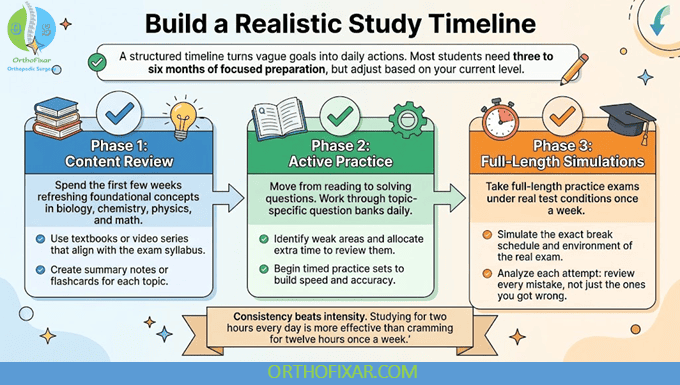
A structured timeline turns vague goals into daily actions. Most students need three to six months of focused preparation, but adjust based on your current level.
Phase 1: Content Review
- Spend the first few weeks refreshing foundational concepts in biology, chemistry, physics, and math.
- Use textbooks or video series that align with the exam syllabus.
- Create summary notes or flashcards for each topic.
Phase 2: Active Practice
- Move from reading to solving questions. Work through topic-specific question banks daily.
- Identify weak areas and allocate extra time to review them.
- Begin timed practice sets to build speed and accuracy.
Phase 3: Full-Length Simulations
- Take full-length practice exams under real test conditions once a week.
- Simulate the exact break schedule and environment of the real exam.
- Analyze each attempt: review every mistake, not just the ones you got wrong.
“Consistency beats intensity. Studying for two hours every day is more effective than cramming for twelve hours once a week.”
Essential Resources for Medical School Entrance Exam Preparation
Choosing the right materials can save hours of wasted effort. Below is a comparison of common resource types to help you decide where to invest your time and money.
| Resource Type | Best For | Example Formats |
|---|---|---|
| Official practice tests | Simulating real exam conditions | Online full-length exams from test administrators |
| Question banks | Targeted practice per subject | Subscription-based platforms with thousands of questions |
| Content review books | Structured overviews of key topics | Compendiums covering biology, chemistry, physics |
| Flashcard apps (e.g., Anki) | Spaced repetition for memorization | Pre-made decks or custom cards |
| Video tutorials | Visual explanations of complex concepts | YouTube channels or paid courses |
Combine at least one question bank with official practice tests. Do not rely on only one resource for your Medical School Entrance Exam Preparation.
Active Learning Techniques That Work
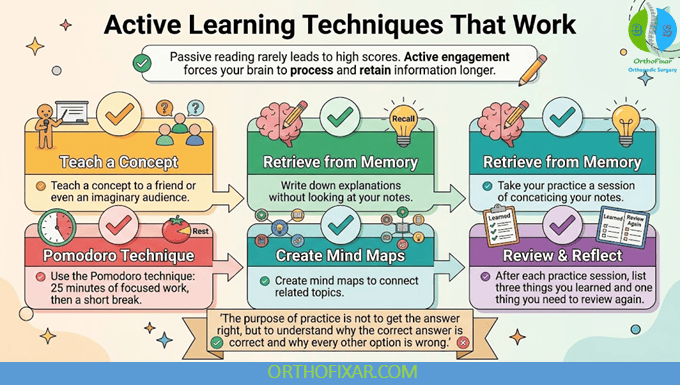
Passive reading rarely leads to high scores. Active engagement forces your brain to process and retain information longer.
- Teach a concept to a friend or even an imaginary audience.
- Write down explanations without looking at your notes.
- Use the Pomodoro technique: 25 minutes of focused work, then a short break.
- Create mind maps to connect related topics.
- After each practice session, list three things you learned and one thing you need to review again.
“The purpose of practice is not to get the answer right, but to understand why the correct answer is correct and why every other option is wrong.”
Common Mistakes and How to Avoid Them
Awareness of typical pitfalls can keep your preparation on track.
- Skipping content review – jumping straight into practice tests without a solid foundation leads to frustration. Spend dedicated time on concepts.
- Ignoring weak areas – it is tempting to keep solving questions you are good at. Force yourself to tackle the subjects you dread.
- Not simulating test conditions – if you always practice in a quiet room with no time limit, the real exam will feel overwhelming. Use a timer and minimal distractions.
- Over-relying on one resource – different materials explain concepts in different ways. Diversity strengthens understanding.
- Neglecting rest – sleep and breaks are not optional. A tired brain cannot learn effectively.
Maintaining Mental and Physical Health
Long study sessions can drain your energy and motivation. Include short walks, stretching, or any physical activity in your daily routine. Stay hydrated and eat balanced meals. Schedule one full day off each week to recharge. If you feel overwhelmed, talk to a peer or mentor. Your well-being directly affects your performance on test day.
Conclusion
Effective Medical School Entrance Exam Preparation is not about studying the hardest or the longest, but about studying smart. Understand the exam structure, follow a phased timeline, use diverse resources, and apply active learning techniques. Avoid common mistakes and take care of your health. With a clear plan and consistent effort, you can approach test day with confidence.
Frequently Asked Questions
How many months should I prepare for the medical school entrance exam?
Most students benefit from three to six months of dedicated study. The exact duration depends on your current knowledge level and how many hours you can study each week. If you need to review many foundational topics, aim for at least five months.
What is the best way to start my Medical School Entrance Exam Preparation?
Begin by taking a diagnostic practice test to identify your baseline score. Then review the official exam syllabus and create a study plan that covers all sections. Gather your core resources, such as a question bank and a content review book, before diving into daily study sessions.
Should I focus on one subject at a time or study multiple subjects each day?
Studies suggest that mixing subjects within a single day improves long-term retention. For example, spend one hour on biology, one hour on chemistry, and one hour on physics. Rotating topics prevents boredom and reinforces connections between disciplines.
How many practice tests should I take before the real exam?
Plan to take at least six to eight full-length practice tests over the course of your preparation. The first few should be untimed or loosely timed to build familiarity. The last four should be taken under strict test conditions to build endurance and time management.
What resources are free or low-cost for Medical School Entrance Exam Preparation?
Official test administrators often provide free sample questions and one full-length practice test. YouTube channels offer detailed concept explanations. You can also use free flashcard apps like Anki or Quizlet, and join online study groups where members share notes and tips.
How do I improve my time management during the exam?
Practice with a timer from the beginning. Learn to skip difficult questions and return to them later. During practice tests, note how long you spend on each question type. Aim to spend no more than one minute per question on average, adjusting for longer critical analysis passages.
Is it better to study alone or in a group?
Both have advantages. Solo study allows you to control your pace and focus on weaknesses. Group study helps you explain concepts out loud and discover different approaches. Use solo study for initial learning and group sessions for review and discussion.
How do I stay motivated during the entire preparation period?
Set small weekly goals and reward yourself when you achieve them. Track your progress with a chart or checklist. Remind yourself why you want to become a doctor. If motivation dips, change your study environment or take a short break to reset.
What should I do in the week before the exam?
Reduce new material. Focus on reviewing your summary notes, high-yield flashcards, and mistakes from recent practice tests. Avoid taking any full-length tests in the last two days. Prioritize sleep, light exercise, and healthy meals to arrive on test day rested and calm.
How do I handle test anxiety on the day of the exam?
Arrive early to avoid rushing. Practice deep breathing or a simple mindfulness exercise before starting. Read each question carefully and trust your preparation. If you feel stuck, take a few seconds to close your eyes and breathe before moving on. Remember that one difficult section does not define your entire score.