You wake up with a sore throat, a fever, or a cough that will not go away. Your first question is urgent care vs emergency room: where should patients go when they need help fast? The answer affects your wait time, your medical bill, and how quickly you receive the right treatment. This guide compares both options clearly, so you can decide with confidence when every minute matters.
Understanding the Difference Between Urgent Care and Emergency Room
Many patients assume urgent care is just a smaller emergency room. That is not how the medical system works. Urgent care centers treat minor conditions, while emergency rooms handle problems that could threaten your life, your limbs, or your long-term health.
- Urgent care: walk-in clinics for minor illness and injury, staffed by doctors, nurse practitioners, or physician assistants.
- Emergency room: a hospital department with advanced imaging, surgical teams, and specialists available around the clock.
- ER doctors are trained to stabilize serious conditions, not just diagnose routine infections.
- Urgent care helps when you need same-day care but are not in immediate danger.
Consider this example: a sprained ankle is a classic urgent care case. A hip fracture from a fall is not, because it may require surgery, stronger pain control, and hospital imaging that a clinic simply does not have.
When to Choose Urgent Care
Urgent care works best for problems that are uncomfortable, inconvenient, or annoying but not dangerous. If you can wait a few hours without putting your health at risk, urgent care is often the smarter choice.
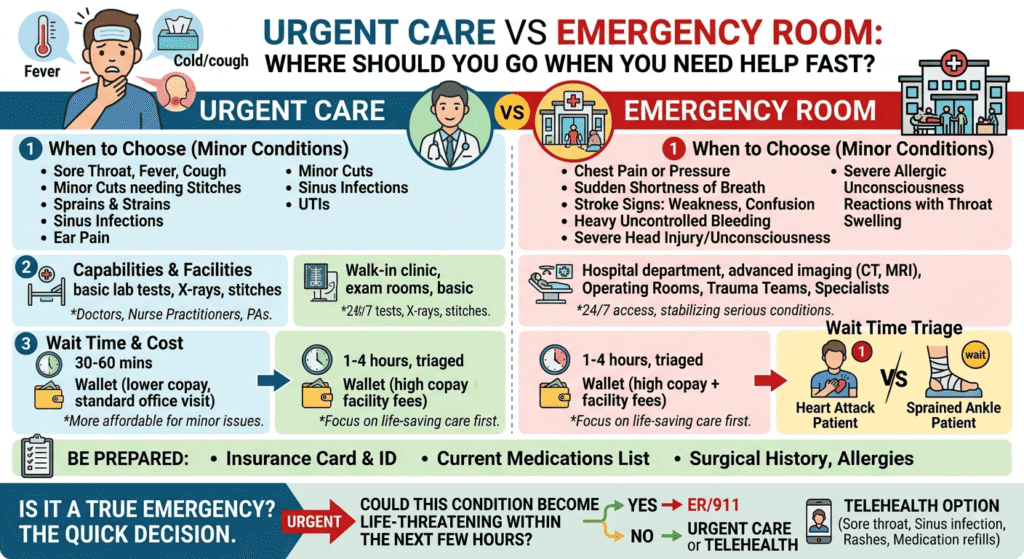
- Common cold, flu symptoms, sore throat, sinus infection, or ear pain
- Minor cuts that may need stitches but are not bleeding heavily
- Sprains, strains, and small fractures such as a broken finger or toe
- Urinary tract infections and minor skin infections
- Rashes, minor allergic reactions, and insect bites
- Mild asthma flare-ups that improve with your inhaler
A useful example: you are chopping vegetables and slice your fingertip. The cut needs cleaning and a few stitches, but the bleeding slows with pressure. Urgent care can handle that from start to finish. The same clinic is not equipped to treat a deep knife wound that is spurting blood.
When to Go to the Emergency Room
The emergency room is for conditions that could become life-threatening within minutes or hours. When in doubt, it is always safer to choose the ER and let the medical team decide your level of risk.
- Chest pain, pressure, tightness, or pain spreading to the arm, neck, or jaw
- Shortness of breath or difficulty breathing that does not improve
- Sudden weakness, numbness, or trouble speaking, which are stroke warning signs
- Severe abdominal pain that comes on suddenly and does not let up
- Heavy bleeding that does not stop with direct pressure
- Head injury with confusion, vomiting, or loss of consciousness
- Severe allergic reaction with throat swelling or trouble swallowing
Chest pain is the classic example. A patient may assume it is heartburn, but if a heart attack is happening, waiting in an urgent care lobby is dangerous. Emergency rooms can run an EKG and cardiac blood tests on the spot, and they have the staff to act immediately.
Urgent Care vs Emergency Room: Side-by-Side Comparison
This table summarizes the most important differences you need to know before you decide where to go.
| Factor | Urgent Care | Emergency Room |
|---|---|---|
| Average wait time | Usually 30 to 60 minutes | Often 1 to 4 hours, depending on severity |
| Typical cost | Lower copay, often a standard office visit fee | Higher copay plus facility fees and separate charges |
| Services | X-rays, lab tests, stitches, basic splinting | Full imaging, CT scans, surgery, specialist consultation |
| Hours | Extended hours, but not always open 24/7 | Open 24 hours a day, 7 days a week |
| Best for | Minor illness and moderate injury | Life-threatening or disabling conditions |
| Staff | Doctor, nurse practitioner, or physician assistant | Doctor plus nurses, specialists, and surgical teams |
Cost Differences and Insurance Considerations
The price gap between an urgent care visit and an emergency room visit is not small. On many insurance plans, an urgent care visit costs the same as a typical doctor office copay. An emergency room visit includes a facility fee, a doctor fee, and often separate charges for every test and imaging study.
- Check your insurance plan copay structure before you need care.
- Many plans discourage emergency room use for non-emergencies with higher copays.
- Urgent care is almost always more affordable for minor conditions.
- Some urgent care centers list their prices online for uninsured patients.
- Ask the urgent care center whether they accept your insurance before you arrive.
Insurance aside, a single ER visit can cost more than ten urgent care visits. That is why every family should know which conditions truly need the ER.
Time and Wait Times: What to Expect
Wait times vary widely depending on the day, the hour, and the number of sick patients. Emergency rooms use a system called triage, which means the sickest people are treated first. If you arrive at the ER with a minor issue, you may wait behind patients with heart attacks, strokes, or serious car accident injuries.
- ER triage is based on medical urgency, not the order you arrive.
- Urgent care typically works on a first-come, first-served basis.
- Evenings and weekends are busy at both urgent care centers and ERs.
- Some ERs provide online wait-time estimates, but these are not a guarantee.
- Bring a phone charger, a jacket, and snacks if you expect a long ER wait.
Just because you waited five minutes at urgent care last time does not mean the ER will move that fast. The people around you may be much sicker than you are.
Telehealth and Virtual Options
Before you leave the house, consider a telehealth visit. Many urgent care centers and health systems now offer virtual appointments for common problems like sore throats, sinus infections, rashes, and pink eye.
- Good for: colds, flu symptoms, sinus infections, eye irritation, and medication refills.
- Not good for: chest pain, trauma, severe breathing trouble, or heavy bleeding.
- Telehealth saves time and money for minor issues that do not require hands-on care.
- A virtual provider can tell you whether you need to visit urgent care or go to the ER.
This option helps you avoid sitting in a waiting room with other sick patients. It also gives you a professional opinion before you make a bigger commitment of time and money.
How to Prepare Before You Go
Preparation matters, especially at the emergency room. Bring a list of your medications, allergies, and surgical history, because you may not be able to recall everything clearly in a stressful moment.
- Keep an updated medication list saved in your phone or wallet.
- Carry your insurance card and a photo ID.
- Write down your allergies and repeat them to every provider you see.
- Call a family member or friend to meet you at the ER if possible.
- At urgent care, expect to complete paperwork and provide your pharmacy information.
For example, a patient who carries a simple note listing their medications, allergies, and blood thinner use can prevent dangerous drug interactions and speed up treatment. Small preparation makes a real difference when you are in pain or feeling anxious.
Final Verdict: How to Decide Fast
Choosing between urgent care and the emergency room does not have to be stressful. Start with a simple question: could this condition become life-threatening within the next few hours? If yes, go to the ER or call emergency services. If no, urgent care or a telehealth visit is likely the better first stop.
When in doubt, lean toward the emergency room. It is always better to be evaluated and released than to stay home while a serious condition gets worse.
Urgent care is for the sprains, the colds, the minor cuts, and the infections that need attention but not rescue. The emergency room is for chest pain, strokes, severe injuries, and any situation where your life or long-term health is at risk. Write down the information that applies to your family, keep it somewhere visible, and share it with your household so everyone knows the plan.
Frequently Asked Questions
These are the questions patients ask most often when deciding between urgent care and the emergency room. Review them now so you are ready later.
- What counts as an emergency?
- How much does each visit cost?
- Which conditions need a hospital, not a clinic?
Can urgent care treat a broken bone?
Urgent care can treat simple fractures like a broken finger or toe. They can order X-rays and apply a splint or cast. Complex fractures, open