After weeks in a cast, the moment of removal should feel freeing. Yet many people find that the limb feels stiff, weak, and awkward, and that movement is harder than expected. Joint stiffness after cast removal is a normal part of healing, not a sign that something went wrong. With consistent movement, targeted exercises, and patience, most people regain full motion within a few weeks. This guide explains why stiffness develops, which exercises help the most, and how to recover safely without pushing too hard.
Why Joint Stiffness Happens After Cast Removal
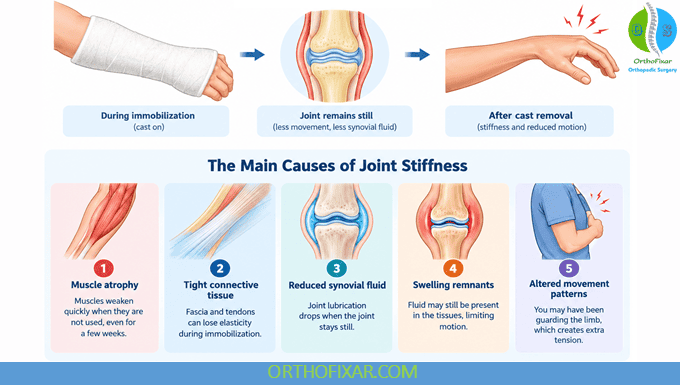
While your bone was healing, the cast kept the joint immobile for weeks. That lack of movement causes the surrounding muscles, tendons, and ligaments to shorten and tighten. The joint itself also produces less synovial fluid when it is not moving, which makes motion feel less smooth.
Joint stiffness after cast removal is not only caused by the injury itself but also by the period of inactivity. Your body essentially needs to relearn how to move that area comfortably.
- Muscle atrophy: Muscles weaken quickly when they are not used, even for a few weeks.
- Tight connective tissue: Fascia and tendons can lose elasticity during immobilization.
- Reduced synovial fluid: Joint lubrication drops when the joint stays still.
- Swelling remnants: Fluid may still be present in the tissues, limiting motion.
- Altered movement patterns: You may have been guarding the limb, which creates extra tension.
What to Expect in the First Weeks
Everyone recovers at a different pace, but some patterns are very common after cast removal. Knowing what is normal can reduce worry and help you stay consistent rather than frustrated.
- Deep aching or tightness when you first try to move the joint.
- Visible swelling that fluctuates throughout the day.
- Dry, flaky, or sensitive skin around the former cast area.
- A feeling that the joint is “clicking” or “catching” during movement.
- Fatigue in the limb after very light activity.
These symptoms usually improve within the first week or two as you begin moving more. The skin sensitivity and mild swelling often resolve fastest, while deep stiffness takes longer.
“You are not starting from zero, and you are not behind. Your joint simply needs time, movement, and gentle loading to remember what it can do.”
Safe Exercises to Restore Joint Mobility
The best way to reduce joint stiffness after cast removal is to use the joint in a controlled, gradual way. Start with gentle range-of-motion movements before adding any resistance. Stop any exercise that causes sharp pain, rather than a mild stretching discomfort.
Range-of-Motion Exercises
These exercises move the joint through its available motion without forcing it. They help restore lubrication, stretch tight tissues, and signal your brain that the joint is safe to move.
- Wrist and forearm: Rest your forearm on a table and slowly move your wrist up and down, then side to side.
- Elbow: Sit with your arm supported and gently bend and straighten the elbow in slow, even motions.
- Shoulder: Use a pendulum swing — lean forward slightly and let your arm hang, then make small circles with your whole arm.
- Ankle: Trace the alphabet with your toes to move the ankle in every direction without strain.
- Knee or leg: Lie down and slide your heel toward your buttocks, then straighten the leg slowly.
Strengthening and Stretching Exercises
Once the joint moves more freely, you can start loading the muscles around it. Light resistance bands, towels, or even gravity can provide enough challenge early on.
- Towel stretch: For an ankle or wrist, loop a towel around the foot or hand and gently pull it toward a deeper stretch.
- Isometric holds: Press the joint against an unmovable surface, such as a wall, and hold for five to ten seconds without visible movement.
- Grip work: Squeeze a soft ball or rolled towel for 10 seconds, then release fully.
- Heel raises: For leg stiffness, hold the back of a chair and slowly rise onto your toes, then lower with control.
- Wall slides: For shoulder stiffness, walk your fingers up a wall as far as comfortable, then ease back down.
Perform these exercises twice daily, or as tolerated. A mild stretch sensation is fine, but pain that feels sharp or that worsens after you stop is a sign to reduce intensity.
“Motion is lotion for your joint. Small, repeated movements throughout the day often work better than one long, intense session.”
Sample Daily Recovery Routine
This routine gives you a practical structure for the first few weeks after cast removal. Adjust repetitions based on your comfort level and your healthcare provider’s advice.
| Time of Day | Activity | Suggested Duration |
|---|---|---|
| Morning | Gentle range-of-motion exercises, slow and full | 5 to 10 minutes |
| Midday | Isometric holds or light towel stretches | 5 minutes |
| Afternoon | Ice or cold pack if swelling is present | 10 to 15 minutes |
| Evening | Warm shower or warm pack, then stretch gently | 5 to 10 minutes |
| Night | Elevate the limb while resting | 20 minutes or more |
This structure works for upper and lower limbs alike. The key is consistency: two to three short sessions each day are more effective than one weekly session that leaves you sore.
Managing Pain and Swelling After Cast Removal
Discomfort during recovery is common, but you can reduce it with simple strategies that also improve your ability to exercise comfortably.
- Use ice after exercise: Apply a cold pack for 10 to 15 minutes if the joint feels hot or swollen afterward.
- Use warmth before exercise: A warm shower or warm towel for 5 to 10 minutes can loosen stiff tissues before you move.
- Elevate the limb: Lying down with the affected arm or leg propped up helps drain excess fluid.
- Gentle massage: Light stroking toward the heart can reduce puffiness and calm the area.
- Wear compression if advised: Some providers recommend a tubular compression bandage during the day, not at night.
Over-the-counter pain relievers may help if approved by your doctor. Do not rely on them to mask pain during exercise; instead, adapt the movement to a range that feels manageable without medicine.
When to Contact Your Doctor
Most cases of joint stiffness after cast removal improve gradually with home exercises and time. However, certain signs should not be ignored because they may point to a complication such as a fracture that did not heal, a tendon injury, or a nerve issue.
- Sharp pain that prevents all movement of the joint.
- Numbness, tingling, or a limb that feels cold or changes color.
- Swelling that worsens instead of improving over several days.
- Redness or warmth that spreads beyond the immediate area.
- No visible improvement in motion after two to three weeks of exercises.
- A feeling that the joint is unstable or gives way when bearing weight.
If any of these apply to you, reach out to your doctor or physical therapist for an evaluation rather than pushing through the symptoms.
Putting It All Together for a Smoother Recovery
Recovering from joint stiffness after cast removal takes patience, but you can make steady progress by moving a little every day, listening to your body, and gradually increasing difficulty. Range-of-motion exercises restore movement first; strengthening and stretching follow once the joint is less guarded. Ice, warmth, elevation, and rest all support the healing process and improve comfort.
If progress stalls or pain increases, seek professional guidance. A physical therapist can provide a personalized exercise plan that fits your exact injury, age, and activity goals. Most importantly, trust the process and give yourself credit for the small improvements each week, because they add up to meaningful recovery.
Frequently Asked Questions
How long does joint stiffness last after cast removal?
Mild to moderate stiffness can last from a few days to several weeks. Many people notice significant improvement within the first two weeks of consistent movement. Full recovery of strength and flexibility may take one to three months, depending on how long the cast was worn and the severity of the original injury.
Can I speed up my recovery?
Yes, within reason. Doing gentle exercises several times per day, staying hydrated, eating protein-rich foods, and managing swelling all support faster recovery. Rest also matters because your tissues need time to adapt to new movement. Pushing too hard too quickly can cause a setback, so aim for gradual progress rather than rapid results.
Should I use heat or ice?
Use warmth before exercise to loosen the joint and improve tissue elasticity. Use ice after exercise to reduce swelling and soothe any aching. If you are not exercising, choose whichever feels most comfortable, but avoid applying ice for more than 15 minutes at a time or heat for more than 20 minutes.
Why does my joint look swollen after cast removal?
Swelling is part of the healing response. The cast limited fluid movement, so some fluid remains trapped in the tissues around the joint. As you start moving and elevating the limb, the lymphatic system can drain that fluid more effectively, and the swelling will gradually go down.
Is it normal to feel weakness in the limb?
Yes, very normal. Muscles lose strength quickly during immobilization, sometimes up to 20 to 30 percent over a few weeks. Weakness is expected and improves as you load the muscle with functional movements and progressive resistance exercises.
How often should I do the exercises?
Most rehabilitation plans recommend exercising the stiff joint two to three times per day for short sessions. This keeps the joint moving without overtiring the surrounding muscles. Listen to your body — if the joint feels excessively sore the next day, reduce the number of repetitions or the range of motion.
Can I return to sports right away?
No. Returning to sports immediately after cast removal puts the healing bone and joint at risk. You should first restore pain-free range of motion, then build strength, and only then return to sport-specific training. Your doctor or physical therapist can tell you when it is safe to take that step.
What if the stiffness gets worse despite exercising?
If stiffness worsens, you may be overdoing the intensity or frequency. Reduce the range of motion, use ice more often, and allow more rest between sessions. If symptoms still worsen after several days of modified activity, contact your healthcare provider for a reassessment.
Do I need physical therapy?
Not everyone needs formal physical therapy, but it is helpful when stiffness is severe, when the cast was worn for a long time, or when your daily activities require high levels of mobility. A therapist can identify specific limitations and provide guided exercises that are safer and more effective than guessing on your own.
What can I do if the stiffness does not improve after several weeks?
If your range of motion has not improved after three to four weeks of daily exercise, schedule a follow-up appointment. Possible causes include scar tissue formation, incomplete fracture healing, joint capsule tightness, or an undiagnosed secondary injury. Imaging or a physical therapy referral may be needed at that point.