Shoulder impingement is one of the most common causes of shoulder pain and stiffness, especially in people who perform overhead movements regularly. It occurs when the rotator cuff tendons or the bursa become pinched between the bones of the shoulder joint. The right news is that most cases improve with simple lifestyle changes, targeted exercises, and a clear understanding of what helps and what hurts.
What Is Shoulder Impingement?
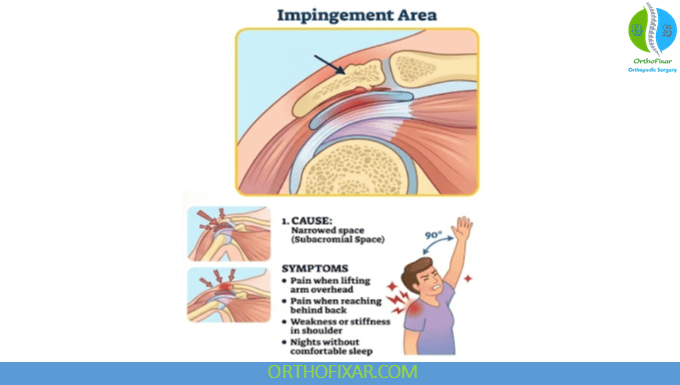
Shoulder impingement, also called subacromial impingement or painful arc syndrome, happens when soft tissues in the shoulder get compressed during arm elevation. The space where the rotator cuff sits, called the subacromial space, becomes too narrow, so tendons and the bursa rub against the acromion bone.
- It is not a single injury but a mechanical problem that develops over time.
- It often affects people who swim, throw, paint, lift, or work with their arms overhead.
- It can range from mild discomfort to severe pain that limits daily activities.
- It is closely related to rotator cuff tendinopathy and shoulder bursitis.
- It is treatable, and most people do not need surgery.
Common Symptoms of Shoulder Impingement
Symptoms usually build gradually rather than appearing suddenly after a single event. The pain is typically felt on the top or outside of the shoulder and can radiate down the upper arm.
- Pain when lifting the arm sideways or forward, especially between 60 and 120 degrees.
- Night pain that makes it hard to sleep, particularly when lying on the affected side.
- Weakness or a feeling of reduced control when reaching overhead.
- A dull ache at rest that becomes sharp with movement.
- Pain when reaching behind your back, like tucking in a shirt or fastening a bra.
The simplest way to describe shoulder impingement is that the shoulder has lost its smooth, pain-free glide, and every overhead movement becomes a test of how much pressure those soft tissues can tolerate.
How Doctors Test for Shoulder Impingement
Diagnosis starts with a conversation about your symptoms and daily activities. Your doctor will then perform a physical examination to check your range of motion, strength, and pain patterns.
- Neer test: your doctor lifts your arm forward while pressing down on the shoulder blade to see if pain is reproduced.
- Hawkins-Kennedy test: your arm is raised forward and then internally rotated to compress the tendons.
- Painful arc test: you raise your arm sideways, and pain occurs only in the middle portion of the arc.
- Resisted strength tests: these help identify whether the rotator cuff muscles are weak or torn.
Your doctor may also request imaging. Plain X-rays can show bone spurs or joint changes, while ultrasound or MRI can detect tendon tears, bursitis, or fluid accumulation.
Self-Care and Early Treatment Steps
The earlier you start managing shoulder impingement, the faster you can reduce pain and restore normal movement. Most people notice meaningful improvement within a few weeks of consistent self-care.
- Rest from painful overhead activities, but do not immobilize the shoulder completely.
- Apply ice packs to the shoulder for 15 minutes several times a day, especially after activity.
- Use over-the-counter pain relievers like ibuprofen or acetaminophen if approved by your doctor.
- Improve your posture by keeping your shoulders relaxed and back, not rounded forward.
- Sleep with a pillow under your affected arm or behind your back to avoid pressure.
Best Exercises for Shoulder Impingement
Exercise is the cornerstone of shoulder impingement treatment. The goal is to strengthen the muscles that control the shoulder blade and rotator cuff so the tendons have more space to move freely.
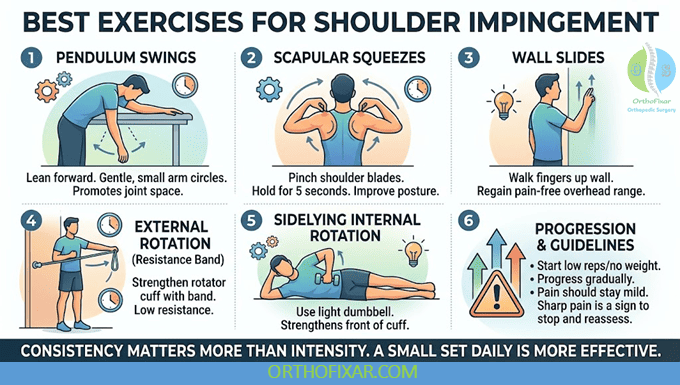
- Pendulum swings: lean forward and let your arm hang, then swing it gently in small circles.
- Scapular squeezes: pinch your shoulder blades together and hold for 5 seconds to improve posture.
- Wall slides: walk your fingers up a wall to regain pain-free overhead motion.
- External rotation with a resistance band: strengthen the rotator cuff without heavy load.
- Sidelying internal rotation: use a light dumbbell to strengthen the front of the rotator cuff.
Start with low repetitions and no resistance, then gradually progress. Pain during exercise should stay below a mild, acceptable level. Sharp or worsening pain is a sign to stop and reassess.
Consistency matters more than intensity. Doing a small set of exercises every day is usually far more effective than doing a long workout once a week.
Medical Treatment Options
If self-care and exercise are not enough, several medical treatments can help reduce pain and improve function. These are typically added step by step, starting with the least invasive options.
- Physical therapy with a personalized exercise program and manual therapy.
- Corticosteroid injections to reduce severe inflammation and allow you to exercise more comfortably.
- Platelet-rich plasma (PRP) therapy in select cases to support tendon healing.
- Surgery, such as subacromial decompression, reserved for persistent cases that do not respond to conservative care.
| Treatment | What It Involves | When It Is Used |
|---|---|---|
| Rest and activity modification | Avoiding overhead movements and adjusting work or sport tasks | First few weeks, for all patients |
| Physical therapy | Stretching, strengthening, and postural training | From the start and throughout recovery |
| Corticosteroid injection | An anti-inflammatory medication injected into the subacromial space | When pain is severe or limits rehab |
| Surgery | Removing bone spurs or inflamed tissue to create more space | After 4 to 6 months of failed conservative care |
When to See a Doctor
You do not need to see a doctor for every mild shoulder ache, but certain warning signs should prompt an evaluation. Early intervention can prevent the problem from becoming chronic.
- Pain that lasts more than two weeks despite rest and simple measures.
- Difficulty lifting your arm or severe weakness.
- Night pain that regularly wakes you from sleep.
- Swelling, bruising, or visible deformity around the shoulder.
- Pain after a fall or direct injury.
Your doctor can rule out more serious problems like rotator cuff tears, arthritis, or referred neck pain. A clear diagnosis will help you choose the right treatment plan from the beginning.
Putting It All Together for Recovery
Recovery from shoulder impingement is rarely linear. Some days will feel better than others, and that is completely normal. The key is to stay active, respect your pain limits, and keep your shoulder moving without provoking sharp symptoms.
Most people notice meaningful improvement within 6 to 12 weeks of consistent exercises and activity changes. Full recovery, including a return to overhead sports or heavy lifting, can take several months. Patience and consistency are your best tools.
Frequently Asked Questions
What is shoulder impingement exactly?
Shoulder impingement is the compression of rotator cuff tendons or the bursa between the bones of the shoulder. This compression causes pain and inflammation, especially when raising the arm overhead.
How long does shoulder impingement take to heal?
Mild cases can improve in a few weeks, while moderate cases typically take 6 to 12 weeks. Chronic cases with tendon changes may take several months of dedicated exercise and treatment.
Can shoulder impingement go away on its own?
It can improve on its own if the aggravating activities are reduced and posture is corrected. However, without strengthening exercises, the problem often returns when you resume normal activities.
Is shoulder impingement the same as a rotator cuff tear?
No. Impingement is a compression problem, while a rotator cuff tear is an actual tear in the tendon tissue. However, long-standing impingement can contribute to tendon damage over time, and the two conditions can exist together.
What makes shoulder impingement worse?
Repetitive overhead movements, poor posture, weak shoulder blade muscles, and sleeping on the affected side can all worsen impingement. Sudden increases in activity or heavy lifting can also flare up symptoms.
Can I still exercise with shoulder impingement?
Yes, but you need to choose exercises that do not provoke sharp pain. Avoid heavy overhead presses and sudden throwing movements. Focus on gentle stretching and low-resistance rotator cuff strengthening instead.
Should I sleep with my arm in a specific position?
Sleeping on your back with a pillow under your affected arm is often most comfortable. If you sleep on your side, do not lie directly on the painful shoulder. Use a pillow to support your arm slightly forward instead of letting it hang.
Are cortisone injections safe for shoulder impingement?
Cortisone injections are generally safe when used in limited doses and spaced appropriately. They help reduce severe inflammation but are not a cure. Overuse of injections can weaken tendons, so they should be part of a larger rehab plan, not a standalone solution.
How is shoulder impingement different from frozen shoulder?
Impingement causes pain with specific movements, usually overhead. Frozen shoulder causes a more severe, global restriction of movement in all directions. Differentiation is best made through physical examination and range-of-motion assessment.
When should I consider surgery for shoulder impingement?
Surgery is usually considered only after 4 to 6 months of consistent conservative treatment without meaningful improvement. Your doctor will also consider your age, activity level, and whether imaging shows bone spurs or a structural blockage that is unlikely to respond to exercise alone.