If you have Medicare or spend time in the healthcare system, you may have heard the term ACO healthcare and wondered what it means for you. Accountable Care Organizations, and the newer ACO REACH model, are changing how doctors coordinate treatment, share information, and manage costs. This article explains the structure, the patient benefits, and what to expect when your provider joins an ACO.
What Is an ACO in Healthcare?
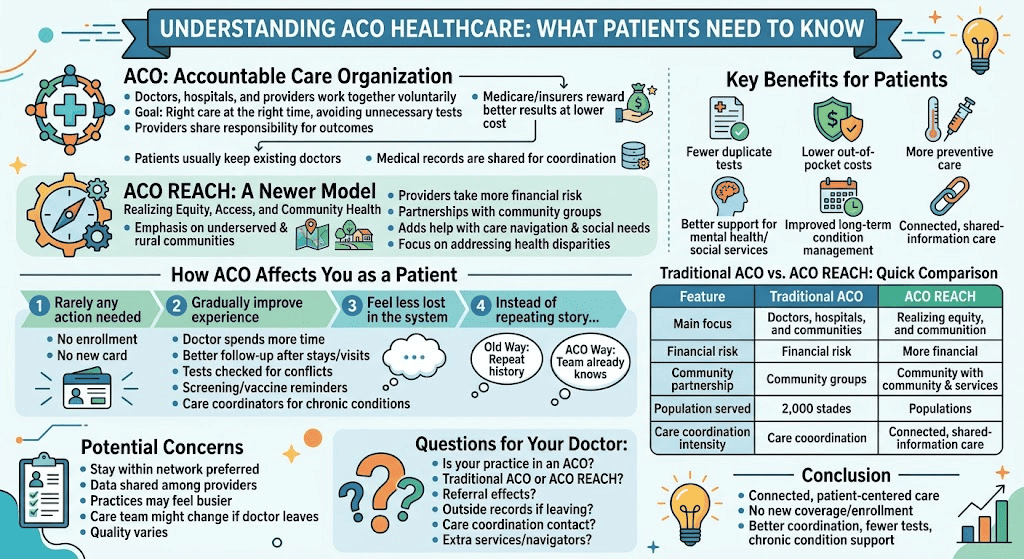
An Accountable Care Organization, or ACO, is a group of doctors, hospitals, and other healthcare providers who voluntarily work together to give coordinated, high-quality care. The main goal is to make sure patients get the right care at the right time, while avoiding unnecessary tests and procedures.
- Providers in an ACO share responsibility for patient outcomes.
- They agree to be held accountable for the quality, cost, and experience of care.
- Medicare and other insurers reward ACOs that deliver better results at a lower cost.
- Patients usually keep their existing doctors and coverage.
- Your medical records are shared among participating providers to improve coordination.
ACO REACH: A Newer Model Built on Lessons Learned
ACO REACH stands for Realizing Equity, Access, and Community Health. It is a newer type of ACO program designed to improve health equity and give providers more flexibility in caring for complex patients. REACH builds on earlier accountable care models but pushes further on community involvement and risk sharing.
- It places a strong emphasis on serving underserved and rural communities.
- Providers take on more financial risk, which encourages careful, preventive care.
- It requires partnerships with community-based organizations.
- Beneficiaries receive added help with care navigation and social needs.
- The model focuses on addressing health disparities that traditional ACOs may overlook.
How ACO Healthcare Affects You as a Patient
When your doctor joins an ACO or ACO REACH program, you rarely need to do anything. You do not enroll, and you do not receive a card. Instead, your daily experience of care may gradually improve in ways you can feel.
- Your doctor may spend more time reviewing your full medical history.
- You may see better follow-up after hospital stays or specialist visits.
- Your prescriptions and test results are more likely to be checked for conflicts.
- You may receive reminder calls for screenings, vaccines, and checkups.
- Care coordinators may reach out if you have a chronic condition like diabetes or heart disease.
When doctors share information and coordinate care, patients often feel less lost in the system. Instead of repeating your story at every visit, your care team already knows your history, medications, and goals.
Key Benefits of ACO and ACO REACH Participation
Patients in well-run ACO programs often notice better communication and fewer gaps in care. The benefits go beyond convenience, especially for people with chronic conditions.
- Fewer duplicate tests and unnecessary procedures.
- Lower out-of-pocket costs when avoidable complications are prevented.
- More attention to preventive care, such as cancer screenings and immunizations.
- Better support for mental health and social services in ACO REACH.
- Improved management of long-term conditions through regular follow-up.
- Care that feels more connected, with providers sharing information across offices.
Patients who feel involved in their care are more likely to follow treatment plans and report better outcomes. ACOs aim to build that involvement into everyday practice.
Traditional ACO vs. ACO REACH: A Quick Comparison
The table below summarizes the main differences so you can understand what to expect from each model.
| Feature | Traditional ACO | ACO REACH |
|---|---|---|
| Main focus | Coordinated care and cost savings | Equity, access, and community health |
| Financial risk for providers | Often lower risk, with shared savings | Higher risk, with stronger accountability |
| Community partnership | Optional or limited | Required and central to the model |
| Population served | General Medicare beneficiaries | Including underserved and rural populations |
| Care coordination intensity | Moderate | High, with dedicated navigators |
Potential Concerns to Keep in Mind
ACO healthcare is not a perfect system, and you may notice a few changes that feel different from traditional care. It helps to know what could come up.
- Some ACOs prefer that you stay within their network for non-emergency care, though you are not locked in.
- Your personal health data is shared among participating providers, so you should receive a notice about this.
- Provider practices may feel busier as they adjust to new reporting and care coordination tasks.
- If a provider leaves the ACO, your care relationship may shift to a different team.
- Results vary by organization, so quality depends on how well your specific ACO operates.
Questions to Ask Your Doctor About ACO Participation
If you want to know whether your provider participates in an ACO or ACO REACH, the best approach is to ask directly. Here are useful questions to guide the conversation.
- Is your practice part of an Accountable Care Organization?
- If so, which model does it follow, a traditional ACO or ACO REACH?
- How does this affect my referrals to specialists?
- What happens to my health records if I see a doctor outside the ACO?
- Who should I contact if I need help coordinating my care?
- Are there extra services like care navigators or community health workers available to me?
Conclusion
ACO healthcare and ACO REACH represent a shift toward more connected, patient-centered care. You do not need to enroll or change your coverage, but you may benefit from better coordination, fewer duplicated tests, and stronger support for chronic conditions. If your provider participates, understanding how the model works can help you make the most of your care and ask better questions at your next visit.
Frequently Asked Questions
Do I have a choice about being in an ACO?
Yes. ACO participation is based on where you receive care, not a formal enrollment. You can see any Medicare-approved provider, and you are never locked into an ACO. If you prefer a doctor outside the ACO network, you can still see them, though some care coordination benefits may be less visible.
Does ACO REACH change my Medicare benefits?
No. ACO REACH does not change your core Medicare benefits. You continue receiving the same coverage you already have. The program changes how providers work together and how they are paid, not what treatments are covered for you.
Can I still see any doctor I want?
In most cases, yes. ACOs do not restrict your choice of doctor or hospital. Medicare beneficiaries have the freedom to seek care from any provider that accepts Medicare. The ACO simply encourages coordination among doctors who choose to participate.
What happens if I disagree with a care plan?
You always have the right to ask questions, seek a second opinion, or refuse a recommended treatment. An ACO should support shared decision-making, which means your doctors explain options clearly and respect your preferences. You are in charge of your own care decisions.
Are ACOs the same as insurance plans or HMOs?
No. ACOs are not insurance plans and they do not limit your network like an HMO often does. An ACO is a voluntary group of providers who collaborate on quality and cost. Your insurance and Medicare coverage remain exactly the same.
How do ACOs save money?
ACOs save money by preventing duplicative tests, reducing unnecessary hospital admissions, and focusing on preventive care that keeps small problems from becoming serious. When they meet quality targets and lower costs, they share in the savings. The idea is better care, not simply cutting services.
Will my doctor share my health data with other organizations?
Your doctor may share your health information with other providers inside the ACO for treatment purposes, which is allowed under privacy laws. You should receive a notice describing how information is shared. ACO REACH also connects providers with community groups for social services, but only with proper safeguards.
What if my doctor leaves the ACO?
If your doctor leaves, you will likely receive a notice explaining the change. Your insurance coverage is not affected, and you can continue seeing that doctor if they still accept Medicare. Your care coordination may shift to another provider within the ACO.
Does ACO healthcare affect my prescriptions?
It can. Coordinated care often includes medication reviews to avoid harmful interactions and to assure your prescriptions work well together. Your ACO doctors may also focus on using lower-cost generic medications when appropriate.
How do I know if my doctor is in an ACO?
Ask your doctor directly or contact the billing office. You can also look for letters from Medicare explaining that your provider is part of an accountable care program. If you are in ACO REACH, you may receive additional information about extra services like care navigation.